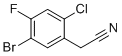
5-Bromo-2-chloro-4-fluorophenylacetonitrile is an aromatic nitrile compound belonging to the class of halogenated benzyl nitriles. Its structure consists of a benzene ring substituted with three different halogen atoms—bromine at the 5-position, chlorine at the 2-position, and fluorine at the 4-position—alongside a benzylic acetonitrile (-CH₂CN) group. This arrangement of electron-withdrawing substituents around the aromatic ring strongly influences the compound's chemical reactivity and physical properties.
The synthesis of 5-bromo-2-chloro-4-fluorophenylacetonitrile is typically achieved via alkylation of a suitably halogenated benzyl halide or benzaldehyde precursor, followed by conversion of a benzylic intermediate (such as an alcohol or halide) to the nitrile group using cyanide sources under nucleophilic substitution conditions. Alternatively, direct cyanation reactions involving transition-metal catalysis have also been employed for related compounds.
Due to the presence of multiple halogens and a nitrile group, this molecule is valuable as a building block in organic synthesis, particularly in medicinal chemistry and agrochemical development. The halogens serve as versatile handles for further functionalization through cross-coupling reactions (such as Suzuki, Heck, or Ullmann-type reactions), enabling the introduction of various aryl, vinyl, or heterocyclic groups. The nitrile group is both chemically stable and synthetically versatile—it can undergo transformations into amines, carboxylic acids, or amidines, expanding its utility in the design of more complex molecules.
In medicinal chemistry, halogenated benzyl nitriles like 5-bromo-2-chloro-4-fluorophenylacetonitrile are often explored as intermediates or fragments in the synthesis of pharmaceutical candidates. The electron-withdrawing halogen atoms influence the compound’s lipophilicity, metabolic stability, and ability to engage in halogen bonding, all of which are factors in modulating biological activity and pharmacokinetic properties.
Furthermore, the unique substitution pattern of this molecule offers opportunities for regioselective functionalization and SAR (structure–activity relationship) exploration in drug development. It may be incorporated into bioactive scaffolds targeting enzyme active sites or receptor binding pockets where precise spatial arrangement of substituents is critical.
Overall, 5-bromo-2-chloro-4-fluorophenylacetonitrile serves as a strategically useful intermediate in the synthesis of advanced chemical entities, prized for its reactivity, stability, and capacity for structural elaboration across a wide range of synthetic applications.
|




 GHS07 Warning Details
 chemBlink Chemical Story