
Online Database of Chemicals from Around the World
| Hangzhou Verychem Science And Technology Co., Ltd. | China | |||
|---|---|---|---|---|
 | www.verychem.com | |||
 | +86 (571) 8816-2785 +86 13606544505 | |||
 | +86 (571) 8816-2787 | |||
 | lucy@verychem.com | |||
| Chemical manufacturer since 2004 | ||||
| chemBlink Massive supplier since 2021 | ||||
| Wuhan Organic Synthetic Material Research Institute | China | |||
|---|---|---|---|---|
| www.whorganic.com | |||
| +86 (27) 8818-9660 | |||
| +86 (27) 8341-1474 | |||
| organic@hi2000.com | |||
| Chemical manufacturer | ||||
| chemBlink Standard supplier since 2008 | ||||
| Hefei TNJ Chemical Industry Co., Ltd. | China | |||
|---|---|---|---|---|
| www.tnjchem.com | |||
| +86 (551) 6541-8684 | |||
| +86 (551) 6541-8697 | |||
| sales@tnjchem.com | |||
| Chemical manufacturer since 2001 | ||||
| chemBlink Standard supplier since 2010 | ||||
| BOC Sciences | USA | |||
|---|---|---|---|---|
| www.bocsci.com | |||
| +1 (631) 485-4226 | |||
| +1 (631) 614-7828 | |||
| info@bocsci.com | |||
| Chemical manufacturer | ||||
| chemBlink Standard supplier since 2010 | ||||
| Hubei Lansun Biochemistry Pharmaceutical Co., Ltd. | China | |||
|---|---|---|---|---|
| www.lansunpharma.com | |||
| +86 (714) 639-5977 | |||
| +86 (714) 639-5877 | |||
| info@lansunpharma.com | |||
 | QQ Chat | |||
| Chemical manufacturer since 2009 | ||||
| chemBlink Standard supplier since 2013 | ||||
| Chengdu Biopurify Phytochemicals Ltd. | China | |||
|---|---|---|---|---|
| www.phytopurify.com | |||
| +86 (28) 8263-3860 8263-3987 | |||
| +86 (28) 8263-3165 | |||
| sales@biopurify.com biopurify@gmail.com | |||
| QQ Chat | |||
 | Skype Chat | |||
| Chemical manufacturer | ||||
| chemBlink Standard supplier since 2017 | ||||
| Cfm Oskar Tropitzsch GmbH | Germany | |||
|---|---|---|---|---|
| www.cfmot.de | |||
| +49 (9231) 9619-0 | |||
| +49 (9231) 9619-60 | |||
| info@cfmot.de | |||
| Chemical distributor since 1985 | ||||
| chemBlink Standard supplier since 2022 | ||||
| Hubei Sinem Flavor Co., Ltd. | China | |||
|---|---|---|---|---|
| www.sinem.cn | |||
| +86 (27) 8818-9660 | |||
| sales@sinem.cn | |||
| Chemical manufacturer since 2018 | ||||
| chemBlink Standard supplier since 2025 | ||||
| Chiron AS | Norway | |||
|---|---|---|---|---|
| www.chiron.no | |||
| +47 (73) 874-490 | |||
| +47 (73) 874-499 | |||
| chiron@chiron.no | |||
| Chemical manufacturer | ||||
| Anvia Chemicals, LLC | USA | |||
|---|---|---|---|---|
| www.anviachem.com | |||
| +1 (414) 534-7845 | |||
| +1 (414) 762-5539 | |||
| sales@anviachem.com | |||
| Chemical manufacturer | ||||
| Classification | Flavors and spices >> Synthetic spice >> Aldehyde fragrance >> Aromatic aldehyde |
|---|---|
| Name | trans-Cinnamaldehyde |
| Synonyms | 3-Phenyl-2-propenal |
| Molecular Structure | 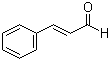 |
| Molecular Formula | C9H8O |
| Molecular Weight | 132.16 |
| CAS Registry Number | 14371-10-9 |
| EC Number | 604-377-8 |
| SMILES | C1=CC=C(C=C1)/C=C/C=O |
| Water solubility | 1.1 g/L (20 °C) |
|---|---|
| Density | 1.0±0.1 g/mL, Calc.*,1.05 g/mL (Expl.) |
| Melting point | -9--4 °C (Expl.) |
| Index of Refraction | 1.577, Calc.*, 1.622 (Expl.) |
| Boiling Point | 246.8±9.0 °C (760 mmHg), Calc.*, 250-252 °C (Expl.) |
| Flash Point | 71.1 °C, Calc.*, 71 °C (Expl.) |
| * | Calculated using Advanced Chemistry Development (ACD/Labs) Software. |
| Hazard Symbols |  GHS07 Warning Details GHS07 Warning Details | ||||||||||||||||||||||||||||
|---|---|---|---|---|---|---|---|---|---|---|---|---|---|---|---|---|---|---|---|---|---|---|---|---|---|---|---|---|---|
| Risk Statements | H312-H315-H317-H319-H335-H412 Details | ||||||||||||||||||||||||||||
| Safety Statements | P261-P264-P264+P265-P271-P272-P273-P280-P302+P352-P304+P340-P305+P351+P338-P317-P319-P321-P332+P317-P333+P317-P337+P317-P362+P364-P403+P233-P405-P501 Details | ||||||||||||||||||||||||||||
| Hazard Classification | |||||||||||||||||||||||||||||
| |||||||||||||||||||||||||||||
| SDS | Available | ||||||||||||||||||||||||||||
 chemBlink Chemical Story
|
Trans-cinnamaldehyde, with the chemical formula C9H8O, is a naturally occurring organic compound found in the essential oil of cinnamon bark. It is the major component of cinnamon oil and contributes significantly to the characteristic odor and flavor of cinnamon. The compound consists of a cinnamyl group attached to an aldehyde functional group, giving it its distinctive aromatic properties. Trans-cinnamaldehyde was first isolated from cinnamon oil in the early 19th century, and its structure was determined through chemical analysis. It is a yellowish liquid with a strong, sweet, spicy odor, widely recognized as a key element in cinnamon's fragrance profile. Trans-cinnamaldehyde is primarily used in the flavor and fragrance industries due to its pleasant, spicy aroma. It is used in the formulation of perfumes, soaps, and cosmetics. In the food industry, trans-cinnamaldehyde is used as a flavoring agent, imparting a cinnamon-like taste to various products, including baked goods, candies, and beverages. In addition to its applications in flavor and fragrance, trans-cinnamaldehyde has demonstrated various biological activities, which have been studied in the context of food preservation, medicinal applications, and potential therapeutic uses. It has been shown to possess antimicrobial, antifungal, and antioxidant properties, making it valuable for use in preservatives, sanitizers, and as a potential component in therapeutic formulations. The compound has also been studied for its potential pharmacological properties. Research indicates that trans-cinnamaldehyde may have anti-inflammatory, analgesic, and anticancer effects, though these applications are still under investigation. It is also being explored for its potential to enhance the bioavailability of certain drugs or to act as a delivery agent for pharmaceutical compounds. Trans-cinnamaldehyde is considered to be of low toxicity in the concentrations typically used in food and cosmetic products. However, in high concentrations, it can cause irritation to the skin and mucous membranes. Standard safety precautions should be followed when handling the compound, particularly in concentrated forms. In summary, trans-cinnamaldehyde is a widely used and versatile compound, valued for its distinctive aromatic properties and its applications in the flavor, fragrance, and chemical industries. Its potential biological and pharmacological activities continue to be explored, broadening its scope of applications in both consumer products and medical research. References 2024. Enhanced synergistic antioxidant and antibacterial effects of stable nanoemulsions prepared from blends of thyme, black pepper, cinnamon, and garlic essential oils. BioNanoScience, 14(4). DOI: 10.1007/s12668-024-01718-0 2012. Kinetics of thermal destruction of Salmonella in ground chicken containing trans-Cinnamaldehyde and carvacrol. Journal of Food Protection, 75(2). DOI: 10.4315/0362-028x.jfp-11-307 2010. The cinnamon-derived dietary factor cinnamic aldehyde activates the Nrf2-dependent antioxidant response in human epithelial colon cells. Molecules (Basel, Switzerland), 15(5). DOI: 10.3390/molecules15053338 |
| Market Analysis Reports |