
Online Database of Chemicals from Around the World
| Hangzhou Verychem Science And Technology Co., Ltd. | China | |||
|---|---|---|---|---|
 | www.verychem.com | |||
 | +86 (571) 8816-2785 +86 13606544505 | |||
 | +86 (571) 8816-2787 | |||
 | lucy@verychem.com | |||
| Chemical manufacturer since 2004 | ||||
| chemBlink Massive supplier since 2021 | ||||
| Zhejiang Sixian Pharmaceutical Co., Ltd. | China | |||
|---|---|---|---|---|
| www.sx-pharm.com | |||
| +86 (575) 8557-5861 8557-5010 8557-4620 | |||
| +86 (575) 8557-5010 | |||
| sxpharm@vip.163.com | |||
| Chemical manufacturer | ||||
| chemBlink Standard supplier since 2006 | ||||
| ChemPacific Corp | USA | |||
|---|---|---|---|---|
| www.chempacific.com | |||
| +1 (410) 633-5771 | |||
| +1 (410) 633-5808 | |||
| sales@chempacific.com | |||
| Chemical manufacturer since 1995 | ||||
| chemBlink Standard supplier since 2007 | ||||
| Simagchem Corporation | China | |||
|---|---|---|---|---|
| www.simagchem.com | |||
| +86 13806087780 | |||
| +86 (592) 268-0237 | |||
| sale@simagchem.com | |||
| Chemical manufacturer since 2002 | ||||
| chemBlink Standard supplier since 2008 | ||||
| Sinfachem Limited | China | |||
|---|---|---|---|---|
| www.sinfachem.com | |||
| +86 (25) 8468-3399 8517-8591 | |||
| +86 (25) 8468-3112 | |||
| sinfachem@foxmail.com sinfachemltd@foxmail.com info@sinfachem.com | |||
 | QQ Chat | |||
| Chemical manufacturer | ||||
| chemBlink Standard supplier since 2009 | ||||
| Hangzhou Utanpharma Biology Co., Ltd. | China | |||
|---|---|---|---|---|
| www.utanpharma.com | |||
| +86 (571) 8682-1378 8682-0258 5683-6287 5683-6288 | |||
| +86 (571) 8682-1328 | |||
| sales@utanpharma.com utansale@hotmail.com | |||
| Chemical manufacturer | ||||
| chemBlink Standard supplier since 2010 | ||||
| BOC Sciences | USA | |||
|---|---|---|---|---|
| www.bocsci.com | |||
| +1 (631) 485-4226 | |||
| +1 (631) 614-7828 | |||
| info@bocsci.com | |||
| Chemical manufacturer | ||||
| chemBlink Standard supplier since 2010 | ||||
| Hangzhou Ich Biofarm Co., Ltd. | China | |||
|---|---|---|---|---|
| www.ichemie.com | |||
| +86 (571) 2818-6870 | |||
| +86 (571) 8993-9479 | |||
| specialchem1@ichemie.com | |||
| QQ Chat | |||
| Chemical manufacturer since 2006 | ||||
| chemBlink Standard supplier since 2011 | ||||
| Cangzhou Enke Pharma-tech Co., Ltd. | China | |||
|---|---|---|---|---|
| www.enkepharma.com | |||
| +86 (317) 529-6180 510-6597 +86 15533709196 | |||
| +86 (317) 510-6596 | |||
| sale@enkepharma.com enkepharma@126.com | |||
| QQ Chat | |||
 | Skype Chat | |||
 | WeChat: ymzhao | |||
| Chemical manufacturer since 2011 | ||||
| chemBlink Standard supplier since 2016 | ||||
| Wuhan Dingxintong Pharmaceutical Co., Ltd. | China | |||
|---|---|---|---|---|
| www.dxtph.com | |||
| +86 15871722230 | |||
| 15871722230@163.com | |||
| QQ Chat | |||
| Chemical distributor since 2019 | ||||
| chemBlink Standard supplier since 2023 | ||||
| Zhejiang Hisun Pharmaceutical Co., Ltd. | China | |||
|---|---|---|---|---|
| www.hisunpharm.com | |||
| +86 13651899693 | |||
| yiwen.sun@hisunpharm.com | |||
| Chemical manufacturer since 1956 | ||||
| chemBlink Standard supplier since 2024 | ||||
| OChem Incorporation | USA | |||
|---|---|---|---|---|
| www.ocheminc.com | |||
| +1 (847) 403-7044 | |||
| +1 (847) 298-5008 | |||
| sales@ocheminc.com | |||
| Chemical manufacturer | ||||
| Actylis | USA | |||
|---|---|---|---|---|
| actylis.com | |||
| +1 (516) 627-6000 | |||
| +1 (516) 627-6093 | |||
| info@actylis.com | |||
| Chemical manufacturer | ||||
| Classification | API >> Antibiotics >> Rifamycin |
|---|---|
| Name | Rifamycin O |
| Synonyms | [(2R,7'S,9'E,11'S,12'R,13'S,14'R,15'R,16'R,17'S,18'S,19'E,21'Z)-2',15',17'-trihydroxy-11'-methoxy-3',7',12',14',16',18',22'-heptamethyl-4,6',23',29'-tetraoxospiro[1,3-dioxolane-2,27'-8,30-dioxa-24-azatetracyclo[23.3.1.14,7.05,28]triaconta-1(28),2,4,9,19,21,25-heptaene]-13'-yl] acetate |
| Molecular Structure | 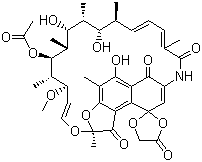 |
| Molecular Formula | C39H47NO14 |
| Molecular Weight | 753.79 |
| CAS Registry Number | 14487-05-9 |
| EC Number | 238-493-1 |
| SMILES | C[C@H]1/C=C/C=C(C(=O)NC2=C[C@@]3(C4=C(C2=O)C(=C(C5=C4C(=O)[C@](O5)(O/C=C/[C@@H]([C@H]([C@H]([C@@H]([C@@H]([C@@H]([C@H]1O)C)O)C)OC(=O)C)C)OC)C)C)O)OCC(=O)O3)/C |
| Density | 1.4±0.1 g/cm3 Calc.* |
|---|---|
| Boiling point | 1001.1±65.0 °C 760 mmHg (Calc.)* |
| Flash point | 559.3±34.3 °C (Calc.)* |
| Index of refraction | 1.613 (Calc.)* |
| * | Calculated using Advanced Chemistry Development (ACD/Labs) Software. |
| Hazard Symbols |    GHS07;GHS08;GHS09 Warning Details GHS07;GHS08;GHS09 Warning Details | ||||||||||||||||||||
|---|---|---|---|---|---|---|---|---|---|---|---|---|---|---|---|---|---|---|---|---|---|
| Risk Statements | H319-H371-H400-H410 Details | ||||||||||||||||||||
| Safety Statements | P260-P264-P264+P265-P270-P273-P280-P305+P351+P338-P308+P316-P337+P317-P391-P405-P501 Details | ||||||||||||||||||||
| Hazard Classification | |||||||||||||||||||||
| |||||||||||||||||||||
 chemBlink Chemical Story
|
Rifamycin O, with the molecular formula C39H49NO14 and CAS number 14487-05-9, is a naturally occurring ansamycin antibiotic produced by the bacterium Amycolatopsis mediterranei (formerly Streptomyces mediterranei). It is an oxidized derivative of rifamycin B and serves as a key intermediate in the biosynthesis and chemical modification of rifamycin antibiotics. Its discovery and applications are well-documented in the literature, rooted in the development of rifamycin-class antibiotics for treating bacterial infections, particularly tuberculosis. The discovery of rifamycin O is linked to the isolation of rifamycins in 1957 by researchers at Gruppo Lepetit SpA in Milan, including Piero Sensi, Maria Teresa Timbal, and Pinhas Margalith. During fermentation studies of Amycolatopsis mediterranei, a soil isolate from St. Raphael, France, a family of related compounds—rifamycins A, B, C, D, and E—was identified. Rifamycin B, the most stable, was initially isolated but found to be poorly active. Further investigation revealed that rifamycin B undergoes spontaneous oxidation and hydrolysis in aqueous solutions, forming rifamycin O, an unstable intermediate. Rifamycin O was characterized in the early 1960s as a precursor to more active derivatives, such as rifamycin S and rifamycin SV, through redox transformations. Its identification was critical in understanding the biosynthetic pathway and enabling semi-synthetic modifications, leading to clinically significant antibiotics like rifampicin. The development of rifamycin O’s role built on advances in microbial fermentation, NMR spectroscopy, and stable isotope labeling, which elucidated the carbon skeleton and oxidative steps in rifamycin biosynthesis. Synthetically, rifamycin O is produced via fermentation of Amycolatopsis mediterranei in a nutrient-rich medium containing glucose, ammonium salts, and trace metals. The fungus is cultured aerobically, and rifamycin B is extracted from the broth using organic solvents like ethyl acetate. Rifamycin O forms spontaneously when rifamycin B is exposed to oxygen in aqueous conditions, undergoing oxidation at the naphthoquinone core to introduce a keto group, yielding the 1,4-quinone structure. Chemically, rifamycin O can be converted to rifamycin S by hydrolysis and further reduction to rifamycin SV, processes optimized in the 1960s to produce active antibiotics. While total chemical synthesis of rifamycins is possible, involving polyketide synthase assembly of 3-amino-5-hydroxybenzoic acid (AHBA) and acetate units, fermentation remains the primary method due to its scalability and cost-effectiveness. These processes rely on established protocols in microbial biotechnology and oxidative chemistry. The primary application of rifamycin O is as a biosynthetic and synthetic intermediate in the production of rifamycin antibiotics. It is not used clinically due to its instability and lack of direct antibacterial activity but is critical in the pathway to active compounds. Rifamycin O is reduced to rifamycin S, which is further modified to rifamycin SV, the first rifamycin used intravenously for tuberculosis in the 1960s. Further derivatization of rifamycin S led to rifampicin, introduced in 1967, which is orally bioavailable and a cornerstone of tuberculosis therapy. Rifampicin, rifabutin, rifapentine, and rifaximin, all derived indirectly from rifamycin O, are used to treat mycobacterial infections (tuberculosis, leprosy, Mycobacterium avium complex), traveler’s diarrhea (rifaximin), and staphylococcal infections. Rifamycin O’s role in biosynthesis involves tailoring enzymes that oxidize rifamycin B, with the rif gene cluster, sequenced in the 1990s, revealing the polyketide synthase and oxidative steps mediated by enzymes like Rif-Orf17. In academic research, rifamycin O is studied for its role in the rifamycin biosynthetic pathway, particularly the oxidative transformations catalyzed by cytochrome P450 enzymes. Its instability has driven investigations into stabilizing analogs and understanding quinone chemistry. The compound’s significance lies in its position as a pivotal intermediate, enabling the production of rifamycins that target bacterial RNA polymerase, inhibiting transcription via steric occlusion of RNA elongation. References 1960. Rifomycin. V. Rifomycin O, a new antibiotic of the rifomycin family. Il Farmaco; Edizione Scientifica, 15(4). URL: https://pubmed.ncbi.nlm.nih.gov/13854754 1998. Comprehensive Study on Structure−Activity Relationships of Rifamycins: Discussion of Molecular and Crystal Structure and Spectroscopic and Thermochemical Properties of Rifamycin O. Journal of Medicinal Chemistry, 41(12). DOI: 10.1021/jm970791o 2020. Rifamycin O, An Alternative Anti-Mycobacterium abscessus Agent. Molecules, 25(7). DOI: 10.3390/molecules25071597 |
| Market Analysis Reports |