
Online Database of Chemicals from Around the World
| Trust Chem Co., Ltd. | China | |||
|---|---|---|---|---|
 | www.trustchem.com | |||
 | +86 (25) 8472-9803 +86 13805169527 | |||
 | +86 (25) 8472-5172 | |||
 | susandee@trustchem.com | |||
| Chemical manufacturer since 2000 | ||||
| chemBlink Standard supplier since 2007 | ||||
| Simagchem Corporation | China | |||
|---|---|---|---|---|
| www.simagchem.com | |||
| +86 13806087780 | |||
| +86 (592) 268-0237 | |||
| sale@simagchem.com | |||
| Chemical manufacturer since 2002 | ||||
| chemBlink Standard supplier since 2008 | ||||
| Hangzhou Leap Chem Co., Ltd. | China | |||
|---|---|---|---|---|
| www.leapchem.com | |||
| +86 (571) 8771-1850 | |||
| market19@leapchem.com | |||
 | QQ Chat | |||
| Chemical manufacturer since 2006 | ||||
| chemBlink Standard supplier since 2015 | ||||
| Nanjing Aribo Biotechnology Co., Ltd. | China | |||
|---|---|---|---|---|
| www.ariboreagent.com | |||
| +86 19951442182 | |||
| sales@ariboreagent.com | |||
| Chemical manufacturer since 2023 | ||||
| chemBlink Standard supplier since 2023 | ||||
| Alchemie Shanghai Co., Ltd. | China | |||
|---|---|---|---|---|
| www.alcshanghai.com | |||
| +86 (021) 5072-0087 | |||
| assistant2@alchemie-shanghai.com | |||
| Chemical distributor since 2018 | ||||
| chemBlink Standard supplier since 2025 | ||||
| AccuStandard Inc. | USA | |||
|---|---|---|---|---|
| www.accustandard.com | |||
| +1 (203) 786-5290 | |||
| +1 (203) 786-5287 | |||
| orders@accustandard.com | |||
| Chemical manufacturer since 1986 | ||||
| Classification | Chemical pesticide >> Herbicide >> Amide herbicide |
|---|---|
| Name | Diclosulam |
| Synonyms | N-(2,6-Dichlorophenyl)-5-ethoxy-7-fluoro-[1,2,4]triazolo[1,5-c]pyrimidine-2-sulfonamide; Strongarm; XDE 564 |
| Molecular Structure | 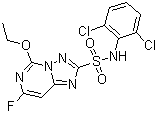 |
| Molecular Formula | C13H10Cl2FN5O3S |
| Molecular Weight | 406.22 |
| CAS Registry Number | 145701-21-9 |
| EC Number | 604-487-6 |
| SMILES | CCOC1=NC(=CC2=NC(=NN21)S(=O)(=O)NC3=C(C=CC=C3Cl)Cl)F |
| Density | 1.7±0.1 g/cm3 Calc.* |
|---|---|
| Index of refraction | 1.708 (Calc.)* |
| * | Calculated using Advanced Chemistry Development (ACD/Labs) Software. |
| Hazard Symbols |  GHS09 Warning Details GHS09 Warning Details | ||||||||||||||||||||
|---|---|---|---|---|---|---|---|---|---|---|---|---|---|---|---|---|---|---|---|---|---|
| Risk Statements | H400-H410 Details | ||||||||||||||||||||
| Safety Statements | P273-P391-P501 Details | ||||||||||||||||||||
| Hazard Classification | |||||||||||||||||||||
| |||||||||||||||||||||
| SDS | Available | ||||||||||||||||||||
 chemBlink Chemical Story
|
Diclosulam is a synthetic herbicide belonging to the triazolopyrimidine sulfonanilide class, first introduced in the late 1990s for use in peanut and soybean cultivation. Its IUPAC name is N-(2,6-dichlorophenyl)-5-ethoxy-7-fluoro-[1,2,4]triazolo[1,5-c]pyrimidine-2-sulfonamide and its molecular formula is C13H10Cl2FN5O3S. The compound was developed to provide effective pre‑emergence control of broadleaf weeds and certain sedges in crops, with early registrations occurring around 1996–2000. Diclosulam acts by inhibiting the plant enzyme acetolactate synthase (ALS, also known as acetohydroxyacid synthase, AHAS), which is essential for the biosynthesis of branched‑chain amino acids. By blocking ALS, diclosulam prevents weed seedling growth and development. Its high potency allows effective weed control at very low application rates, often around 25–35 g active ingredient per hectare. Its primary application is as a soil‑applied herbicide used pre‑emergence or early post‑emergence in crops such as peanut (groundnut) and soybean. In peanut production, diclosulam has been shown to provide consistent control of key broadleaf weeds including lambsquarters, ragweed, morningglory species, prickly sida, and nutsedge when applied before crop emergence. It is often tank‑mixed with other herbicides such as metolachlor to broaden weed spectrum and improve efficacy. Field studies conducted in multiple US states demonstrated that systems including diclosulam pre‑emergence followed by post‑emergence treatments significantly improved yields and net returns in peanut production. In strip‑tillage peanut systems, diclosulam controlled target weeds at rates above 80–90 %, contributing to improved crop outcomes. Diclosulam exhibits residual activity in soil, with half‑lives ranging from approximately 16 to 65 days depending on environmental conditions. Microbial degradation is the primary pathway for its dissipation, with minimal impact from photolysis. Soil persistence can lead to rotational crop restrictions; for example, corn planted after peanut may suffer injury if diclosulam levels have not declined sufficiently (typically after five half‑lives). Its environmental profile indicates moderate mobility in soil and low volatility. It is not highly toxic to mammals, birds, or fish, but shows moderate toxicity to aquatic invertebrates, algae, earthworms, and honeybees. Safety assessments categorize it as a slight irritant to skin and eyes. Diclosulam is not approved for use in all regions, for instance it is not registered in the European Union under current regulations. Research has also evaluated the use of cover crops such as oats and legumes for phytoremediation of diclosulam‑contaminated soils, allowing crop rotation or bioenergy production while reducing residual herbicide levels. In summary, diclosulam is a potent, low‑rate ALS‑inhibiting herbicide discovered in the late 20th century and used extensively in peanut and soybean production. Its discovery provided growers with a powerful tool for pre‑emergence weed control. Its applications have expanded through combination with other herbicides, and its residual properties have led to investigation of remediation and rotation strategies to minimize persistence. References 2024. Herbicides in the initial growth and chlorophyll indices of sugarcane in pre-sprouted seedlings. Journal of environmental science and health. Part. B, Pesticides, food contaminants, and agricultural wastes, 59(4). DOI: 10.1080/03601234.2024.2331946 2022. Crops with potential for diclosulam remediation and concomitant bioenergy production. International Journal of Phytoremediation, 24(7). DOI: 10.1080/15226514.2022.2074363 2021. Effects of cloransulam-methyl and diclosulam on soil nitrogen and carbon cycle-related microorganisms. Journal of Hazardous Materials, 416. DOI: 10.1016/j.jhazmat.2021.126395 |
| Market Analysis Reports |