
Online Database of Chemicals from Around the World
| Shanghai Zhuyao Pharmaceutical Technology Co., Ltd. | China | |||
|---|---|---|---|---|
 | cn.pharmalego.com | |||
 | +86 (021) 5859-6383 | |||
 | marketing@pharmalego.com | |||
 | QQ Chat | |||
| Chemical manufacturer since 2023 | ||||
| chemBlink Standard supplier since 2024 | ||||
| Classification | Chemical reagent >> Organic reagent >> Amide |
|---|---|
| Name | Zolamide |
| Synonyms | 5-amino-1,3,4-thiadiazole-2-sulfonamide |
| Molecular Structure | 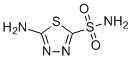 |
| Molecular Formula | C2H4N4O2S2 |
| Molecular Weight | 180.21 |
| CAS Registry Number | 14949-00-9 |
| EC Number | 687-998-7 |
| SMILES | C1(=NN=C(S1)S(=O)(=O)N)N |
| Density | 1.9±0.1 g/cm3, Calc.* |
|---|---|
| Index of Refraction | 1.681, Calc.* |
| Boiling Point | 484.2±28.0 °C (760 mmHg), Calc.* |
| Flash Point | 246.6±24.0 °C, Calc.* |
| * | Calculated using Advanced Chemistry Development (ACD/Labs) Software. |
| Hazard Symbols |  GHS05 Danger Details GHS05 Danger Details | ||||||||||||||||||||||||
|---|---|---|---|---|---|---|---|---|---|---|---|---|---|---|---|---|---|---|---|---|---|---|---|---|---|
| Risk Statements | H314 Details | ||||||||||||||||||||||||
| Safety Statements | P260-P264-P280-P301+P330+P331-P303+P361+P353-P304+P340-P305+P351+P338-P310-P321-P363-P405-P501 Details | ||||||||||||||||||||||||
| Hazard Classification | |||||||||||||||||||||||||
| |||||||||||||||||||||||||
| Transport Information | UN 3259 | ||||||||||||||||||||||||
| SDS | Available | ||||||||||||||||||||||||
 chemBlink Chemical Story
|
Zolamide, also known by its systematic name as 2-(2,4-dimethylphenyl)-5-methyl-1H-imidazole-4-carboxamide, is a synthetic organic compound that has garnered attention in the fields of pharmacology and medicinal chemistry. Discovered in the late 20th century, zolamide belongs to a class of compounds known for their potential therapeutic uses in treating various health conditions, particularly those related to ocular diseases. The discovery of zolamide was driven by the need for new treatments for glaucoma, a condition that leads to increased intraocular pressure (IOP), which can ultimately result in optic nerve damage and vision loss. Glaucoma is one of the leading causes of blindness worldwide, and effective treatment options are crucial in managing this condition. Zolamide emerged as a promising candidate due to its ability to reduce IOP by inhibiting carbonic anhydrase, an enzyme involved in the production of aqueous humor, the fluid in the eye that regulates pressure. As a carbonic anhydrase inhibitor, zolamide works by inhibiting the enzyme's action, which results in a reduction in the secretion of aqueous humor and a subsequent decrease in intraocular pressure. This makes zolamide an effective treatment for glaucoma, particularly in patients who may not respond well to traditional therapies. By reducing the pressure in the eye, zolamide helps prevent further damage to the optic nerve and preserves vision. In addition to its use in glaucoma management, zolamide has potential applications in other areas of medicine. Carbonic anhydrase inhibitors, such as zolamide, have been investigated for their role in treating conditions like edema (fluid retention), epilepsy, and altitude sickness. The ability of zolamide to alter fluid balance in the body by inhibiting carbonic anhydrase has made it a candidate for clinical trials in these areas, though its use in these indications is less widespread compared to its role in treating glaucoma. Zolamide is typically administered in the form of eye drops or oral tablets, depending on the severity of the condition being treated. When used as an eye drop, it is applied directly to the affected eye, allowing for targeted treatment of elevated intraocular pressure. As with other carbonic anhydrase inhibitors, zolamide can be associated with side effects such as tingling, nausea, or eye irritation, although these effects are generally mild and temporary. In addition to its medical uses, zolamide is also an important tool in scientific research. Its role in inhibiting carbonic anhydrase has made it a valuable reagent in studies exploring the physiological processes involving this enzyme. Researchers continue to explore the potential for zolamide and other carbonic anhydrase inhibitors in treating a variety of conditions, as well as in understanding the mechanisms of action of the enzyme itself. Overall, zolamide has proven to be an important compound in the management of glaucoma, offering an alternative treatment option for patients struggling with elevated intraocular pressure. Its potential in other medical applications also highlights its versatility, making it a valuable substance in both clinical and research settings. References J. C. Pedregosa, G. Alzuet, J. Borrás, S. Fustero, S. GarcÃa-Granda and M. R. DÃaz. Structure of 5-amino-1,3,4-thiadiazole-2-sulfonamide, an inhibitor of the enzyme carbonic anhydrase, Acta Cryst. (1993). C49, 630-633 |
| Market Analysis Reports |