
Online Database of Chemicals from Around the World
| Wuhan Kemi-works Chemical Co., Ltd. | China | |||
|---|---|---|---|---|
 | www.kemiworks.net | |||
 | +86 (27) 8573-6489 | |||
 | +86 (27) 8573-6485 | |||
 | info@kemiworks.net sales@kemiworks.com | |||
| Chemical manufacturer | ||||
| chemBlink Premium supplier since 2011 | ||||
| Classification | Chemical reagent >> Organic reagent >> Ester >> Acid ester compound |
|---|---|
| Name | Trimethylolpropane triacrylate |
| Synonyms | TMPTA; 2-Ethyl-2-[[(1-oxoallyl)oxy]methyl]-1,3-propanediyl diacrylate; 2-Propenoic acid 2-ethyl-2-[[(1-oxo-2-propenyl)oxy]methyl]-1,3-propanediyl ester |
| Molecular Structure | 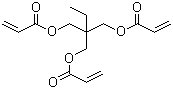 |
| Molecular Formula | C15H20O6 |
| Molecular Weight | 296.32 |
| CAS Registry Number | 15625-89-5 |
| EC Number | 239-701-3 |
| SMILES | CCC(COC(=O)C=C)(COC(=O)C=C)COC(=O)C=C |
| Density | 1.10 |
|---|---|
| Refractive index | 1.474 |
| Flash point | >110 °C |
| Hazard Symbols |    GHS08;GHS07;GHS09 Warning Details GHS08;GHS07;GHS09 Warning Details | ||||||||||||||||||||||||||||||||||||||||||||||||
|---|---|---|---|---|---|---|---|---|---|---|---|---|---|---|---|---|---|---|---|---|---|---|---|---|---|---|---|---|---|---|---|---|---|---|---|---|---|---|---|---|---|---|---|---|---|---|---|---|---|
| Risk Statements | H351-H315-H319-H317-H400-H410 Details | ||||||||||||||||||||||||||||||||||||||||||||||||
| Safety Statements | P261-P264-P264+P265-P272-P280-P302+P352-P305+P351+P338-P321-P332+P317-P333+P317-P337+P317-P362+P364-P501 Details | ||||||||||||||||||||||||||||||||||||||||||||||||
| Hazard Classification | |||||||||||||||||||||||||||||||||||||||||||||||||
| |||||||||||||||||||||||||||||||||||||||||||||||||
| SDS | Available | ||||||||||||||||||||||||||||||||||||||||||||||||
 chemBlink Chemical Story
|
Trimethylolpropane triacrylate is a chemical compound recognized for its versatile applications in polymer chemistry and materials science. It is a triacrylate ester derived from trimethylolpropane, a polyol used extensively in the synthesis of polymers and resins. This compound is characterized by its three acrylate groups attached to a trimethylolpropane core, which imparts unique properties suitable for various industrial uses. The discovery of trimethylolpropane triacrylate can be attributed to the need for multifunctional monomers in polymer chemistry. The compound was developed to address the demand for cross-linking agents in the production of high-performance polymers. Its structure, featuring multiple acrylate groups, allows it to participate in polymerization reactions, forming cross-linked networks that enhance the mechanical and chemical properties of the resulting materials. In practical applications, trimethylolpropane triacrylate plays a crucial role in the formulation of adhesives, coatings, and composites. Its primary function is as a cross-linking agent in the production of UV-curable coatings. When exposed to ultraviolet light, trimethylolpropane triacrylate undergoes a polymerization reaction, leading to the formation of a hard, durable film. This property is highly valued in the coating industry for its ability to produce fast-drying and chemically resistant surfaces. Another significant application of trimethylolpropane triacrylate is in the formulation of adhesives. The compound is used to enhance the adhesive properties of various formulations, improving their bonding strength and resistance to environmental factors. The cross-linking capability of trimethylolpropane triacrylate contributes to the durability and longevity of adhesive products, making them suitable for demanding applications in construction and manufacturing. In the field of composites, trimethylolpropane triacrylate is used to improve the mechanical properties of polymer matrices. By incorporating this compound into composite materials, manufacturers can achieve enhanced strength, stiffness, and thermal stability. This makes trimethylolpropane triacrylate an important ingredient in the production of high-performance composites used in aerospace, automotive, and other industries where material performance is critical. Research into trimethylolpropane triacrylate continues to focus on optimizing its applications and exploring new uses in emerging technologies. The compound's ability to provide strong cross-linking and enhance material properties underscores its significance in the development of advanced polymers and composite materials. References 2024-11-25. Preparation and Characterization of Red, Green, Blue (RGB) and White Luminescent Inorganic/Organic Polymers Through In Situ Polymerization. DOI: 10.1007/s10895-024-04046-4 2024-10-18. Trifluoromethyl-substituted pyrrolo[3,2-b]pyrrole derivatives for visible light photopolymerization. DOI: 10.1007/s11164-024-05423-1 2024-10-10. Development of a Fully Bio-based, Higly Efficient Polymeric Adsorbent Via UV Curing for Removal of Cationic Dyes. DOI: 10.1007/s10924-024-03428-w |
| Market Analysis Reports |