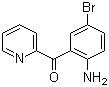
2-(2-Amino-5-bromophenyl)-2-pyridylmethanone, also known as 2-(2-amino-5-bromobenzoyl)pyridine (CAS 1563-56-0), is a brominated aromatic heterocyclic ketone in which a pyridine ring is linked by a carbonyl to a 2-amino-5-bromophenyl moiety. Its molecular formula is C12H9BrN2O, with a molecular weight of approximately 277.12 g/mol.
This compound was first introduced in the context of medicinal chemistry as a key intermediate in the synthesis of **bromazepam**, a brominated benzodiazepine. In the development of bromazepam, chemists recognized the utility of the brominated aminobenzoyl-pyridine structure to build the diazepine core. The amino and bromine substituents provide handles for further chemical transformations.
In terms of synthesis, one method described in the patent literature begins with 2-bromopyridine and 2-amino-5-bromobenzoic acid. The 2-bromopyridine is lithiated (for example with n-butyllithium) at low temperature to generate a nucleophilic pyridyl species, which is then reacted with the benzoic acid derivative to form the benzoyl-pyridine ketone. A protecting or activation step is used to manage reactivity, and following coupling, the intermediate is purified to furnish the target compound. Alternative routes include palladium-mediated coupling or more modern cross-coupling strategies. A Chinese patent describes a route where 4-bromo-2-(bromomethyl)phenol is converted via boronic acid chemistry and then coupled to 2-bromopyridine, oxidized, then deprotected and rearranged to yield the amino-bromobenzoyl pyridine.
As a building block, 2-(2-amino-5-bromobenzoyl)pyridine is particularly valuable because of its dual functionality: the amino group can be acylated or otherwise elaborated, while the bromine provides a site for cross-coupling (for example, via palladium-catalyzed reactions) to introduce other substituents. This makes the compound useful for exploring structure–activity relationships (SAR) in drug discovery. The ketone linkage to a heterocyclic pyridine ring further adds rigidity and aromatic character to derived molecules, influencing binding, solubility, and metabolic stability.
Besides its role in bromazepam synthesis, the intermediate has been studied in process development contexts. Handling considerations include its solid-state stability, typical storage at low temperature (some suppliers suggest –20 °C), and purification via crystallization or chromatography. Its UV-visible absorption maximum has been reported (e.g., at 238 nm in one specification sheet), which can help in analytical QC.
In a broader historical and medicinal-chemical context, the use of brominated aromatic ketones as intermediates in benzodiazepine analog synthesis reflects the flexibility of combining heteroaromatic rings (like pyridine) with substituted benzophenone-type motifs. The amino group enables cyclization steps or further functionalizations, while the halogen can direct reactivity or serve as a functional handle. Over time, synthetic improvements—including more efficient and safer coupling methods—have supported the scale-up of these intermediates for pharmaceutical research.
Overall, 2-(2-amino-5-bromophenyl)-2-pyridylmethanone remains a critical intermediate in benzodiazepine-type medicinal chemistry. Its stable but reactive functional groups, and its well-characterized synthetic routes, continue to make it a valuable compound for both small-scale research and larger process development programs.
References
Sawada H, Hara A, Hayashi K (1978) Studies on metabolism of bromazepam. VI. Reduction of 2‑(2‑amino‑5‑bromobenzoyl)pyridine, a metabolite of bromazepam, in the rabbit, rat, and guinea pig. Drug Metabolism and Disposition 6(3) 205–212 PMID: 26538
Darwish H W, Abdel-Gawad S A, Elmansi H M (2021) Development and validation of a stability‑indicating RP‑HPLC‑DAD method for the determination of bromazepam and its degradant 2‑(2‑amino-5-bromobenzoyl)pyridine. PLoS ONE 16(4) e0244951 DOI: 10.1371/journal.pone.0244951
El‑Haj B M, Alessa A M, Bououdina M, et al (2001) GC‑MS determination of bromazepam metabolites including 2‑amino-3‑hydroxy-5-bromobenzoylpyridine. Journal of Analytical Toxicology 25(5) 316–319 DOI: 10.1093/jat/25.5.316
|




 GHS07 Warning Details
 chemBlink Chemical Story