
Online Database of Chemicals from Around the World
| wuhan chemi Pharmacy Chemical Technology Co., Ltd. | China | |||
|---|---|---|---|---|
 | www.chemipharm.com.cn | |||
 | +86 13971619949 | |||
 | gmn424@chemipharm.com.cn | |||
 | QQ Chat | |||
 | WeChat: 13971619949 | |||
| Chemical manufacturer since 2014 | ||||
| chemBlink Standard supplier since 2026 | ||||
| Classification | Organic raw materials >> Carboxylic compounds and derivatives |
|---|---|
| Name | Hexane-1,3,6-tricarboxylic acid |
| Molecular Structure | 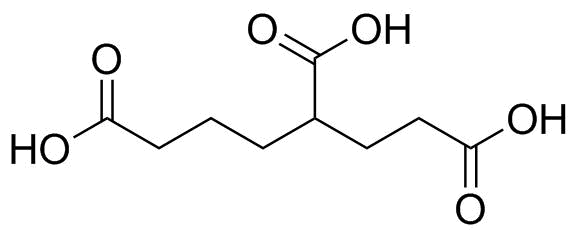 |
| Molecular Formula | C9H14O6 |
| Molecular Weight | 218.20 |
| CAS Registry Number | 1572-40-3 |
| SMILES | C(CC(CCC(=O)O)C(=O)O)CC(=O)O |
| Density | 1.4±0.1 g/cm3 Calc.* |
|---|---|
| Boiling point | 439.9±30.0 °C 760 mmHg (Calc.)* |
| Flash point | 234.0±21.1 °C (Calc.)* |
| Index of refraction | 1.512 (Calc.)* |
| * | Calculated using Advanced Chemistry Development (ACD/Labs) Software. |
| Hazard Symbols |  GHS07 Warning Details GHS07 Warning Details |
|---|---|
| Risk Statements | H319 Details |
| Safety Statements | P264-P280-P305+P351+P338-P337+P313 Details |
| SDS | Available |
 chemBlink Chemical Story
|
Hexane-1,3,6-tricarboxylic acid is an aliphatic polycarboxylic acid containing a six-carbon linear backbone with three carboxyl functional groups located at the 1-, 3-, and 6-positions. Compounds of this type belong to the broader class of multifunctional organic acids, which have been extensively studied in organic synthesis, coordination chemistry, and materials science due to their ability to form multiple hydrogen bonds and coordinate metal ions. The development and study of polycarboxylic acids such as hexane-1,3,6-tricarboxylic acid are closely tied to the evolution of organic acid chemistry in the nineteenth and twentieth centuries. As analytical methods and structural organic chemistry advanced, chemists systematically explored dicarboxylic and tricarboxylic acids to understand how functional group placement along carbon chains influences acidity, solubility, and reactivity. Tricarboxylic acids in particular became important in the study of polyfunctional acid behavior and in the development of chelating agents and polymer precursors. Hexane-1,3,6-tricarboxylic acid is characterized by three carboxyl groups capable of undergoing typical carboxylic acid reactions, including esterification, amidation, and salt formation. The presence of multiple acidic sites allows the compound to form mono-, di-, and tri-deprotonated species depending on the pH of the environment. This stepwise deprotonation behavior is a key feature of polycarboxylic acids and is important in both solution chemistry and solid-state structure formation. One of the most significant properties of tricarboxylic acids is their ability to act as multidentate ligands in coordination chemistry. Hexane-1,3,6-tricarboxylic acid can bind metal ions through one or more of its carboxylate groups, forming coordination complexes with various geometries. Such ligands are useful in the construction of coordination polymers and metal-organic frameworks, where organic linkers connect metal centers into extended structures. The spatial arrangement of carboxyl groups in hexane-1,3,6-tricarboxylic acid influences the dimensionality and topology of the resulting coordination networks. The compound has also been considered in studies of hydrogen bonding and supramolecular assembly. Carboxylic acid groups are strong hydrogen bond donors and acceptors, and molecules containing multiple carboxyl groups often form extensive hydrogen-bonded networks in the solid state. These interactions can lead to the formation of crystalline structures with defined packing arrangements, making polycarboxylic acids useful models in crystallography and materials science. In organic synthesis, polycarboxylic acids serve as intermediates for the preparation of esters, anhydrides, and other functional derivatives. Hexane-1,3,6-tricarboxylic acid can undergo esterification with alcohols to produce triesters, which may have applications as plasticizers, polymer additives, or intermediates in further chemical transformations. The presence of three carboxyl groups provides multiple points for chemical modification, increasing its versatility as a synthetic building block. The compound is also relevant in the broader context of functionalized aliphatic acids used in materials chemistry. Polycarboxylic acids are frequently employed in the design of crosslinked polymer networks, where they can react with polyols or polyamines to form ester- or amide-linked structures. These reactions are fundamental in the production of resins, coatings, and specialty polymers. Although hexane-1,3,6-tricarboxylic acid is not among the most commonly industrialized tricarboxylic acids, its structural features make it representative of multifunctional organic acids used in coordination and polymer chemistry research. Studies of such compounds contribute to a broader understanding of how molecular geometry and functional group distribution affect chemical behavior and material properties. Overall, hexane-1,3,6-tricarboxylic acid is a linear tricarboxylic acid with three carboxyl groups distributed along a six-carbon chain. Its ability to participate in acid–base chemistry, coordination bonding, and hydrogen bonding makes it a useful structural motif in organic and materials chemistry, particularly in studies involving multidentate ligands and multifunctional organic acids. References 2011. Metabolite Production during in Vitro Colonic Fermentation of Dietary Fiber: Analysis and Comparison of Two European Diets. Journal of Agricultural and Food Chemistry. DOI: 10.1021/jf201777w 2009. Digestive enzyme activities and gastrointestinal fermentation in wood-eating catfishes. Journal of comparative physiology. B, Biochemical, systemic, and environmental physiology. DOI: 10.1007/s00360-009-0383-z 2009. Do herbivorous minnows have “plug-flow reactor” guts? Evidence from digestive enzyme activities, gastrointestinal fermentation, and luminal nutrient concentrations. Journal of comparative physiology. B, Biochemical, systemic, and environmental physiology. DOI: 10.1007/s00360-009-0359-z |
| Market Analysis Reports |