
Online Database of Chemicals from Around the World
| BOC Sciences | USA | |||
|---|---|---|---|---|
 | www.bocsci.com | |||
 | +1 (631) 485-4226 | |||
 | +1 (631) 614-7828 | |||
 | info@bocsci.com | |||
| Chemical manufacturer | ||||
| chemBlink Standard supplier since 2010 | ||||
| Creative Peptides | USA | |||
|---|---|---|---|---|
| www.creative-peptides.com | |||
| +1 (631) 624-4882 | |||
| +1 (631) 614-7828 | |||
| info@creative-peptides.com | |||
| Chemical manufacturer | ||||
| chemBlink Standard supplier since 2010 | ||||
| Chengdu Youngshe Chemical Co., Ltd. | China | |||
|---|---|---|---|---|
| www.youngshechem.com | |||
| +86 (28) 6232-8193 +86 17380623303 | |||
| +86 (28) 6232-8193 | |||
| caroline@youngshechem.com | |||
 | QQ Chat | |||
 | Skype Chat | |||
| Chemical manufacturer since 2013 | ||||
| chemBlink Standard supplier since 2015 | ||||
| Chengdu Biopurify Phytochemicals Ltd. | China | |||
|---|---|---|---|---|
| www.phytopurify.com | |||
| +86 (28) 8263-3860 8263-3987 | |||
| +86 (28) 8263-3165 | |||
| sales@biopurify.com biopurify@gmail.com | |||
| QQ Chat | |||
| Skype Chat | |||
| Chemical manufacturer | ||||
| chemBlink Standard supplier since 2017 | ||||
| Cellmano Biotech Co., Ltd. | China | |||
|---|---|---|---|---|
| www.cellmano.com | |||
| +86 (551) 6532-6643 | |||
| qilin@cellmano.com | |||
| Chemical manufacturer since 2013 | ||||
| chemBlink Standard supplier since 2019 | ||||
| Aajiang Jiuzhou Chem Co., Ltd. | China | |||
|---|---|---|---|---|
| www.jiuzhou-chem.com | |||
| +86 13454675544 | |||
| jamie@jiuzhou-chem.com | |||
| QQ Chat | |||
 | WeChat: +86 18632988332 | |||
 | WhatsApp:+86 18632988332 | |||
| Chemical manufacturer since 2007 | ||||
| chemBlink Standard supplier since 2023 | ||||
| Guangzhou Amsper Biotechnology Ltd. | China | |||
|---|---|---|---|---|
| www.amsper.com | |||
| +8618565278009 | |||
| gifty@amsper.com | |||
| QQ Chat | |||
| Skype Chat | |||
| WeChat: +8618565278009 | |||
| WhatsApp:+8618565278009 | |||
| Chemical distributor since 2018 | ||||
| chemBlink Standard supplier since 2025 | ||||
| Classification | API >> Hormone and endocrine-regulating drugs |
|---|---|
| Name | L-Methionyl-L-prolyl-D-phenylalanyl-L-arginyl-D-tryptophyl-L-phenylalanyl-L-lysyl-L-prolyl-L-valinamide |
| Synonyms | Met-Pro-D-Phe-Arg-D-Trp-Phe-Lys-Pro-Val-NH<sub>2</sub> |
| Molecular Structure | 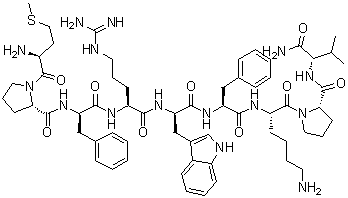 |
| Molecular Formula | C61H87N15O9S |
| Molecular Weight | 1206.50 |
| Protein Sequence | MPFRWFKPV |
| CAS Registry Number | 158563-45-2 |
| SMILES | CC(C)[C@@H](C(=O)N)NC(=O)[C@@H]1CCCN1C(=O)[C@H](CCCCN)NC(=O)[C@H](CC2=CC=CC=C2)NC(=O)[C@@H](CC3=CNC4=CC=CC=C43)NC(=O)[C@H](CCCN=C(N)N)NC(=O)[C@@H](CC5=CC=CC=C5)NC(=O)[C@@H]6CCCN6C(=O)[C@H](CCSC)N |
| Solubility | Slightly soluble (9.5 g/L) (25 °C), Calc.* |
|---|---|
| Density | 1.38±0.1 g/cm3 (20 °C 760 Torr), Calc.* |
| Index of refraction | 1.672 (Calc.)* |
| * | Calculated using Advanced Chemistry Development (ACD/Labs) Software. |
| Hazard Symbols |  GHS07 Warning Details GHS07 Warning Details |
|---|---|
| Risk Statements | H302 Details |
| Safety Statements | P280-P305+P351+P338 Details |
| SDS | Available |
 chemBlink Chemical Story
|
L-Methionyl-L-prolyl-D-phenylalanyl-L-arginyl-D-tryptophyl-L-phenylalanyl-L-lysyl-L-prolyl-L-valinamide is a synthetic nonapeptide that exemplifies the design of short peptide sequences for biochemical and pharmacological research. The discovery of peptides with biological activity has a long history, beginning with the isolation of natural hormones and signaling peptides in the early twentieth century. The ability to synthesize peptides of defined sequence through solid-phase peptide synthesis, first introduced by Robert Bruce Merrifield in 1963, made it possible to design, modify, and study artificial peptides with high precision. The sequence under consideration combines both proteinogenic L-amino acids and stereochemically inverted D-amino acids, illustrating the application of stereochemical modification to modulate biological properties. The N-terminal residue of this peptide is L-methionine, an essential amino acid known since its isolation in the 1920s. Methionine often contributes to peptide stability and biological recognition through its thioether group. Following methionine, the sequence includes proline residues at two positions, which introduce conformational constraints due to the cyclic nature of their pyrrolidine ring. Proline has long been recognized as a structure-disrupting amino acid in α-helices and as a turn-inducing residue, making it valuable for peptide folding studies. Two of the residues in the sequence are present in the D-configuration: D-phenylalanine and D-tryptophan. The incorporation of D-amino acids into synthetic peptides is a strategy that became widespread in the latter half of the twentieth century to improve resistance against enzymatic degradation and to alter receptor interactions. D-phenylalanine and D-tryptophan not only influence the conformational preferences of the peptide but also reduce its susceptibility to proteolytic cleavage, thereby increasing its potential half-life in biological systems. Arginine and lysine residues introduce positively charged side chains into the sequence, a feature that is often used in peptides intended to interact with nucleic acids, cell membranes, or negatively charged biomolecules. Arginine, with its guanidinium group, is well known for its strong hydrogen bonding and electrostatic interactions, while lysine provides flexibility with a terminal amino group. Both residues play key roles in biological peptides, including antimicrobial and cell-penetrating sequences. Phenylalanine and tryptophan contribute aromatic side chains, which can be important for hydrophobic interactions, stacking effects, and binding to protein pockets or lipid membranes. The presence of multiple aromatic residues within this peptide highlights its potential for stabilizing secondary structure through intramolecular interactions or for facilitating intermolecular recognition. The C-terminal valinamide group represents a modification of the free carboxylic acid into an amide, a change that can significantly alter peptide stability and bioactivity. Amide capping is a well-established technique in peptide design, known to improve membrane permeability and reduce enzymatic degradation by exopeptidases. Applications of peptides such as L-methionyl-L-prolyl-D-phenylalanyl-L-arginyl-D-tryptophyl-L-phenylalanyl-L-lysyl-L-prolyl-L-valinamide include their use as models for studying peptide folding, receptor binding, and stability. They are also of interest in the development of drug candidates, particularly in areas such as antimicrobial peptides, enzyme inhibitors, and signaling modulators. The strategic combination of L- and D-amino acids, together with N-terminal and C-terminal modifications, represents an important approach in medicinal chemistry to optimize bioactive peptides for therapeutic use. The study and application of synthetic peptides like this one build directly on the pioneering advances in peptide synthesis and stereochemical modification. Through careful control of sequence composition, researchers have been able to generate compounds that not only provide insight into fundamental biochemical processes but also open pathways to practical applications in medicine and biotechnology. References 1994. Discovery and structure-function analysis of alpha-melanocyte-stimulating hormone antagonists. The Journal of Biological Chemistry, 269(47). DOI: 10.1016/s0021-9258(18)43958-0 |
| Market Analysis Reports |