
Online Database of Chemicals from Around the World
| Hangzhou Verychem Science And Technology Co., Ltd. | China | |||
|---|---|---|---|---|
 | www.verychem.com | |||
 | +86 (571) 8816-2785 +86 13606544505 | |||
 | +86 (571) 8816-2787 | |||
 | lucy@verychem.com | |||
| Chemical manufacturer since 2004 | ||||
| chemBlink Massive supplier since 2021 | ||||
| Shanghai Oripharm Co., Ltd. | China | |||
|---|---|---|---|---|
| www.oripharm.com.cn | |||
| +86 (21) 6439-6936 | |||
| +86 (21) 6481-4386 | |||
| info@oripharm.com.cn sales@oripharm.com.cn | |||
| Chemical distributor since 2003 | ||||
| chemBlink Standard supplier since 2006 | ||||
| Glentham Life Sciences | UK | |||
|---|---|---|---|---|
| www.glenthamls.com | |||
| +44 (2033) 978-798 | |||
| +44 (2033) 978-909 | |||
| info@glenthamls.com | |||
| Chemical distributor since 2013 | ||||
| chemBlink Standard supplier since 2013 | ||||
| Biosynth AG. | Switzerland | |||
|---|---|---|---|---|
| www.biosynth.com | |||
| +41 (71) 858-2020 | |||
| +41 (71) 858-2030 | |||
| welcome@biosynth.ch | |||
| Chemical manufacturer | ||||
| chemBlink Standard supplier since 2014 | ||||
| Amadis Chemical Co., Ltd. | China | |||
|---|---|---|---|---|
| www.amadischem.com | |||
| +86 (571) 8992-5085 | |||
| +86 (571) 8992-5065 | |||
| sales@amadischem.com | |||
| Chemical manufacturer since 2010 | ||||
| chemBlink Standard supplier since 2015 | ||||
| Allbiosyn Biotechnology Co., Ltd. | China | |||
|---|---|---|---|---|
| www.allbiosyn.com | |||
| +86 15900695956 | |||
| info@allbiosyn.com | |||
 | WeChat: 15900695956 | |||
 | WhatsApp:86 15900695956 | |||
| Chemical manufacturer since 2023 | ||||
| chemBlink Standard supplier since 2024 | ||||
| Classification | Biochemical >> Nucleoside drugs >> Deoxynucleotides and their analogues |
|---|---|
| Name | N4-Acetyl-2'-deoxy-2'-fluorocytidine |
| Synonyms | N-[1-[(2R,3R,4R,5R)-3-fluoro-4-hydroxy-5-(hydroxymethyl)oxolan-2-yl]-2-oxopyrimidin-4-yl]acetamide |
| Molecular Structure | 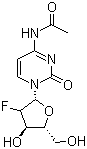 |
| Molecular Formula | C11H14FN3O5 |
| Molecular Weight | 287.24 |
| Protein Sequence | N |
| CAS Registry Number | 159414-97-8 |
| SMILES | CC(=O)NC1=NC(=O)N(C=C1)[C@H]2[C@@H]([C@@H]([C@H](O2)CO)O)F |
| Hazard Symbols |  GHS07 Warning Details |
|---|---|
| Risk Statements | H302-H315-H319-H335 Details |
| Safety Statements | P261-P305+P351+P338 Details |
| SDS | Available |
 chemBlink Chemical Story
|
N4-acetyl-2'-deoxy-2'-fluorocytidine is a modified nucleoside that has received much attention for its potential in medicinal chemistry and molecular biology. This compound, called acetyl-DF-cytidine, combines structural and chemical modifications to enhance its functionality and stability. Acetyl-DF-cytidine was developed as part of a research effort to create nucleoside analogs with improved properties. The compound is synthesized by selective acetylation of the N4 position of cytidine followed by the introduction of a fluorine atom at the 2' position of the sugar moiety. The synthesis involves protecting groups and specific reaction conditions to ensure high purity and yield of the final product. The unique modification of acetyl-DF-cytidine lends it potential as an antiviral and anticancer agent. The fluorine substitution at the 2' position of the deoxyribose enhances the stability and bioavailability of the compound, which is essential for the development of effective drugs. This stability makes it a promising candidate for further investigation of its efficacy against viral infections and tumors. In molecular biology, acetyl-DF-cytidine is a useful tool for studying nucleic acid interactions and modifications. Its structural alterations compared to native cytidine allow researchers to explore the effects of such modifications on nucleic acid behavior, including binding affinity and structural changes. The acetyl and fluorine groups in acetyl-DF-cytidine improve its pharmacokinetic properties, making it a valuable compound in drug development. Its enhanced stability and reduced susceptibility to enzymatic degradation suggest that it could be developed into a more effective and durable drug formulation. |
| Market Analysis Reports |