
Online Database of Chemicals from Around the World
| BOC Sciences | USA | |||
|---|---|---|---|---|
 | www.bocsci.com | |||
 | +1 (631) 485-4226 | |||
 | +1 (631) 614-7828 | |||
 | info@bocsci.com | |||
| Chemical manufacturer | ||||
| chemBlink Standard supplier since 2010 | ||||
| EnBridge PharmTech (Wuxi) Co., Ltd. | China | |||
|---|---|---|---|---|
| www.enbridgepharm.com | |||
| +86 (510) 8359-1909 +86 18018392058 | |||
| +86 (510) 8359-1909 | |||
| info@enbridgepharm.com | |||
 | QQ Chat | |||
| Chemical distributor since 2013 | ||||
| chemBlink Standard supplier since 2020 | ||||
| Zhejiang Boxiao Biopharmaceutical Co., Ltd. | China | |||
|---|---|---|---|---|
| www.bx-biopharm.com | |||
| +86 (571) 6328-0982 | |||
| helena_huang@bx-biopharm.com | |||
| QQ Chat | |||
| Chemical manufacturer since 2020 | ||||
| chemBlink Standard supplier since 2023 | ||||
| Classification | Organic raw materials >> Amino compound >> Amide compound |
|---|---|
| Name | N-((1S,9S)-9-Ethyl-5-fluoro-2,3,9,10,13,15-hexahydro-9-hydroxy-4-methyl-10,13-dioxo-1H,12H-benzo(de)pyrano(3',4':6,7)indolizino(1,2-b)quinolin-1-yl)-2-hydroxyacetamide |
| Synonyms | N-[(10S,23S)-10-ethyl-18-fluoro-10-hydroxy-19-methyl-5,9-dioxo-8-oxa-4,15-diazahexacyclo[14.7.1.02,14.04,13.06,11.020,24]tetracosa-1,6(11),12,14,16,18,20(24)-heptaen-23-yl]-2-hydroxyacetamide |
| Molecular Structure | 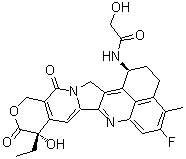 |
| Molecular Formula | C26H24FN3O6 |
| Molecular Weight | 493.48 |
| CAS Registry Number | 1599440-33-1 |
| SMILES | CC[C@@]1(C2=C(COC1=O)C(=O)N3CC4=C5[C@H](CCC6=C5C(=CC(=C6C)F)N=C4C3=C2)NC(=O)CO)O |
| Density | 1.6±0.1 g/cm3 Calc.* |
|---|---|
| Boiling point | 957.9±65.0 °C 760 mmHg (Calc.)* |
| Flash point | 533.1±34.3 °C (Calc.)* |
| Index of refraction | 1.726 (Calc.)* |
| * | Calculated using Advanced Chemistry Development (ACD/Labs) Software. |
| Hazard Symbols |  GHS06 Danger Details GHS06 Danger Details |
|---|---|
| Risk Statements | H301 Details |
| Safety Statements | P501-P270-P264-P301+P310+P330-P405 Details |
| Transport Information | UN 2811 |
| SDS | Available |
 chemBlink Chemical Story
|
CAS 1599440-33-1 is DXd, an exatecan-derived DNA topoisomerase I inhibitor best known as the cytotoxic payload of trastuzumab deruxtecan, originally DS-8201a. DXd belongs to the camptothecin/exatecan lineage. Topoisomerase I normally relieves torsional stress through transient DNA breaks; inhibitors stabilize cleavage complexes so replication converts a reversible event into damaging lesions. DXd's modern significance comes from antibody-drug-conjugate engineering: a potent payload is connected through a cleavable linker to a targeting antibody, separating target recognition, intracellular release and cytotoxic action into coordinated molecular functions. The exact registry identity matters because related free forms, salts, hydrates, stereoisomers, process intermediates and finished medicines can have separate CAS numbers even when their names share a familiar stem. In pharmaceutical and fine-chemical work this distinction is practical: composition changes formula weight and can alter solubility, crystallization, analytical standards, manufacturing specifications and interpretation of physical-property data. The molecule also illustrates how chemists use functional groups as deliberate handles. Aromatic rings and heterocycles establish shape and electronic character, while amines, alcohols, carbonyl groups, carboxylic acids, esters or ionic centers control reactivity and intermolecular interactions. In a multistep route, an intermediate may be valuable precisely because one group can be transformed selectively while another survives for a later operation. Modern development is equally an analytical problem. Chemists must demonstrate identity and purity, control stereochemistry or salt composition where relevant, follow process-related impurities and establish reproducible specifications. Reference materials and isolated intermediates therefore have scientific importance even when they are never administered to a patient or sold as the final commercial product. A careful Chemical Story must distinguish documented use from structural possibility. A familiar scaffold can suggest a biological hypothesis, but resemblance is not evidence that the exact CAS substance has been tested, approved or commercially adopted for that purpose. The account therefore emphasizes verified identity, development history and supported applications, and deliberately leaves unsupported claims out. Seen more broadly, the compound shows that useful molecular design rarely depends on one functional group in isolation. Performance emerges from the whole structure, stereochemistry and physical form, the route used to make it, and the environment in which it operates. Connecting those molecular details to a real manufacturing, analytical or therapeutic role turns a technical registry entry into a meaningful chemical story. The exact registry identity matters because related free forms, salts, hydrates, stereoisomers, process intermediates and finished medicines can have separate CAS numbers even when their names share a familiar stem. In pharmaceutical and fine-chemical work this distinction is practical: composition changes formula weight and can alter solubility, crystallization, analytical standards, manufacturing specifications and interpretation of physical-property data. The molecule also illustrates how chemists use functional groups as deliberate handles. Aromatic rings and heterocycles establish shape and electronic character, while amines, alcohols, carbonyl groups, carboxylic acids, esters or ionic centers control reactivity and intermolecular interactions. In a multistep route, an intermediate may be valuable precisely because one group can be transformed selectively while another survives for a later operation. Modern development is equally an analytical problem. Chemists must demonstrate identity and purity, control stereochemistry or salt composition where relevant, follow process-related impurities and establish reproducible specifications. Reference materials and isolated intermediates therefore have scientific importance even when they are never administered to a patient or sold as the final commercial product. References: 1. PubChem. DXd, CID 117888634. 2. Ogitani Y et al. Clin Cancer Res. 2016. 3. Nakada T et al. Chem Pharm Bull. |
| Market Analysis Reports |