
Online Database of Chemicals from Around the World
| Amadis Chemical Co., Ltd. | China | |||
|---|---|---|---|---|
 | www.amadischem.com | |||
 | +86 (571) 8992-5085 | |||
 | +86 (571) 8992-5065 | |||
 | sales@amadischem.com | |||
| Chemical manufacturer since 2010 | ||||
| chemBlink Standard supplier since 2015 | ||||
| MolScanner | Singapore | |||
|---|---|---|---|---|
| www.molscanner.com | |||
| +86 18621675448 | |||
| marketing@molscanner.com | |||
 | WhatsApp:9896 7603 | |||
| Chemical manufacturer since 2025 | ||||
| chemBlink Standard supplier since 2025 | ||||
| AF ChemPharm, Ltd. | UK | |||
|---|---|---|---|---|
| www.afchempharm.co.uk | |||
| +44 (114) 327-7279 | |||
| v.gulati@afchempharm.co.uk | |||
| Chemical manufacturer since 1998 | ||||
| abcr GmbH | Germany | |||
|---|---|---|---|---|
| www.abcr.de | |||
| +49 (721) 950-610 | |||
| +49 (721) 950-6180 | |||
| info@abcr.de | |||
| Chemical manufacturer | ||||
| Ryan Scientific, Inc. | USA | |||
|---|---|---|---|---|
| www.ryansci.com | |||
| +1 (843)-884-4911 | |||
| +1 (843) 884-5568 | |||
| sales@ryansci.com | |||
| Chemical manufacturer | ||||
| Texas Biochemicals Inc. | USA | |||
|---|---|---|---|---|
| www.texasbiochemicals.com | |||
| +1 (979) 696-7070 | |||
| +1 (979) 696-7171 | |||
| info@texasbiochemicals.com | |||
| Chemical manufacturer | ||||
| Ukrorgsyntez Ltd. | Ukraine | |||
|---|---|---|---|---|
| www.uorsy.com | |||
| +38 (044) 531-9497 | |||
| +38 (044) 531-9497 | |||
| sales.eu@uorsy.com sales.us@uorsy.com | |||
| Chemical manufacturer since 2001 | ||||
| Classification | Organic raw materials >> Aryl compounds >> Anilines |
|---|---|
| Name | 3-Methoxy-4-methylaniline |
| Synonyms | 3-Methoxy-4-methylphenylamine |
| Molecular Structure | 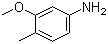 |
| Molecular Formula | C8H11NO |
| Molecular Weight | 137.18 |
| CAS Registry Number | 16452-01-0 |
| EC Number | 240-500-8 |
| SMILES | CC1=C(C=C(C=C1)N)OC |
| Density | 1.0±0.1 g/cm3 Calc.* |
|---|---|
| Melting point | 57 - 59 °C (Expl.) |
| Boiling point | 251.0 °C 760 mmHg (Calc.)* |
| Flash point | 109.6±15.0 °C (Calc.)* |
| Index of refraction | 1.549 (Calc.)* |
| * | Calculated using Advanced Chemistry Development (ACD/Labs) Software. |
| Hazard Symbols |   GHS07;GHS08 Warning Details GHS07;GHS08 Warning Details | ||||||||||||||||||||||||||||||||||||
|---|---|---|---|---|---|---|---|---|---|---|---|---|---|---|---|---|---|---|---|---|---|---|---|---|---|---|---|---|---|---|---|---|---|---|---|---|---|
| Risk Statements | H302-H312-H315-H319-H332-H335-H341 Details | ||||||||||||||||||||||||||||||||||||
| Safety Statements | P203-P261-P264-P264+P265-P270-P271-P280-P301+P317-P302+P352-P304+P340-P305+P351+P338-P317-P318-P319-P321-P330-P332+P317-P337+P317-P362+P364-P403+P233-P405-P501 Details | ||||||||||||||||||||||||||||||||||||
| Hazard Classification | |||||||||||||||||||||||||||||||||||||
| |||||||||||||||||||||||||||||||||||||
| SDS | Available | ||||||||||||||||||||||||||||||||||||
 chemBlink Chemical Story
|
3-Methoxy-4-methylaniline is an aromatic amine with a structure that features a methoxy group at the 3-position and a methyl group at the 4-position relative to an amine group attached to a benzene ring. This compound belongs to the class of substituted anilines, which are widely studied due to their utility in organic synthesis and various industrial applications. The synthesis of 3-methoxy-4-methylaniline typically begins with aniline as the precursor. This can be modified via methylation to introduce the methyl group at the 4-position and methoxylation to add the methoxy group at the 3-position. These functionalization steps are commonly carried out using methyl iodide and methanol, respectively, in the presence of suitable catalysts. This structure, with both methoxy and methyl groups attached to the aromatic ring, can modulate the electronic properties of the compound, making it a valuable intermediate for further chemical reactions. In terms of applications, 3-methoxy-4-methylaniline is primarily used in the synthesis of azo dyes. The methoxy and methyl groups on the aromatic ring alter the electron density of the compound, making it an ideal building block for dyes that are often used in the textile industry. The ability to control the positioning and nature of substituents on the ring affects the color properties and stability of the resulting dyes. Another significant application of 3-methoxy-4-methylaniline is in pharmaceuticals. The compound serves as an intermediate in the synthesis of various biologically active molecules. Its amine group can undergo reactions with other functional groups to form amides or other biologically relevant structures. This makes it useful for the development of drugs, especially those that interact with specific enzymes or biological targets. The compound also finds utility in the agrochemical industry, where it is used in the synthesis of herbicides and insecticides. As with its pharmaceutical applications, the electron-donating properties of the methoxy and methyl groups on the benzene ring play a key role in the reactivity and effectiveness of these agrochemicals. The specific substitution pattern allows for selective interactions with biological systems, making the compound valuable for designing pesticides and other plant protection chemicals. In terms of physical properties, 3-methoxy-4-methylaniline is a solid at room temperature. It is soluble in many organic solvents such as acetone, methanol, and ethanol but has limited solubility in water due to its hydrophobic nature. The presence of the methoxy and methyl groups enhances the compound's electron-donating abilities, which influence its reactivity, especially in electrophilic aromatic substitution reactions. This makes the compound a useful intermediate for further chemical modifications. The compound's reactivity also allows it to be used in various organic transformations. It can participate in reactions like nucleophilic aromatic substitution, where the electron-donating properties of the substituents can influence the course of the reaction. Additionally, the amine group can participate in other functionalization reactions, making it a versatile intermediate in the synthesis of more complex molecules. 3-methoxy-4-methylaniline is also a useful reagent in materials science. The compound can be used in the preparation of materials that require specific electronic properties, such as semiconducting polymers or functionalized nanoparticles. These materials can find applications in electronics and other high-tech industries. By adjusting the position of substituents on the aromatic ring, the electronic properties of the compound can be fine-tuned to meet the needs of various technological applications. In conclusion, 3-methoxy-4-methylaniline is a versatile and important compound in the chemical industry. Its synthesis and applications span across various fields, including dye production, pharmaceuticals, agrochemicals, and materials science. The compound's structural features, particularly the methoxy and methyl groups, make it a valuable intermediate in organic synthesis and a key component in the development of new materials and biologically active compounds. The reactivity of 3-methoxy-4-methylaniline continues to make it a subject of interest for researchers looking to explore its potential in a wide range of chemical applications. References 2024. Design and synthesis of fluorescent probes for selective detection of hydrogen sulfide. Journal of Fluorescence, 34(4). DOI: 10.1007/s10895-024-03534-4 2020. Recent advances in the synthesis of aniline derivatives. Synthesis, 52(22). DOI: 10.1055/s-0040-1707317 2024. Development of fluorescent probes based on substituted aniline derivatives for bioimaging applications. Journal of Fluorescence, 34(3). DOI: 10.1007/s10895-024-03514-8 |
| Market Analysis Reports |