
Online Database of Chemicals from Around the World
| wuhan chemi Pharmacy Chemical Technology Co., Ltd. | China | |||
|---|---|---|---|---|
 | www.chemipharm.com.cn | |||
 | +86 13971619949 | |||
 | gmn424@chemipharm.com.cn | |||
 | QQ Chat | |||
 | WeChat: 13971619949 | |||
| Chemical manufacturer since 2014 | ||||
| chemBlink Standard supplier since 2026 | ||||
| Classification | Pharmaceutical intermediate >> Heterocyclic compound intermediate >> Pyridine compound |
|---|---|
| Name | Bis(2,2'-bipyridine)copper |
| Synonyms | copper bis(2-pyridin-2-ylpyridine) |
| Molecular Structure | 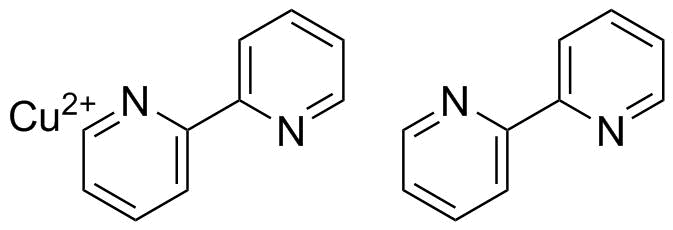 |
| Molecular Formula | C20H16CuN4+2 |
| Molecular Weight | 375.91 |
| CAS Registry Number | 16787-11-4 |
| SMILES | C1=CC=NC(=C1)C2=CC=CC=N2.C1=CC=NC(=C1)C2=CC=CC=N2.[Cu+2] |
| Hazard Symbols |  GHS07 Warning Details GHS07 Warning Details |
|---|---|
| Risk Statements | H315-H319-H335 Details |
| Safety Statements | P262-P280-P305+P351+P338-P304+P340-P403+P233-P501 Details |
| SDS | Available |
 chemBlink Chemical Story
|
Bis(2,2′-bipyridine)copper is a coordination compound formed between copper ions and the bidentate ligand 2,2′-bipyridine. The most commonly encountered forms are the copper(I) complex, often written as [Cu(bpy)2]+, and related copper(II) species depending on oxidation state and counterions. The compound belongs to a broad class of metal–polypyridyl complexes that have been extensively studied in coordination chemistry due to their well-defined structures, redox activity, and photophysical properties. The development of copper–bipyridine complexes is closely tied to the historical expansion of coordination chemistry in the nineteenth and twentieth centuries. The discovery that transition metal ions could form stable complexes with nitrogen-containing ligands such as bipyridine significantly advanced the understanding of metal–ligand bonding. 2,2′-bipyridine, a rigid bidentate ligand containing two pyridine rings, was shown to form stable chelate rings with many transition metals, including copper. This chelating ability contributes to the stability and characteristic geometry of the resulting complexes. In bis(2,2′-bipyridine)copper systems, each bipyridine ligand coordinates through its two nitrogen atoms to the copper center, forming five-membered chelate rings. In the copper(I) oxidation state, the complex typically adopts a tetrahedral coordination geometry with two bipyridine ligands surrounding the metal center. In copper(II) complexes, additional ligands or counterions may be present to satisfy the preferred coordination environment, which is often distorted octahedral or square-planar depending on the ligand field. One of the most important aspects of bis(2,2′-bipyridine)copper complexes is their redox behavior. Copper(I)/copper(II) interconversion is a well-studied redox couple, and the presence of bipyridine ligands stabilizes both oxidation states. This redox flexibility has made copper–bipyridine complexes useful in electron transfer studies and coordination chemistry research. The ligands help modulate the redox potential of the copper center by influencing electron density through coordination. These complexes have also been widely studied in photochemistry and photophysics. Copper(I)–bipyridine complexes can exhibit metal-to-ligand charge transfer (MLCT) excited states upon light absorption. These excited states are of interest because they can participate in electron transfer processes, making such complexes relevant in areas such as photoredox chemistry and light-driven catalysis. The electronic properties of the bipyridine ligand play a central role in stabilizing these excited states. Bis(2,2′-bipyridine)copper complexes have also been investigated as catalysts or catalyst precursors in organic synthesis. Copper-based catalytic systems are widely used in reactions such as oxidative coupling, azide–alkyne cycloaddition, and other carbon–heteroatom bond-forming processes. In many cases, bipyridine ligands are used to stabilize the active copper species and control reactivity and selectivity. The ligand environment can significantly influence catalytic efficiency and reaction pathways. Another important application area is analytical chemistry and biochemical research. Copper–bipyridine complexes have been used as model systems for studying DNA interactions, electron transfer in biological systems, and coordination-driven molecular recognition. The planar aromatic structure of bipyridine allows for π-stacking interactions, which can be relevant in interactions with biomolecules. From a structural perspective, bis(2,2′-bipyridine)copper complexes are well-characterized by spectroscopic methods such as UV–visible spectroscopy, nuclear magnetic resonance spectroscopy, and X-ray crystallography. These techniques have provided detailed insight into bonding, geometry, and electronic structure. The strong ligand field created by bipyridine results in characteristic absorption bands associated with charge transfer transitions. Overall, bis(2,2′-bipyridine)copper represents an important class of coordination compounds in which a transition metal is stabilized by chelating nitrogen donor ligands. Its significance lies in its roles in coordination chemistry, redox studies, photophysical research, and catalysis. The compound continues to serve as a model system for understanding metal–ligand interactions and electron transfer processes in both chemical and biochemical contexts. |
| Market Analysis Reports |