
Online Database of Chemicals from Around the World
| Shanghai Edu Chemical Technology Co., Ltd. | China | |||
|---|---|---|---|---|
 | www.chemido.com | |||
 | +86 19301251526 | |||
 | sales1@chemido.com | |||
 | QQ Chat | |||
| Chemical manufacturer since 2011 | ||||
| chemBlink Standard supplier since 2025 | ||||
| Classification | Pharmaceutical intermediate >> Heterocyclic compound intermediate |
|---|---|
| Name | 6-Bromo-7-(dimethoxymethyl)-1,2,3,4-tetrahydro-1,8-naphthyridine |
| Molecular Structure | 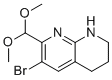 |
| Molecular Formula | C11H15BrN2O2 |
| Molecular Weight | 287.15 |
| CAS Registry Number | 1708974-02-0 |
| SMILES | COC(C1=C(C=C2CCCNC2=N1)Br)OC |
| Density | 1.4±0.1 g/cm3 Calc.* |
|---|---|
| Boiling point | 347.6±42.0 °C 760 mmHg (Calc.)* |
| Flash point | 164.0±27.9 °C (Calc.)* |
| Index of refraction | 1.551 (Calc.)* |
| * | Calculated using Advanced Chemistry Development (ACD/Labs) Software. |
| Hazard Symbols |  GHS07 Warning Details GHS07 Warning Details |
|---|---|
| Risk Statements | H302-H315-H319-H335 Details |
| Safety Statements | P261-P264-P270-P271-P280-P302+P352-P304+P340-P305+P351+P338-P312-P330-P362-P403+P233-P501 Details |
| SDS | Available |
 chemBlink Chemical Story
|
6-Bromo-7-(dimethoxymethyl)-1,2,3,4-tetrahydro-1,8-naphthyridine is a heterocyclic compound featuring a partially saturated 1,8-naphthyridine core substituted with a bromine atom at the 6-position and a dimethoxymethyl group at the 7-position. The tetrahydro-1,8-naphthyridine scaffold provides a bicyclic framework with nitrogen atoms positioned to influence electronic distribution and reactivity, while the bromine and dimethoxymethyl substituents enable selective chemical transformations. This combination of functional groups makes the compound a useful intermediate in the preparation of more complex heterocyclic derivatives. The synthesis of 6-bromo-7-(dimethoxymethyl)-1,2,3,4-tetrahydro-1,8-naphthyridine typically involves the selective bromination of a 1,8-naphthyridine precursor, followed by functionalization at the 7-position with a dimethoxymethyl group. The dimethoxymethyl substituent can be introduced through acetal formation from an aldehyde intermediate using methanol and an acid catalyst. Reaction conditions are carefully controlled to preserve the tetrahydro core and prevent over-bromination or side reactions. The resulting product is often purified by recrystallization or chromatographic methods to yield a crystalline solid suitable for further applications. In synthetic organic chemistry, this compound serves as a versatile intermediate for the preparation of substituted 1,8-naphthyridine derivatives. The bromine atom provides a site for cross-coupling reactions, such as Suzuki or Buchwald–Hartwig couplings, enabling the introduction of aryl or alkyl groups. The dimethoxymethyl group can be converted to an aldehyde or other electrophilic species for further functionalization. The tetrahydro-1,8-naphthyridine core offers structural rigidity while maintaining nitrogen atoms that can participate in hydrogen bonding or metal coordination in subsequent transformations. In medicinal chemistry, derivatives derived from 6-bromo-7-(dimethoxymethyl)-1,2,3,4-tetrahydro-1,8-naphthyridine have potential applications as enzyme inhibitors, receptor ligands, or scaffolds for small-molecule drug development. The presence of the nitrogen atoms in the naphthyridine core facilitates hydrogen bonding interactions, while the bromine and dimethoxymethyl substituents allow further derivatization to optimize binding affinity, selectivity, and pharmacokinetic properties. Structural modifications of this intermediate can produce libraries of compounds for screening against biological targets. The compound is also relevant in methodology research and materials chemistry. Its combination of a halogenated heterocycle and a protected aldehyde functionality makes it suitable for studying selective functionalization reactions, protective group strategies, and cross-coupling chemistry. The tetrahydro-1,8-naphthyridine scaffold provides a rigid framework that can influence stereochemistry and electronic properties in multistep synthesis, making it useful for developing new synthetic routes to complex heterocyclic molecules. Physically, 6-bromo-7-(dimethoxymethyl)-1,2,3,4-tetrahydro-1,8-naphthyridine is generally obtained as a crystalline solid with moderate solubility in polar organic solvents such as dichloromethane, dimethylformamide, and ethanol. It is stable under standard laboratory conditions but should be protected from strong acids, bases, and oxidizing agents that could affect the bromine substituent or the dimethoxymethyl group. Proper storage ensures chemical integrity for synthetic, medicinal, and exploratory applications. Overall, 6-bromo-7-(dimethoxymethyl)-1,2,3,4-tetrahydro-1,8-naphthyridine is a multifunctional heterocyclic intermediate with a tetrahydro-1,8-naphthyridine core, a reactive bromine atom, and a convertible dimethoxymethyl group. Its structural features allow selective transformations and derivatization, making it a valuable building block for the synthesis of bioactive molecules, substituted heterocycles, and complex intermediates in medicinal and synthetic organic chemistry. References 2021. Synthesis of Roblitinib. Synfacts, 17(3). DOI: 10.1055/s-0040-1719320 |
| Market Analysis Reports |