
Online Database of Chemicals from Around the World
| Jiangsu Evergreen New Material Technology Incorporated | China | |||
|---|---|---|---|---|
 | www.cqs-hm.com | |||
 | +86 (025) 8491-1160 | |||
 | flora.wang@cqsgfz.cn | |||
 | QQ Chat | |||
 | Skype Chat | |||
 | WeChat: 13605178468 | |||
 | WhatsApp:+8613605178468 | |||
| Chemical manufacturer since 2010 | ||||
| chemBlink Standard supplier since 2024 | ||||
| Classification | Organic raw materials >> Hydrocarbon compounds and their derivatives >> Aromatic hydrocarbon |
|---|---|
| Name | 4-tert-Butylstyrene |
| Synonyms | 1-tert-butyl-4-ethenylbenzene |
| Molecular Structure | 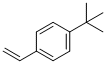 |
| Molecular Formula | C12H16 |
| Molecular Weight | 160.26 |
| CAS Registry Number | 1746-23-2 |
| EC Number | 217-126-9 |
| SMILES | CC(C)(C)C1=CC=C(C=C1)C=C |
| Density | 0.9±0.1 g/cm3, Calc.*, 0.884 g/mL (Expl.) |
|---|---|
| Melting Point | -38 °C (Expl.) |
| Index of Refraction | 1.522, Calc.*, 1.526 (Expl.) |
| Boiling Point | 212.6±10.0 °C (760 mmHg), Calc.*, 242.7-244.1 °C (Expl.) |
| Flash Point | 75.4±7.6 °C, Calc.*, 80 °C (Expl.) |
| * | Calculated using Advanced Chemistry Development (ACD/Labs) Software. |
| Hazard Symbols |    GHS07;GHS08;GHS09 Danger Details GHS07;GHS08;GHS09 Danger Details | ||||||||||||||||||||||||||||||||||||||||||||||||
|---|---|---|---|---|---|---|---|---|---|---|---|---|---|---|---|---|---|---|---|---|---|---|---|---|---|---|---|---|---|---|---|---|---|---|---|---|---|---|---|---|---|---|---|---|---|---|---|---|---|
| Risk Statements | H304-H315-H319-H335-H361f-H400-H410 Details | ||||||||||||||||||||||||||||||||||||||||||||||||
| Safety Statements | P203-P261-P264-P264+P265-P271-P273-P280-P301+P316-P302+P352-P304+P340-P305+P351+P338-P318-P319-P321-P331-P332+P317-P337+P317-P362+P364-P391-P403+P233-P405-P501 Details | ||||||||||||||||||||||||||||||||||||||||||||||||
| Hazard Classification | |||||||||||||||||||||||||||||||||||||||||||||||||
| |||||||||||||||||||||||||||||||||||||||||||||||||
| SDS | Available | ||||||||||||||||||||||||||||||||||||||||||||||||
 chemBlink Chemical Story
|
4-tert-Butylstyrene is an aromatic hydrocarbon with the molecular formula C12H16. It consists of a styrene backbone—comprising a phenyl ring attached to a vinyl group—bearing a tert-butyl substituent at the para position of the aromatic ring. This structural modification imparts distinct steric and electronic properties to the molecule compared to unsubstituted styrene. The compound can be synthesized via Friedel–Crafts alkylation of styrene with isobutylene or tert-butyl chloride in the presence of Lewis acid catalysts such as aluminum chloride. Alternatively, it can be prepared through alkylation of para-substituted benzene derivatives followed by vinylation reactions. The tert-butyl group at the para position contributes to increased thermal and oxidative stability of polymers derived from this monomer. 4-tert-Butylstyrene is primarily utilized as a monomer in the production of specialty polymers. Copolymerization with monomers such as styrene, acrylonitrile, or maleic anhydride leads to materials with enhanced mechanical, thermal, or chemical resistance. The bulky tert-butyl substituent reduces chain mobility and increases glass transition temperatures, making the resulting polymers suitable for high-performance coatings, adhesives, and elastomeric materials. The compound has also found applications in the development of ion-exchange resins, especially in systems requiring hydrophobic matrix structures. In such resins, 4-tert-butylstyrene serves as a hydrophobic monomer that enhances structural rigidity and water resistance. Additionally, it has been incorporated into functional copolymers for use in membrane technologies and chromatographic materials. In the field of materials science, derivatives of 4-tert-butylstyrene have been used to synthesize dendritic macromolecules and other architecturally complex polymers. Its chemical structure allows for controlled polymerization techniques such as atom transfer radical polymerization (ATRP) and reversible addition−fragmentation chain-transfer (RAFT) polymerization. The substance is classified as flammable and should be handled with care in laboratory and industrial settings. It is relatively stable under normal conditions but should be stored away from strong oxidizing agents and sources of ignition. Its vapors may cause irritation to the respiratory tract, eyes, and skin, and appropriate personal protective equipment is recommended during handling. 4-tert-Butylstyrene is a well-characterized monomer of industrial relevance, valued for its contributions to polymer science and materials engineering, where steric hindrance and stability are desirable in functional or structural polymer applications. References 2024. Flow-induced demixing of polyisoprene/poly(4-tert-butyl styrene) with high dynamic contrast. Korea-Australia Rheology Journal, 36(4). DOI: 10.1007/s13367-024-00114-0 2024. Synthesis, characterization, degradation and applications of vinyl polyperoxides. Polymer Journal, 56(1). DOI: 10.1038/s41428-023-00860-y 2022. Applications of Photoredox Catalysis for the Radical-Induced Cleavage of C-C Bonds. Synthesis, 54(5). DOI: 10.1055/a-1702-6193 |
| Market Analysis Reports |