
Online Database of Chemicals from Around the World
| Shanghai Zhuyao Pharmaceutical Technology Co., Ltd. | China | |||
|---|---|---|---|---|
 | cn.pharmalego.com | |||
 | +86 (021) 5859-6383 | |||
 | marketing@pharmalego.com | |||
 | QQ Chat | |||
| Chemical manufacturer since 2023 | ||||
| chemBlink Standard supplier since 2024 | ||||
| Classification | Organic raw materials >> Carboxylic compounds and derivatives >> Carboxylic esters and their derivatives |
|---|---|
| Name | (9Z,12Z)-3-((4,4-Bis(octyloxy)butanoyl)oxy)-2-((((3-(diethylamino)propoxy)carbonyl)oxy)methyl)propyl octadeca-9,12-dienoate |
| Synonyms | CCD Lipid01; [2-[3-(diethylamino)propoxycarbonyloxymethyl]-3-(4,4-dioctoxybutanoyloxy)propyl] (9Z,12Z)-octadeca-9,12-dienoate |
| Molecular Structure | 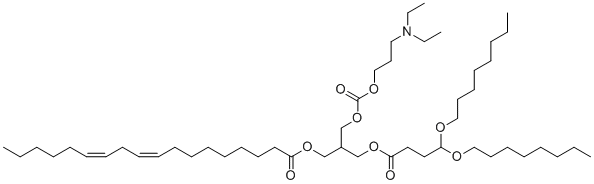 |
| Molecular Formula | C50H93NO9 |
| Molecular Weight | 852.27 |
| CAS Registry Number | 1799316-64-5 |
| SMILES | CCCCCCCCOC(CCC(=O)OCC(COC(=O)CCCCCCC/C=CC/C=CCCCCC)COC(=O)OCCCN(CC)CC)OCCCCCCCC |
| Density | 1.0±0.1 g/cm3, Calc.* |
|---|---|
| Index of Refraction | 1.476, Calc.* |
| Boiling Point | 795.4±60.0 °C (760 mmHg), Calc.* |
| Flash Point | 434.8±32.9 °C, Calc.* |
| * | Calculated using Advanced Chemistry Development (ACD/Labs) Software. |
| Hazard Symbols |  GHS07 Warning Details GHS07 Warning Details |
|---|---|
| Risk Statements | H302-H315-H319 Details |
| Safety Statements | P501-P270-P264-P280-P302+P352-P337+P313-P305+P351+P338-P362+P364-P332+P313-P301+P312+P330 Details |
 chemBlink Chemical Story
|
(9Z,12Z)-3-((4,4-Bis(octyloxy)butanoyl)oxy)-2-((((3-(diethylamino)propoxy)carbonyl)oxy)methyl)propyl octadeca-9,12-dienoate is a complex chemical compound with various functional groups, making it a potential candidate for applications in advanced materials and pharmaceutical fields. The compound contains ester linkages, amide functional groups, and long alkyl chains, all of which contribute to its unique properties, such as solubility, stability, and potential interactions with biological systems. The structure is based on a conjugated dienoate core, which is typical of molecules designed for specific biochemical activity. The discovery of compounds like (9Z,12Z)-3-((4,4-Bis(octyloxy)butanoyl)oxy)-2-((((3-(diethylamino)propoxy)carbonyl)oxy)methyl)propyl octadeca-9,12-dienoate is often driven by the need for new materials or therapeutic agents with tailored properties. The inclusion of octyl and butyl groups in the molecule imparts hydrophobic characteristics, which may enhance its interaction with lipid membranes or its ability to form micelles or liposomes. These types of molecules are particularly useful in drug delivery systems, where controlling the release of active pharmaceutical ingredients is crucial. The presence of ester and amide linkages within the structure of this compound suggests potential use in controlled-release drug delivery. In drug design, ester linkages can be used to modulate the release rate of therapeutic agents by breaking down in the body over time. This compound could therefore be explored in pharmaceutical formulations where slow and sustained release of a drug is needed. The diethylamino group could also suggest some neuroactive properties, as such moieties are often incorporated into compounds with potential central nervous system activity. Furthermore, the conjugated dienoate structure is commonly seen in compounds that exhibit photoreactive properties. The compound may have applications in materials science, particularly in the development of light-sensitive materials or in photodynamic therapy, where compounds are activated by light to produce therapeutic effects. The amphiphilic nature of (9Z,12Z)-3-((4,4-Bis(octyloxy)butanoyl)oxy)-2-((((3-(diethylamino)propoxy)carbonyl)oxy)methyl)propyl octadeca-9,12-dienoate makes it a prime candidate for use in nanotechnology. Molecules with such structures are often utilized in the creation of nanoparticles or liposomes for drug encapsulation and targeted drug delivery. These nanoparticles can be designed to deliver active drugs directly to specific cells or tissues, minimizing side effects and improving treatment efficacy. Due to its combination of hydrophobic and hydrophilic segments, this compound could also be studied for its potential use in forming self-assembled structures, such as micelles or vesicles, which could encapsulate therapeutic agents. These structures have applications in the delivery of poorly soluble drugs or in gene therapy, where controlled release of therapeutic molecules is essential. In conclusion, (9Z,12Z)-3-((4,4-Bis(octyloxy)butanoyl)oxy)-2-((((3-(diethylamino)propoxy)carbonyl)oxy)methyl)propyl octadeca-9,12-dienoate represents a versatile chemical compound with potential applications in drug delivery systems, materials science, and phototherapy. Its structure suggests various promising properties, including controlled release, amphiphilic behavior, and photoreactivity, making it an exciting compound for further exploration in both pharmaceutical and technological fields. |
| Market Analysis Reports |