
Online Database of Chemicals from Around the World
| Targetmol Chemicals Inc. | USA | |||
|---|---|---|---|---|
 | www.targetmol.com | |||
 | +1 (781) 999-5354 | |||
 | +1 (781) 281-9145 | |||
 | sales@targetmol.com | |||
| Chemical manufacturer since 2013 | ||||
| chemBlink Standard supplier since 2025 | ||||
| Classification | Biochemical >> Inhibitor >> Metabolism >> Ferroptosis activator |
|---|---|
| Name | Imidazole ketone erastin |
| Synonyms | 2-[[4-[2-(4-chlorophenoxy)acetyl]piperazin-1-yl]methyl]-3-[5-(2-imidazol-1-ylacetyl)-2-propan-2-yloxyphenyl]quinazolin-4-one |
| Molecular Structure | 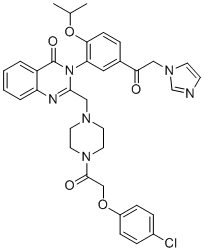 |
| Molecular Formula | C35H35ClN6O5 |
| Molecular Weight | 655.14 |
| CAS Registry Number | 1801530-11-9 |
| SMILES | CC(C)OC1=C(C=C(C=C1)C(=O)CN2C=CN=C2)N3C(=NC4=CC=CC=C4C3=O)CN5CCN(CC5)C(=O)COC6=CC=C(C=C6)Cl |
| Density | 1.3±0.1 g/cm3 Calc.* |
|---|---|
| Boiling point | 886.5±75.0 °C 760 mmHg (Calc.)* |
| Flash point | 489.9±37.1 °C (Calc.)* |
| Index of refraction | 1.659 (Calc.)* |
| * | Calculated using Advanced Chemistry Development (ACD/Labs) Software. |
| Hazard Symbols |  GHS07 Warning Details GHS07 Warning Details |
|---|---|
| Risk Statements | H302-H315-H319-H335 Details |
| Safety Statements | P280-P305+P351+P338 Details |
| SDS | Available |
 chemBlink Chemical Story
|
Imidazole ketone erastin is a synthetic small-molecule derivative of erastin, developed as a potent and selective inducer of ferroptosis, a regulated, iron-dependent form of non-apoptotic cell death characterized by the accumulation of lipid peroxides. This compound emerged from efforts to improve the pharmacokinetic properties and potency of erastin, a compound initially discovered through high-throughput screening for agents that selectively kill tumor cells with oncogenic RAS mutations. The discovery of erastin in the early 2000s led to the identification of ferroptosis as a distinct mechanism of cell death, different from apoptosis, necrosis, and autophagy. Erastin was found to inhibit the cystine/glutamate antiporter system xc−, which blocks the uptake of cystine into the cell, subsequently leading to depletion of intracellular glutathione and loss of activity of the antioxidant enzyme glutathione peroxidase 4 (GPX4). The resulting oxidative stress causes iron-dependent lipid peroxidation and cell death. However, the original erastin compound had limited in vivo utility due to its poor solubility and metabolic stability. To overcome these limitations, researchers synthesized a series of erastin analogs, among which imidazole ketone erastin demonstrated favorable pharmacological properties, including improved metabolic stability, solubility, and in vivo efficacy. The addition of the imidazole ketone moiety was instrumental in enhancing the compound’s stability in biological systems and enabling its systemic administration in preclinical animal models. Imidazole ketone erastin retains the core biological activity of erastin by targeting system xc− and triggering ferroptosis. It has been used in various experimental models to further elucidate the role of ferroptosis in cancer biology, particularly in the context of RAS-driven tumors and those exhibiting sensitivity to redox imbalances. In vitro studies have demonstrated that imidazole ketone erastin effectively induces ferroptosis in cancer cells, with higher potency than the parent compound. In vivo, it has shown antitumor activity in mouse xenograft models, providing a proof of concept for ferroptosis induction as a potential therapeutic strategy. Beyond oncology, imidazole ketone erastin has been employed as a chemical probe in the study of ferroptosis pathways in neurodegeneration, kidney injury, and ischemia-reperfusion injury, where oxidative damage plays a pathogenic role. Its selective mechanism of action has made it a valuable tool in dissecting the molecular underpinnings of ferroptosis and exploring the therapeutic potential of ferroptosis modulation in diverse pathological settings. Imidazole ketone erastin is not approved for clinical use and remains an investigational compound used primarily in academic and preclinical research. It exemplifies the progression from a screening hit to an optimized chemical tool with improved in vivo applicability, illustrating the medicinal chemistry strategies used to translate basic biological findings into potential therapeutic leads. The compound continues to support the growing interest in ferroptosis as a therapeutic target, and its use is expanding in the fields of cancer biology, pharmacology, and redox research. References 2015. Incorporation of metabolically stable ketones into a small molecule probe to increase potency and water solubility. Bioorganic & Medicinal Chemistry Letters, 25(21). DOI: 10.1016/j.bmcl.2015.07.018 2019. Imidazole Ketone Erastin Induces Ferroptosis and Slows Tumor Growth in a Mouse Lymphoma Model. Cell Chemical Biology, 26(5). DOI: 10.1016/j.chembiol.2019.01.008 2022. TNF antagonist sensitizes synovial fibroblasts to ferroptotic cell death in collagen-induced arthritis mouse models. Nature Communications, 13(1). DOI: 10.1038/s41467-021-27948-4 |
| Market Analysis Reports |