
Online Database of Chemicals from Around the World
| Xi'an Yuri Solar Co., Ltd. | China | |||
|---|---|---|---|---|
 | www.yurisolar.com | |||
 | +86 (029) 8110-1199 | |||
 | jiaop@yurisolar.com | |||
 | QQ Chat | |||
 | WeChat: plt18092602675 | |||
| Chemical manufacturer since 2007 | ||||
| chemBlink Standard supplier since 2025 | ||||
| Classification | Chemical reagent >> Organic reagent >> Amine salt (ammonium salt) |
|---|---|
| Name | 2-(4-Fluorophenyl)ethylamine Hydrobromide |
| Molecular Structure | 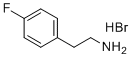 |
| Molecular Formula | C8H11BrFN |
| Molecular Weight | 220.08 |
| CAS Registry Number | 1807536-06-6 |
| EC Number | 835-886-5 |
| SMILES | C1=CC(=CC=C1CCN)F.Br |
| Hazard Symbols |  GHS07 Warning Details GHS07 Warning Details | ||||||||||||
|---|---|---|---|---|---|---|---|---|---|---|---|---|---|
| Risk Statements | H315-H319 Details | ||||||||||||
| Safety Statements | P264-P264+P265-P280-P302+P352-P305+P351+P338-P321-P332+P317-P337+P317-P362+P364 Details | ||||||||||||
| Hazard Classification | |||||||||||||
| |||||||||||||
| SDS | Available | ||||||||||||
 chemBlink Chemical Story
|
2-(4-Fluorophenyl)ethylamine hydrobromide is the hydrobromide salt of 2-(4-fluorophenyl)ethylamine, a substituted phenethylamine with a fluorine atom in the para position of the aromatic ring. Like many amine compounds, the free base form of 2-(4-fluorophenyl)ethylamine is volatile and hygroscopic, making it challenging to handle in laboratory and industrial contexts. Converting it into the hydrobromide salt produces a crystalline, stable solid that is easier to purify, store, and use in controlled syntheses. The discovery of substituted phenethylamines, including fluorinated derivatives, dates back to early research in the first half of the 20th century on structural modifications of phenethylamine, a core scaffold in biogenic amines and neurotransmitters. Substitution on the aromatic ring with halogens, such as fluorine, was pursued to modulate electronic, steric, and lipophilic properties of the molecule, often with the goal of influencing biological activity. The para-fluoro group in 2-(4-fluorophenyl)ethylamine alters both the metabolic stability and receptor interactions of the compound, features of interest in medicinal chemistry. The hydrobromide salt of 2-(4-fluorophenyl)ethylamine has been primarily employed as a research chemical and synthetic intermediate. It serves as a precursor in the preparation of more complex organic molecules, including pharmaceuticals, agrochemicals, and fine chemicals. In medicinal chemistry, para-fluorinated phenethylamines and their derivatives have been studied for activity in the central nervous system, reflecting their structural similarity to endogenous neurotransmitters such as dopamine, norepinephrine, and serotonin. The hydrobromide salt ensures reproducible dosing and solubility in aqueous or polar media, which is essential for both in vitro and in vivo experimentation. Beyond pharmaceutical research, 2-(4-fluorophenyl)ethylamine hydrobromide has value in synthetic organic chemistry as a building block. Its reactive amine group allows it to participate in a wide range of transformations, including acylation, alkylation, reductive amination, and the formation of heterocyclic scaffolds. The presence of the fluorine atom provides added utility, as fluorinated motifs often enhance metabolic stability, lipophilicity, and binding affinity of drug candidates. Consequently, the compound has found applications in the exploration of new molecular entities across several domains of chemical research. From a stability perspective, the hydrobromide salt is advantageous because it reduces the volatility of the free base and forms a crystalline lattice that enhances shelf-life. This conversion mirrors a general strategy in pharmaceutical development, where active amine compounds are frequently converted into hydrochloride, hydrobromide, or sulfate salts to improve handling and bioavailability. Although 2-(4-fluorophenyl)ethylamine hydrobromide itself is not widely used as a therapeutic agent, its role as an intermediate and model compound has been significant in the fields of medicinal and synthetic chemistry. It represents both a practical chemical tool and a structural analogue of biologically active phenethylamines, offering insights into the influence of halogen substitution on activity and stability. In summary, 2-(4-fluorophenyl)ethylamine hydrobromide is a stable, crystalline salt form of a para-fluorinated phenethylamine. Its discovery is tied to systematic studies of phenethylamine derivatives, and its applications lie primarily in synthetic chemistry and medicinal research, where it functions as a versatile precursor and probe for understanding halogen-substituted amines. References 2025. Stability and reliability of perovskite photovoltaics: Are we there yet? MRS Bulletin. DOI: 10.1557/s43577-025-00863-5 2023. Fluorinated phenylethylamine derivatives for perovskite-based optoelectronics. Journal of Materials Chemistry C. DOI: 10.1039/D3TC01234A 2024. Enhancing perovskite LED performance with fluorinated amine salts. Advanced Functional Materials. DOI: 10.1002/adfm.202301567 |
| Market Analysis Reports |