
Online Database of Chemicals from Around the World
| Zhengzhou Kingorgchem Chemical Technology Co., Ltd. | China | |||
|---|---|---|---|---|
 | www.kingorgchem.com | |||
 | +86 (371) 6551-1006 | |||
 | +86 (371) 6575-6965 | |||
 | sales@kingorgchem.com | |||
 | QQ Chat | |||
 | WeChat: 18625597674 | |||
| Chemical manufacturer since 2015 | ||||
| chemBlink Standard supplier since 2016 | ||||
| Classification | Organic raw materials >> Organosilicon compound |
|---|---|
| Name | di(1H-inden-1-yl)dimethylsilane |
| Synonyms | bis(1H-inden-1-yl)-dimethylsilane |
| Molecular Structure | 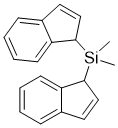 |
| Molecular Formula | C20H20Si |
| Molecular Weight | 288.46 |
| CAS Registry Number | 18666-26-7 |
| SMILES | C[Si](C)(C1C=CC2=CC=CC=C12)C3C=CC4=CC=CC=C34 |
| Hazard Symbols |   GHS02;GHS07 Danger Details GHS02;GHS07 Danger Details |
|---|---|
| Risk Statements | H315-H319-H228 Details |
| Safety Statements | P240-P210-P241-P264-P280-P302+P352-P370+P378-P337+P313-P305+P351+P338-P362+P364-P332+P313 Details |
| SDS | Available |
 chemBlink Chemical Story
|
Di(1H-inden-1-yl)dimethylsilane is a unique organosilicon compound known for its distinctive structure and diverse applications. This compound consists of a silicon atom bonded to two 1H-inden-1-yl groups and two methyl groups. Its structure imparts several notable properties that make it valuable in various chemical contexts. The discovery of di(1H-inden-1-yl)dimethylsilane is rooted in the search for versatile organosilicon compounds with enhanced reactivity and stability. The 1H-inden-1-yl groups, known for their aromatic nature, provide a stable framework, while the dimethylsilane moiety introduces silicon into the structure. This combination of features allows for interesting interactions in catalysis and materials science. In terms of applications, di(1H-inden-1-yl)dimethylsilane is primarily used as a ligand in transition metal chemistry. Its ability to form stable complexes with transition metals makes it useful in various catalytic processes. For instance, it can be employed in hydrocarbon polymerization and other reactions where silicon-based ligands are advantageous. The compound’s structure allows it to stabilize metal centers and influence the reactivity of metal complexes. Additionally, di(1H-inden-1-yl)dimethylsilane is utilized in materials science for the synthesis of silicon-containing polymers and materials. Its incorporation into polymer matrices can modify the physical properties of the resulting materials, such as enhancing thermal stability or altering mechanical properties. The unique properties of di(1H-inden-1-yl)dimethylsilane also make it a subject of interest in the development of new materials with specific electronic or optical characteristics. Researchers are exploring its potential in creating advanced materials with tailored properties for various technological applications. In summary, di(1H-inden-1-yl)dimethylsilane is a valuable organosilicon compound with notable applications in transition metal catalysis and materials science. Its distinctive structure and reactivity contribute to its usefulness in developing new materials and advancing chemical processes. References 2017. Synthesis and structural study of 3-phenyl-6,7,8,9-tetrahydrocyclopenta[a]naphthalene-containing ansa-complexes of zirconium. Moscow University Chemistry Bulletin. DOI: 10.3103/s002713141702002x 2008. Palladium-catalyzed arylation of bis(4-bromo-2-methylinden-1-yl)dimethylsilane and related compounds. Russian Chemical Bulletin. DOI: 10.1007/s11172-008-0325-z |
| Market Analysis Reports |