
Online Database of Chemicals from Around the World
| Beijing Eagle Sky Pharmatech Co., Ltd. | China | |||
|---|---|---|---|---|
 | www.eagleskypharmatech.com | |||
 | +86 (10) 5979-9429 8875-5821 | |||
 | +86 (10) 5804-3698 | |||
 | sophia_818@126.com contact@eagleskypharmatech.com | |||
 | QQ Chat | |||
| Chemical manufacturer since 2009 | ||||
| chemBlink Premium supplier since 2010 | ||||
| Classification | Biochemical >> Peptide |
|---|---|
| Name | Eptifibatide |
| Synonyms | N6-(Aminoiminomethyl)-N2-(3-mercapto-1-oxopropyl)-L-lysylglycyl-L-alpha-aspartyl-L-tryptophyl-L-prolyl-L-cysteinamide cyclic (1→6)-disulfide; Integrelin; Integrilin; Intrifiban |
| Molecular Structure | 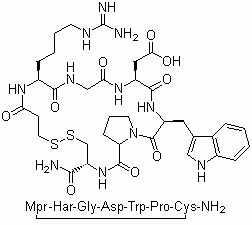 |
| Molecular Formula | C35H49N11O9S2 |
| Molecular Weight | 831.96 |
| Protein Sequence | CXGDWPC |
| CAS Registry Number | 188627-80-7 (148031-34-9) |
| EC Number | 641-366-7 |
| SMILES | C1C[C@H]2C(=O)N[C@@H](CSSCCC(=O)N[C@H](C(=O)NCC(=O)N[C@H](C(=O)N[C@H](C(=O)N2C1)CC3=CNC4=CC=CC=C43)CC(=O)O)CCCCN=C(N)N)C(=O)N |
| Density | 1.6±0.1 g/cm3 Calc.* |
|---|---|
| Solubility | DMSO: 32 mg/mL (Expl.) |
| Index of refraction | 1.735 (Calc.)* |
| * | Calculated using Advanced Chemistry Development (ACD/Labs) Software. |
| Hazard Symbols |  GHS08 Danger Details GHS08 Danger Details | ||||||||||||
|---|---|---|---|---|---|---|---|---|---|---|---|---|---|
| Risk Statements | H370-H373 Details | ||||||||||||
| Safety Statements | P260-P264-P270-P308+P316-P319-P321-P405-P501 Details | ||||||||||||
| Hazard Classification | |||||||||||||
| |||||||||||||
| SDS | Available | ||||||||||||
 chemBlink Chemical Story
|
Eptifibatide is a synthetic cyclic heptapeptide antiplatelet drug that functions as a selective and reversible inhibitor of the platelet glycoprotein IIb/IIIa receptor. It was developed by COR Therapeutics and is marketed under the trade name Integrilin. The compound was designed by mimicking a peptide recognition motif found in barbourin, a disintegrin protein originally isolated from the venom of the southeastern pygmy rattlesnake (Sistrurus miliarius barbouri). Eptifibatide occupies the fibrinogen‑binding site on the activated glycoprotein IIb/IIIa receptor on platelets, preventing fibrinogen and von Willebrand factor from binding. This blockade inhibits the final common pathway of platelet aggregation, thus reducing the formation of platelet‑rich thrombi in the arterial circulation. Unlike some earlier antiplatelet agents, the inhibition of platelet aggregation by eptifibatide is rapidly reversible upon discontinuation of drug administration, which is clinically advantageous in procedures where control of bleeding risk is necessary. The clinical development of eptifibatide included several key trials that established its efficacy and safety profile in patients with acute coronary syndromes (ACS) and those undergoing percutaneous coronary intervention (PCI). In the Platelet Glycoprotein IIb/IIIa in Unstable Angina: Receptor Suppression Using Integrilin Therapy (PURSUIT) trial, eptifibatide administered as an intravenous bolus followed by continuous infusion significantly reduced the incidence of death or nonfatal myocardial infarction at 30 days compared with placebo when added to standard therapy with aspirin and heparin in patients presenting with unstable angina or non‑ST‑segment elevation myocardial infarction (NSTEMI). The benefit was observed early and persisted throughout the follow‑up period. Eptifibatide has also been evaluated in the context of PCI to prevent periprocedural ischemic complications. Trials such as IMPACT‑II (Integrilin to Minimize Platelet Aggregation and Coronary Thrombosis) demonstrated that adjunctive administration of eptifibatide reduced the incidence of ischemic adverse outcomes, including urgent target vessel revascularization and acute coronary events, without a disproportionate increase in serious bleeding complications compared with placebo. Other studies, such as ESPRIT (Enhanced Suppression of the Platelet IIb/IIIa Receptor with Integrilin Therapy), showed that a double‑bolus regimen of eptifibatide followed by infusion reduced composite endpoints including death, myocardial infarction, or urgent revascularization in patients undergoing stent implantation. Eptifibatide’s clinical use is usually confined to hospital settings and is commonly co‑administered with aspirin and heparin or other anticoagulants as part of comprehensive antithrombotic therapy. The pharmacokinetic and pharmacodynamic profile of eptifibatide contributes to its clinical utility. It is administered intravenously, achieving rapid onset of platelet inhibition within minutes. The plasma half‑life is relatively short, allowing platelet function to recover soon after cessation of the infusion. This reversibility distinguishes it from some other glycoprotein IIb/IIIa inhibitors and is beneficial when balancing antithrombotic efficacy with bleeding risk. Nonetheless, as with all potent antiplatelet agents, careful patient selection and monitoring are essential, particularly with respect to bleeding risk and renal function, since eptifibatide is cleared, in part, via the kidneys. Beyond ACS and PCI, eptifibatide has been investigated in other clinical contexts. For example, studies have explored its potential effects in reducing inflammation and thrombosis in peripheral vascular interventions and other vascular procedures, although its routine use in these settings remains limited and further evidence is required. While newer antiplatelet agents and combination therapies have emerged, eptifibatide remains a valuable model of peptide‑based targeted therapy that demonstrates how specific inhibition of a key receptor in platelet aggregation can translate into improved clinical outcomes in acute cardiovascular care. References Platelet Glycoprotein IIb/IIIa in Unstable Angina: Receptor Suppression Using Integrilin Therapy (PURSUIT) Trial Investigators (1998) Inhibition of platelet glycoprotein IIb/IIIa with eptifibatide in patients with acute coronary syndromes. New England Journal of Medicine 339(7) 436–443 DOI: 10.1056/NEJM199808133390704 O’Shea JC, Tcheng JE (2002) Eptifibatide: a potent inhibitor of the platelet receptor integrin glycoprotein IIb/IIIa. Expert Opinion on Pharmacotherapy 3(8) 1199–1210 DOI: 10.1517/14656566.3.8.1199 O’Shea JC, Buller CE, Cantor WJ, Chandler AB, Cohen EA, Cohen DJ, et al. (2002) Long‑term efficacy of platelet glycoprotein IIb/IIIa integrin blockade with eptifibatide in coronary stent intervention. JAMA 287(5) 618–621 DOI: 10.1001/jama.287.5.618 |
| Market Analysis Reports |