
Online Database of Chemicals from Around the World
| Shandong Chenghui Shuangda Pharmaceutical Co., Ltd. | China | |||
|---|---|---|---|---|
 | www.chsdpharma.com | |||
 | +86-531-58897029 | |||
 | ericqiao@jnchsd.com | |||
 | QQ Chat | |||
 | WeChat: 15550412551 | |||
 | WhatsApp:15550412551 | |||
| Chemical manufacturer since 2014 | ||||
| chemBlink Standard supplier since 2025 | ||||
| Classification | Biochemical >> Inhibitor >> Transmembrane transporters >> Proton pump inhibitor |
|---|---|
| Name | Abeprazan hydrochloride |
| Synonyms | 1-[5-(2,4-difluorophenyl)-1-(3-fluorophenyl)sulfonyl-4-methoxypyrrol-3-yl]-N-methylmethanamine hydrochloride |
| Molecular Structure | 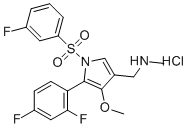 |
| Molecular Formula | C19H18ClF3N2O3S |
| Molecular Weight | 446.87 |
| CAS Registry Number | 1902954-87-3 |
| SMILES | CNCC1=CN(C(=C1OC)C2=C(C=C(C=C2)F)F)S(=O)(=O)C3=CC=CC(=C3)F.Cl |
| Hazard Symbols |  GHS07 Warning Details GHS07 Warning Details |
|---|---|
| Risk Statements | H302-H315-H319 Details |
| Safety Statements | P501-P270-P264-P280-P302+P352-P337+P313-P305+P351+P338-P362+P364-P332+P313-P301+P312+P330 Details |
| SDS | Available |
 chemBlink Chemical Story
|
Abeprazan hydrochloride is a potassium-competitive acid blocker (P-CAB) developed for the treatment of acid-related gastrointestinal disorders. It represents a newer class of drugs that inhibit the gastric H+,K+-ATPase enzyme system in a reversible, potassium-competitive manner. This mechanism differs fundamentally from that of traditional proton pump inhibitors (PPIs), which require acid activation and covalently bind to the enzyme. Abeprazan hydrochloride does not require acid activation, allowing for a faster onset of action and more stable control of gastric acid secretion. The development of abeprazan hydrochloride was driven by the need for therapeutic agents that provide more consistent acid suppression and fewer dietary or dosing restrictions than PPIs. Early research and clinical development took place in South Korea, where the compound was synthesized and investigated for its pharmacodynamic properties. Its ability to maintain elevated gastric pH levels over 24 hours has been confirmed in comparative clinical trials, showing a more predictable and potent acid suppression profile than conventional PPIs. Abeprazan hydrochloride is used primarily in the treatment of gastroesophageal reflux disease (GERD), peptic ulcers, and other acid-related conditions. The compound’s pharmacokinetic profile supports once-daily dosing, contributing to improved patient adherence. It reaches peak plasma concentration quickly, and its action is not dependent on meal timing, unlike many PPIs that must be taken before meals to ensure efficacy. Clinical studies have shown that abeprazan hydrochloride offers rapid symptom relief and mucosal healing in patients with erosive esophagitis and non-erosive reflux disease. Its acid suppression begins within hours of the first dose and maintains consistent gastric pH elevation over a 24-hour period. These results have positioned the drug as a useful alternative for patients who experience delayed relief or incomplete response to PPIs. The approval of abeprazan hydrochloride for clinical use was granted in South Korea under the trade name "K-CAB®". Since its approval, it has been incorporated into treatment guidelines for acid-related diseases within its country of origin. Its favorable safety profile, combined with its ease of administration and rapid therapeutic effects, has supported its growing use in clinical practice. Abeprazan hydrochloride is also being studied for its potential role in the treatment of Helicobacter pylori infection, where it may improve eradication rates when used in combination therapy with antibiotics. Its strong and consistent acid suppression helps maintain an environment conducive to antibiotic efficacy, which is critical in H. pylori treatment protocols. The compound has also been evaluated for long-term management of GERD and related conditions, with studies indicating sustained efficacy and tolerability over extended treatment periods. In conclusion, abeprazan hydrochloride represents a significant advancement in the pharmacologic management of acid-related disorders. Its distinct mechanism as a P-CAB offers advantages over traditional PPIs, particularly in terms of onset of action and meal-independent administration. The drug continues to be explored in broader clinical applications, including combination regimens and maintenance therapy, affirming its role in the evolving landscape of gastroenterological therapeutics. |
| Market Analysis Reports |