
Online Database of Chemicals from Around the World
| Epochem Co., Ltd. | China | |||
|---|---|---|---|---|
 | www.epochem.com | |||
 | +86 (21) 6760-1595 6760-1597 | |||
 | +86 (21) 6760-1605 | |||
 | seth_wang@epochem.com | |||
 | QQ Chat | |||
| Chemical manufacturer since 2006 | ||||
| chemBlink Standard supplier since 2005 | ||||
| Simagchem Corporation | China | |||
|---|---|---|---|---|
| www.simagchem.com | |||
| +86 13806087780 | |||
| +86 (592) 268-0237 | |||
| sale@simagchem.com | |||
| Chemical manufacturer since 2002 | ||||
| chemBlink Standard supplier since 2008 | ||||
| ABA Chemicals (Shanghai) Limited | China | |||
|---|---|---|---|---|
| www.abachem.com | |||
| +86 (21) 5115-9199 | |||
| +86 (21) 5115-9188 | |||
| rimondlong@abachem.com sales@abachem.com | |||
| Chemical manufacturer since 2006 | ||||
| chemBlink Standard supplier since 2009 | ||||
| Hefei TNJ Chemical Industry Co., Ltd. | China | |||
|---|---|---|---|---|
| www.tnjchem.com | |||
| +86 (551) 6541-8684 | |||
| +86 (551) 6541-8697 | |||
| sales@tnjchem.com | |||
| Chemical manufacturer since 2001 | ||||
| chemBlink Standard supplier since 2010 | ||||
| BOC Sciences | USA | |||
|---|---|---|---|---|
| www.bocsci.com | |||
| +1 (631) 485-4226 | |||
| +1 (631) 614-7828 | |||
| info@bocsci.com | |||
| Chemical manufacturer | ||||
| chemBlink Standard supplier since 2010 | ||||
| Zhejiang Aofutuo Chemical Co., Ltd. | China | |||
|---|---|---|---|---|
| www.aftchem.com | |||
| +86 (21) 3872-2060 +86 13621929207 | |||
| +86 (21) 3872-2061 | |||
| guxp@bi-jing.com zhaojinw@263.net | |||
| QQ Chat | |||
| Chemical manufacturer since 1993 | ||||
| chemBlink Standard supplier since 2011 | ||||
| Jiangsu Zhongbang Pharmaceutical Co., Ltd. | China | |||
|---|---|---|---|---|
| www.zhbpharm.com | |||
| +86 (25) 8715-1996 +86 18013378039 | |||
| +86 (25) 8715-1970 | |||
| sales@chinaredsun.com | |||
| QQ Chat | |||
| Chemical manufacturer since 2001 | ||||
| chemBlink Standard supplier since 2014 | ||||
| Hangzhou Leap Chem Co., Ltd. | China | |||
|---|---|---|---|---|
| www.leapchem.com | |||
| +86 (571) 8771-1850 | |||
| market19@leapchem.com | |||
| QQ Chat | |||
| Chemical manufacturer since 2006 | ||||
| chemBlink Standard supplier since 2015 | ||||
| Shandong Huimeng Biotech Co., Ltd. | China | |||
|---|---|---|---|---|
| www.huimengchem.com | |||
| +86 (530) 884-2888 +86 18523002917 | |||
| +86 (530) 884-2666 | |||
| cindy@szgoldenunion.com | |||
| Chemical manufacturer since 2013 | ||||
| chemBlink Standard supplier since 2016 | ||||
| Neostar United (Changzhou) Industrial Co., Ltd. | China | |||
|---|---|---|---|---|
| www.neostarunited.com | |||
| +86 (519) 8555-7386 +86 18015025600 | |||
| +86 (519) 8555-7389 | |||
| marketing1@neostarunited.com | |||
| Chemical distributor since 2014 | ||||
| chemBlink Standard supplier since 2020 | ||||
| Molekula Ltd | UK | |||
|---|---|---|---|---|
| www.molekula.com | |||
| +44 (1747) 831-066 | |||
| +44 (1747) 831-199 | |||
| info@molekula.com | |||
| Chemical manufacturer | ||||
| Crescent Chemical Co. Inc. | USA | |||
|---|---|---|---|---|
| www.crescentchemical.com | |||
| +1 (631) 348-0333 | |||
| +1 (631) 348-0913 | |||
| crescent@creschem.com | |||
| Chemical distributor | ||||
| AccuStandard Inc. | USA | |||
|---|---|---|---|---|
| www.accustandard.com | |||
| +1 (203) 786-5290 | |||
| +1 (203) 786-5287 | |||
| orders@accustandard.com | |||
| Chemical manufacturer since 1986 | ||||
| Wako Pure Chemical Industries, Ltd. | Japan | |||
|---|---|---|---|---|
| www.wako-chem.co.jp | |||
| +81 (6) 6203-3741 | |||
| +81 (6) 6201-5964 | |||
| wkhk.info@fujifilm.com | |||
| Chemical manufacturer since 1922 | ||||
| Shanghai Worldyang Chemical Co., Ltd. | China | |||
|---|---|---|---|---|
| www.worldyachem.com | |||
| +86 13651600618 +86 (21) 5679-5779 | |||
| +86 (21) 5679-5266 | |||
| sales7777@worldyachem.com | |||
| QQ Chat | |||
 | WeChat: 13651600618 | |||
 | WhatsApp:+86 13651600618 | |||
| Chemical manufacturer since 2012 | ||||
| Kingchem Inc. | USA | |||
|---|---|---|---|---|
| www.kingchem.com | |||
| +1 (800) 211-4330 (201) 825-9988 | |||
| +1 (201) 825-9148 | |||
| customer-service@kingchem.com | |||
| Chemical manufacturer since 1994 | ||||
| Classification | Pharmaceutical intermediate >> Heterocyclic compound intermediate >> Pyridine compound >> Methylpyridine |
|---|---|
| Name | Nitrapyrin |
| Synonyms | 2-Chloro-6-(trichloromethyl)pyridine |
| Molecular Structure | 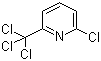 |
| Molecular Formula | C6H3Cl4N |
| Molecular Weight | 230.91 |
| CAS Registry Number | 1929-82-4 |
| EC Number | 217-682-2 |
| SMILES | C1=CC(=NC(=C1)Cl)C(Cl)(Cl)Cl |
| Melting point | 62-63 °C |
|---|---|
| Boiling point | 136-138 °C |
| Water solubility | Insoluble. <0.01 g/100 mL at 18 °C |
| Hazard Symbols |   GHS07;GHS09 Warning Details GHS07;GHS09 Warning Details | ||||||||||||||||||||||||||||||||||||||||
|---|---|---|---|---|---|---|---|---|---|---|---|---|---|---|---|---|---|---|---|---|---|---|---|---|---|---|---|---|---|---|---|---|---|---|---|---|---|---|---|---|---|
| Risk Statements | H302-H411 Details | ||||||||||||||||||||||||||||||||||||||||
| Safety Statements | P260-P261-P264-P264+P265-P270-P272-P273-P280-P301+P317-P302+P352-P305+P351+P338-P319-P321-P330-P333+P317-P337+P317-P362+P364-P391-P501 Details | ||||||||||||||||||||||||||||||||||||||||
| Hazard Classification | |||||||||||||||||||||||||||||||||||||||||
| |||||||||||||||||||||||||||||||||||||||||
| Transport Information | UN 2811 | ||||||||||||||||||||||||||||||||||||||||
| SDS | Available | ||||||||||||||||||||||||||||||||||||||||
 chemBlink Chemical Story
|
Nitropyridine, a compound with the chemical formula C6H3Cl2N, is widely known for its role as a nitrification inhibitor in agricultural practices. This compound has had a significant impact on modern agriculture by increasing nitrogen use efficiency and reducing environmental pollution. The discovery of nitropyridine dates back to the mid-20th century, when the agricultural industry was looking for solutions to increase crop yields and reduce nitrogen losses. Nitrogen is a key nutrient for plant growth, but its efficient use in agriculture is often challenged by nitrification, a microbial process that converts ammonium (NH4+) to nitrate (NO3-). Nitrate is highly mobile in soil and can seep into groundwater or be lost as nitrous oxide (N2O), a potent greenhouse gas. Researchers have found that nitropyridine is an effective nitrification inhibitor that stabilizes ammonium in soil and reduces these losses. Nitropyridine works by inhibiting the activity of nitrosating bacteria, which are responsible for the first step of nitrification: the oxidation of ammonium to nitrite (NO2-). By slowing down this microbial process, nitropyridine helps maintain higher ammonium levels in the soil for longer periods of time. This long-term availability of ammonium allows plants to take up nitrogen more efficiently, which improves growth and yield. In addition, by reducing the conversion of ammonium to nitrates, nitropyridine minimizes the risk of nitrogen leaching and nitrous oxide emissions, which helps achieve more sustainable agricultural practices. The main application of nitropyridine is in formulating nitrogen fertilizers. It is often used with anhydrous ammonia, urea, and other ammonium-based fertilizers. When applied to fields, nitropyridine ensures that the majority of the applied nitrogen is retained in a form that is readily available for plant uptake. This increased efficiency means that farmers can achieve similar or better crop yields with less fertilizer, reducing costs and environmental impact. The benefits of nitropyridine are not limited to improving nitrogen use efficiency. By stabilizing ammonium in the soil, nitropyridine helps prevent soil acidification caused by excessive use of nitrogen fertilizers. This stabilization promotes a healthier soil ecosystem and can improve the long-term productivity of farmland. Despite its many advantages, nitropyridine's use is not without concerns. The compound needs to be managed carefully to avoid potential negative impacts on non-target soil microorganisms and to ensure that it does not persist in the environment longer than necessary. Regulatory agencies have established guidelines for the safe use of nitropyridines to mitigate these concerns and ensure that they provide benefits without adverse environmental impacts. In addition to agricultural applications, nitropyridines have been studied for their potential use in other areas. For example, their ability to inhibit nitrification has important implications for wastewater treatment, where controlling nitrogen levels is critical to preventing eutrophication of aquatic systems. However, their primary and most impactful use remains in agriculture, where they continue to play a key role in promoting sustainable agricultural practices. References 2023. Are nitrification inhibitors effective in reducing N2O from farm-scale emission hotspots?. Nutrient Cycling in Agroecosystems, 127(3). DOI: 10.1007/s10705-023-10322-9 2023. Biochar with nitrapyrin reduces ammonia volatilization and increases nitrogen use efficiency of cabbage: A 15N tracer study. Plant and Soil, 495(1-2). DOI: 10.1007/s11104-023-06448-y 1965. THE EFFECT OF 2-CHLORO, 6-(TRICHLOROMETHYL) PYRIDINE ON THE CHEMOAUTOTROPHIC METABOLISM OF NITRIFYING BACTERIA. I. AMMONIA AND HYDROXYLAMINE OXIDATION BY NITROSOMONAS. Antonie van Leeuwenhoek, 31(1). DOI: 10.1007/bf02045882 |
| Market Analysis Reports |