
Online Database of Chemicals from Around the World
| Jiangsu Juming Chemical Technology Co., Ltd. | China | |||
|---|---|---|---|---|
 | en.jmchemchina.com | |||
 | +86 17798763151 | |||
 | admin@jumingchem.com | |||
| Chemical manufacturer since 2017 | ||||
| chemBlink Standard supplier since 2026 | ||||
| Classification | Chemical reagent >> Organic reagent >> Aromatic hydrocarbon reagent |
|---|---|
| Name | C-chloro-C-methyl-1H-Benzotriazole sodium salt (1:1) |
| Synonyms | 4-Chloro-5-methylbenzotriazole sodium salt |
| Molecular Structure | 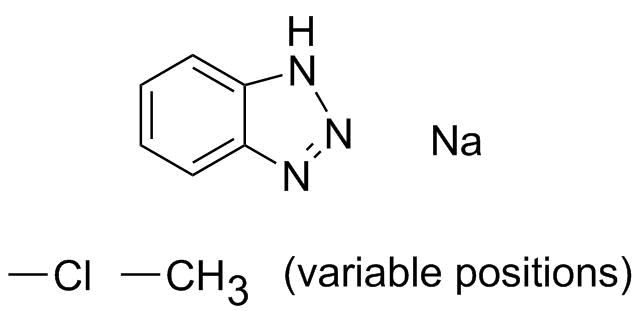 |
| Molecular Formula | C7H6ClN3 .Na |
| Molecular Weight | 607.63 |
| CAS Registry Number | 202420-04-0 |
| EC Number | 427-730-6 |
| Hazard Symbols |  GHS05 Danger Details GHS05 Danger Details |
|---|---|
| Risk Statements | H314-H412 Details |
| Safety Statements | P260-P264-P273-P280-P301+P330+P331-P302+P361+P354-P304+P340-P305+P354+P338-P316-P321-P363-P405-P501 Details |
 chemBlink Chemical Story
|
CAS 202420-04-0 is recorded as a sodium salt of a chloro-methyl-substituted benzotriazole system. Public identity records are somewhat complicated because commercial material can be associated with positional isomers or reaction masses, so the safest description is the registry name rather than assigning one unique ring position without analytical evidence. What is clear is that the substance belongs to the benzotriazole family, one of the classic classes of corrosion inhibitors for copper and copper alloys. Benzotriazole became important in corrosion science because protection does not require a thick paint-like barrier. The heterocycle contains several nitrogen atoms capable of interacting with copper surfaces. Adsorption and coordination lead to a very thin copper-benzotriazole-containing interfacial film that suppresses the electrochemical reactions responsible for corrosion. The exact composition and structure of that film depend on oxidation state, potential, pH and solution chemistry, and the mechanistic literature includes several models rather than one universally simple species. Substitution on the benzotriazole ring provides a way to tune practical behavior. Methylbenzotriazoles, often called tolyltriazoles when supplied as isomer mixtures, are widely used as copper corrosion inhibitors in aqueous industrial systems. Converting an acidic triazole form into a sodium salt improves handling and incorporation into water-based formulations. CAS 202420-04-0 adds chlorine and methyl substitution to that general benzotriazole framework, while retaining the nitrogen-rich ring responsible for metal-surface interaction. Regulatory identity data deserve attention here. ECHA lists CAS 202420-04-0 in its substance information system, while PubChem aggregates records that describe the material as a reaction mass of several chloro-methylbenzotriazole sodium salts. Other commercial databases give a simpler formula corresponding to a single chloro-methylbenzotriazole sodium salt. This difference is a reminder that industrial substances are not always represented by one perfectly isolated constitutional isomer. The chemical story is nevertheless coherent. A small aromatic heterocycle can protect a macroscopic metal object by organizing itself at an interface only molecules thick. The sodium counterion helps deliver the inhibitor through aqueous media; the benzotriazole nitrogens provide the affinity for copper; substituents adjust properties of the inhibitor and its formulation. Corrosion protection here is therefore a surface-coordination problem rather than simply a matter of coating thickness. References: 1. ECHA Substance Information, CAS 202420-04-0. 2. PubChem, 1H-Benzotriazole, C-chloro-C-methyl-, sodium salt (1:1). 3. Finšgar M, Milošev I. Inhibition of copper corrosion by 1,2,3-benzotriazole: a review. Corros Sci. 2010;52:2737-2749. DOI: 10.1016/j.corsci.2010.05.002. |
| Market Analysis Reports |