
Online Database of Chemicals from Around the World
| Simagchem Corporation | China | |||
|---|---|---|---|---|
 | www.simagchem.com | |||
 | +86 13806087780 | |||
 | +86 (592) 268-0237 | |||
 | sale@simagchem.com | |||
| Chemical manufacturer since 2002 | ||||
| chemBlink Standard supplier since 2008 | ||||
| Colourise Industries | India | |||
|---|---|---|---|---|
| www.colourise.in | |||
| +91 (79) 2685-3684 2685-7684 | |||
| +91 (79) 2685-7684 | |||
| info@colourise.in | |||
| Chemical manufacturer since 1978 | ||||
| chemBlink Standard supplier since 2010 | ||||
| Alfa Chemistry | USA | |||
|---|---|---|---|---|
| www.alfa-chemistry.com | |||
| +1 (201) 478-8534 | |||
| +1 (516) 927-0118 | |||
| inquiry@alfa-chemistry.com | |||
| Chemical distributor since 2012 | ||||
| chemBlink Standard supplier since 2012 | ||||
| Shen Zhen Reagent Biotechnology Co., Ltd. | China | |||
|---|---|---|---|---|
| www.haoreagent.com | |||
| +86 (755) 8945-9231 | |||
| sales@haoreagent.com | |||
| Chemical distributor since 2016 | ||||
| chemBlink Standard supplier since 2024 | ||||
| Classification | Dyes and pigments >> Dyes >> Reactive dye (reactive dye) |
|---|---|
| Name | Reactive Orange 16 |
| Synonyms | 6-(Acetylamino)-4-hydroxy-3-[[4-[[2-(sulfooxy)ethyl]sulfonyl]phenyl]azo]-2-naphthalenesulfonic acid disodium salt |
| Molecular Structure | 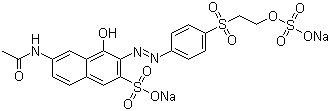 |
| Molecular Formula | C20H17N3O11S3.2Na |
| Molecular Weight | 617.53 |
| CAS Registry Number | 20262-58-2 (12225-88-6) |
| EC Number | 243-653-9 |
| SMILES | CC(=O)NC1=CC2=C(C(=C(C=C2C=C1)S(=O)(=O)[O-])N=NC3=CC=C(C=C3)S(=O)(=O)CCOS(=O)(=O)[O-])O.[Na+].[Na+] |
| Hazard Symbols |   GHS07;GHS08 Danger Details GHS07;GHS08 Danger Details | ||||||||||||||||||||||||||||
|---|---|---|---|---|---|---|---|---|---|---|---|---|---|---|---|---|---|---|---|---|---|---|---|---|---|---|---|---|---|
| Risk Statements | H317-H319-H334-H335 Details | ||||||||||||||||||||||||||||
| Safety Statements | P233-P260-P261-P264+P265-P271-P272-P280-P284-P302+P352-P304+P340-P305+P351+P338-P319-P321-P333+P317-P337+P317-P342+P316-P362+P364-P403-P403+P233-P405-P501 Details | ||||||||||||||||||||||||||||
| Hazard Classification | |||||||||||||||||||||||||||||
| |||||||||||||||||||||||||||||
 chemBlink Chemical Story
|
Reactive Orange 16 is a synthetic dye that emerged in the late 20th century and is widely utilized for its vibrant orange color and strong reactivity with fibers. It is part of the reactive dye class, characterized by its ability to form covalent bonds with textile fibers, leading to bright and durable colors. The primary application of Reactive Orange 16 is in the textile industry, where it is employed to dye natural fibers such as cotton and wool, as well as synthetic fibers like polyester and nylon. Its reactive nature allows it to create a strong chemical bond with the fiber molecules, resulting in intense and long-lasting hues. This makes Reactive Orange 16 a preferred choice for dyeing a variety of textile products, including apparel, home textiles, and upholstery. The dye’s excellent wash-fastness and light-fastness ensure that the color remains vibrant and stable even after multiple washes and prolonged exposure to light. In addition to textiles, Reactive Orange 16 is used in the paper industry to color various paper products. Its ability to adhere to paper fibers effectively makes it suitable for producing colorful specialty papers and packaging materials. The dye contributes to the aesthetic appeal of paper goods, enhancing their visual impact and marketability. Reactive Orange 16 also finds applications in the field of molecular biology and biochemistry. It is used as a staining agent in laboratory techniques, such as gel electrophoresis, where it aids in visualizing biomolecules like proteins and nucleic acids. The dye’s staining properties help researchers to analyze and interpret experimental results with greater clarity and accuracy. Despite its beneficial uses, the application of Reactive Orange 16 must be managed with attention to environmental and safety considerations. As with many synthetic dyes, there are ongoing efforts to monitor its environmental impact and explore safer alternatives. References 2019. A novel sorbent Ulva lactuca-derived biochar for remediation of Remazol Brilliant Orange 3R in packed column. Water Environment Research, 91(7). DOI: 10.1002/wer.1092 2014. Nanostructure Cu-Zn mixed-oxide supported photocatalyst fabricated by impregnation method for the photocatalytic degradation of C.I. Reactive Orange 16 (V3R) in water. Spectrochimica Acta. Part A, Molecular and Biomolecular Spectroscopy, 126. DOI: 10.1016/j.saa.2014.01.079 2009. Influence of organic and inorganic compounds on oxidoreductive decolorization of sulfonated azo dye C.I. Reactive Orange 16. Journal of Hazardous Materials, 172(2-3). DOI: 10.1016/j.jhazmat.2009.07.008 |
| Market Analysis Reports |