
Online Database of Chemicals from Around the World
| Qingdao Lilai Fine Chemical Co., Ltd. | China | |||
|---|---|---|---|---|
 | www.lilaichem.com | |||
 | +86 (532) 8676-7976 | |||
 | +86 (532) 8676-7976 | |||
 | sales@lilaichem.com | |||
| Chemical manufacturer | ||||
| chemBlink Standard supplier since 2010 | ||||
| Classification | Organic raw materials >> Carboxylic compounds and derivatives >> Carboxylic esters and their derivatives |
|---|---|
| Name | Diethyl suberate |
| Molecular Structure | 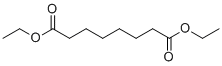 |
| Molecular Formula | C12H22O4 |
| Molecular Weight | 230.30 |
| CAS Registry Number | 2050-23-9 |
| EC Number | 218-084-4 |
| SMILES | CCOC(=O)CCCCCCC(=O)OCC |
| Density | 1.0±0.1 g/cm3 Calc.*, 0.98 g/mL (Expl.) |
|---|---|
| Boiling point | 282.6 °C 760 mmHg (Calc.)*, 282 - 283 °C (Expl.) |
| Flash point | 123.3±16.9 °C (Calc.)* |
| Index of refraction | 1.437 (Calc.)*, 1.432 (Expl.) |
| * | Calculated using Advanced Chemistry Development (ACD/Labs) Software. |
| Hazard Symbols |  GHS07 Warning Details GHS07 Warning Details |
|---|---|
| Risk Statements | H302-H315-H319-H335 Details |
| Safety Statements | P261-P301+P312-P302+P352-P304+P340-P305+P351+P338 Details |
| SDS | Available |
 chemBlink Chemical Story
|
Diethyl suberate is the diethyl ester of suberic acid, also known as octanedioic acid, and has been recognized in the literature for its utility as both a synthetic intermediate and a component in fragrance formulations. The compound, with the molecular formula C12H22O4, is synthesized through esterification of suberic acid with ethanol under acidic conditions, typically using sulfuric acid as a catalyst. The reaction results in a clear, colorless to pale yellow liquid with a characteristic mild, fruity odor, which is attributed to its ester functional groups. Historically, the identification and synthesis of diethyl suberate emerged from broader studies of aliphatic dicarboxylic acids and their esters. Suberic acid itself was originally isolated from the oxidation of cork, and its esters have since been investigated for both industrial and olfactory applications. The transformation of suberic acid into its diethyl ester variant was part of a series of synthetic efforts aimed at producing dialkyl esters for use as potential plasticizers and solvents. Diethyl suberate was one of several esters derived from medium-chain dicarboxylic acids whose physical properties and chemical reactivity made them appealing candidates for further development. One of the most documented applications of diethyl suberate is in the fragrance industry. Its mild, sweet, and slightly green odor profile has led to its inclusion in perfume compositions, soaps, and toiletries. The compound functions as a fixative and as a modifier that imparts a subtle, musky character when used in conjunction with other aroma chemicals. Its stability, low volatility, and compatibility with a wide range of other ingredients make it a useful component in perfumery. Diethyl suberate has been recorded in fragrance databases and ingredient catalogs as safe for use in cosmetic products under standard usage levels, subject to existing regulations on esters and alcohol-derived ingredients. Beyond perfumery, diethyl suberate has found roles in synthetic chemistry as a starting material for the preparation of more complex molecules. The ester functionality allows for predictable reactivity under a range of conditions, enabling its transformation through hydrolysis, transesterification, and reduction. It is sometimes used in laboratory-scale synthesis of polymers and in the study of ester hydrolysis kinetics. Its relatively low reactivity under ambient conditions also makes it suitable as a model compound in studies of ester stability. From an industrial perspective, the compound’s low water solubility but good solubility in organic solvents positions it as a candidate for use in solvent systems, particularly in applications where hydrophobic characteristics are desirable. Although its direct use as a plasticizer has not been as widespread as that of shorter-chain analogues or phthalate-based compounds, diethyl suberate has been examined in experimental formulations of biodegradable polymers and as part of comparative studies assessing the plasticizing efficiency of various aliphatic esters. Safety assessments of diethyl suberate have shown it to have a relatively low toxicity profile. In laboratory studies, it exhibits low acute oral and dermal toxicity in animal models. It does not show strong irritant or sensitizing properties under standard test conditions, and it has not been classified as a mutagen or carcinogen. Its physicochemical properties—such as high boiling point and low vapor pressure—also contribute to its favorable safety profile in applications involving controlled exposure. The discovery and application of diethyl suberate represent a typical trajectory in the field of organic esters: beginning with the derivatization of a naturally occurring dicarboxylic acid, progressing through synthetic optimization, and culminating in applications in fragrance and materials chemistry. Its continued use in the formulation of fragrances and its presence in chemical catalogs underscore its relevance as a niche but valuable compound within industrial and laboratory contexts. References 2020. Dual thermo-responsive amphiphilic alternating copolymers: one-pot synthesis and the temperature-induced self-assembly. Journal of Materials Science, 55(20). DOI: 10.1007/s10853-020-04747-8 2017. Combination of ester biosynthesis and ω-oxidation for production of mono-ethyl dicarboxylic acids and di-ethyl esters in a whole-cell biocatalytic setup with Escherichia coli. Microbial Cell Factories, 16(1). DOI: 10.1186/s12934-017-0803-9 2013. Cyclization of Suberic Acid and Related Ester Derivatives. Science of Synthesis. URL: https://science-of-synthesis.thieme.com/app/text/?id=SD-126-00027 |
| Market Analysis Reports |