
Online Database of Chemicals from Around the World
| Boron Molecular Inc. | USA | |||
|---|---|---|---|---|
 | www.boronmolecular.com | |||
 | +1 (919) 981-4441 | |||
 | +1 (919) 981-4442 | |||
 | sales@boronmolecular-usa.com | |||
| Chemical manufacturer since 2001 | ||||
| chemBlink Standard supplier since 2009 | ||||
| BOC Sciences | USA | |||
|---|---|---|---|---|
| www.bocsci.com | |||
| +1 (631) 485-4226 | |||
| +1 (631) 614-7828 | |||
| info@bocsci.com | |||
| Chemical manufacturer | ||||
| chemBlink Standard supplier since 2010 | ||||
| Zhengzhou Kingorgchem Chemical Technology Co., Ltd. | China | |||
|---|---|---|---|---|
| www.kingorgchem.com | |||
| +86 (371) 6551-1006 | |||
| +86 (371) 6575-6965 | |||
| sales@kingorgchem.com | |||
 | QQ Chat | |||
 | WeChat: 18625597674 | |||
| Chemical manufacturer since 2015 | ||||
| chemBlink Standard supplier since 2016 | ||||
| Jiangxi Liyuan Chemical Tech Industry Co., Ltd. | China | |||
|---|---|---|---|---|
| www.liyuanchem.com | |||
| +86 (791) 832-8094 | |||
| +86 (791) 832-8094 | |||
| sjpjq001@sina.com | |||
| Chemical manufacturer | ||||
| Sinova Corporation | USA | |||
|---|---|---|---|---|
| www.sinovainc.com | |||
| +1 (301) 961-1525 | |||
| +1 (240) 235-4288 | |||
| sales@sinovainc.com | |||
| Chemical manufacturer | ||||
| Toronto Research Chemicals Inc. | Canada | |||
|---|---|---|---|---|
| www.trc-canada.com | |||
| +1 (416) 665-9696 | |||
| +1 (416) 665-4439 | |||
| info@trc-canada.com | |||
| Chemical manufacturer since 1982 | ||||
| Classification | Analytical chemistry >> Food safety >> Dioxins, polychlorinated biphenyls, furans |
|---|---|
| Name | 4-Chlorobiphenyl |
| Synonyms | 1-Chloro-4-phenylbenzene; 4-Chloro-1,1'-biphenyl |
| Molecular Structure | 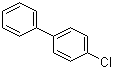 |
| Molecular Formula | C12H9Cl |
| Molecular Weight | 188.66 |
| CAS Registry Number | 2051-62-9 |
| EC Number | 218-127-7 |
| SMILES | C1=CC=C(C=C1)C2=CC=C(C=C2)Cl |
| Melting point | 77.7 °C |
|---|---|
| Boiling point | 291 °C |
| Water solubility | <0.1 g/100 mL at 22 °C |
| Hazard Symbols |   GHS08;GHS09 Warning Details GHS08;GHS09 Warning Details | ||||||||||||||||||||||||||||||||||||||||
|---|---|---|---|---|---|---|---|---|---|---|---|---|---|---|---|---|---|---|---|---|---|---|---|---|---|---|---|---|---|---|---|---|---|---|---|---|---|---|---|---|---|
| Risk Statements | H373-H400-H411 Details | ||||||||||||||||||||||||||||||||||||||||
| Safety Statements | P260-P273-P319-P391-P501 Details | ||||||||||||||||||||||||||||||||||||||||
| Hazard Classification | |||||||||||||||||||||||||||||||||||||||||
| |||||||||||||||||||||||||||||||||||||||||
| Transport Information | UN 3432 | ||||||||||||||||||||||||||||||||||||||||
| SDS | Available | ||||||||||||||||||||||||||||||||||||||||
 chemBlink Chemical Story
|
4-Chlorobiphenyl, a halogenated biphenyl derivative, has played a significant role in various industrial applications and environmental studies. The compound is characterized by two benzene rings connected by a single bond, with a chlorine atom substituted at the fourth position of one of the rings. This structural feature imparts the compound with both stability and reactivity, making it useful in different chemical processes and products. The discovery of 4-chlorobiphenyl can be traced back to the broader investigation of polychlorinated biphenyls (PCBs), which were first synthesized in the early 20th century. PCBs, including 4-chlorobiphenyl, were initially valued for their chemical stability, non-flammability, and insulating properties, leading to widespread use in electrical equipment, particularly in transformers and capacitors. The chlorine atom in 4-chlorobiphenyl increases its hydrophobicity and chemical resistance, making it an ideal candidate for applications where durability and stability are required. One of the primary applications of 4-chlorobiphenyl has been as a dielectric fluid in electrical transformers and capacitors. The compound's ability to resist degradation under high temperatures and its excellent insulating properties made it a preferred material for these applications. Additionally, 4-chlorobiphenyl has been used as a plasticizer in the manufacturing of plastics, where it imparts flexibility and durability to the final products. Its chemical stability also led to its use as an additive in paints, coatings, and sealants, where long-term performance was critical. However, the widespread use of 4-chlorobiphenyl and other PCBs came with significant environmental and health concerns. Over time, it became evident that these compounds were persistent in the environment, resistant to natural degradation processes, and capable of bioaccumulating in the food chain. The stability that made 4-chlorobiphenyl valuable in industrial applications also meant that it could remain in the environment for decades, leading to contamination of soil, water, and air. The recognition of the environmental impact of PCBs, including 4-chlorobiphenyl, led to extensive research into their behavior in the environment and their effects on human health. Studies revealed that PCBs could cause a range of adverse health effects, including cancer, immune system suppression, and neurological damage. The toxicological profile of 4-chlorobiphenyl, in particular, highlighted its potential to cause liver damage and disrupt endocrine function. As a result, many countries, including the United States, banned the production and use of PCBs in the late 1970s. Despite the ban on its production, 4-chlorobiphenyl remains a compound of interest in environmental studies due to its persistence and widespread contamination. It serves as a model compound in research focused on the remediation of PCB-contaminated sites. Efforts to develop effective methods for the degradation or removal of PCBs from the environment often use 4-chlorobiphenyl as a representative substance due to its prevalence and well-documented properties. These remediation strategies include chemical, biological, and physical approaches, such as the use of advanced oxidation processes, bioremediation using specialized microorganisms, and thermal desorption. In addition to its role in environmental research, 4-chlorobiphenyl has also been studied in the context of toxicology and risk assessment. Understanding its behavior in the environment and its effects on human health has been crucial for developing guidelines and regulations aimed at protecting public health. This compound has served as a benchmark for evaluating the effectiveness of environmental policies and remediation efforts. Research into 4-chlorobiphenyl continues, particularly in the areas of environmental science and toxicology. The lessons learned from its widespread use and subsequent environmental impact have informed the development of safer and more sustainable chemicals for industrial applications. The study of 4-chlorobiphenyl has also contributed to a greater understanding of the challenges associated with persistent organic pollutants (POPs) and the need for global cooperation in managing and mitigating their effects. References 2023. Catalytic Hydrodehalogenation of Haloarenes with Hydrogen and Hydrogen-Containing Compounds: A Review. Theoretical and Experimental Chemistry, 59(3). DOI: 10.1007/s11237-023-09775-4 2021. Characterization of the Metabolic Pathways of 4-Chlorobiphenyl (PCB3) in HepG2 Cells Using the Metabolite Profiles of Its Hydroxylated Metabolites. Environmental Science & Technology, 55(12). DOI: 10.1021/acs.est.1c01076 1971. Polychlorinated biphenyls: Synthesis of some individual chlorobiphenyls. Bulletin of Environmental Contamination and Toxicology, 6(3). DOI: 10.1007/bf01539929 |
| Market Analysis Reports |