
Online Database of Chemicals from Around the World
| Simagchem Corporation | China | |||
|---|---|---|---|---|
 | www.simagchem.com | |||
 | +86 13806087780 | |||
 | +86 (592) 268-0237 | |||
 | sale@simagchem.com | |||
| Chemical manufacturer since 2002 | ||||
| chemBlink Standard supplier since 2008 | ||||
| Hangzhou Leap Chem Co., Ltd. | China | |||
|---|---|---|---|---|
| www.leapchem.com | |||
| +86 (571) 8771-1850 | |||
| market19@leapchem.com | |||
 | QQ Chat | |||
| Chemical manufacturer since 2006 | ||||
| chemBlink Standard supplier since 2015 | ||||
| Shanghai Xin Cheng Yue Chemical Co., Ltd. | China | |||
|---|---|---|---|---|
| www.szxinyuechemical.com | |||
| +86 (021) 5870-2787 | |||
| +86 (021) 5870-2786 | |||
| wuziwei@xinyuefirm.com | |||
| QQ Chat | |||
 | Skype Chat | |||
 | WeChat: 17701820076 | |||
| Chemical distributor since 2005 | ||||
| chemBlink Standard supplier since 2023 | ||||
| Wuxishi Huiyou Chemical Co., Ltd. | China | |||
|---|---|---|---|---|
| www.huiyouchem.com | |||
| +86 13801519880 (510) 8878-6688 | |||
| +86 (510) 8878-6988 | |||
| sales@huiyouchem.com | |||
| Chemical manufacturer since 1988 | ||||
| Shanghai Shenqiang Industrial Co., Ltd. | China | |||
|---|---|---|---|---|
| www.shenqiang.com | |||
| +86 (21) 6297-1188 6297-1788 | |||
| +86 (21) 6257-8811 | |||
| shenqiang@shenqiang.com | |||
| Chemical manufacturer since 1996 | ||||
| Crescent Chemical Co. Inc. | USA | |||
|---|---|---|---|---|
| www.crescentchemical.com | |||
| +1 (631) 348-0333 | |||
| +1 (631) 348-0913 | |||
| crescent@creschem.com | |||
| Chemical distributor | ||||
| Sinocure Chemical Group | China | |||
|---|---|---|---|---|
| www.sinocurechem.com | |||
| +86 15550440621 | |||
| info@sinocurechem.com | |||
| Chemical manufacturer since 2020 | ||||
| Chem Service, Inc. | USA | |||
|---|---|---|---|---|
| www.chemservice.com | |||
| +1 (610) 692-3026 | |||
| +1 (610) 692-8729 | |||
| info@chemservice.com | |||
| Chemical manufacturer since 1962 | ||||
| Classification | Organic raw materials >> Amino compound >> Acyclic monoamines, polyamines and their derivatives and salts |
|---|---|
| Name | 4-(N,N-Diethyl)-2-methyl-p-phenylenediamine monohydrochloride |
| Synonyms | 2-Amino-5-diethylaminotoluene monohydrochloride; Color developing agent CD-2 |
| Molecular Structure | 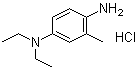 |
| Molecular Formula | C11H18N2.HCl |
| Molecular Weight | 214.74 |
| CAS Registry Number | 2051-79-8 |
| EC Number | 218-130-3 |
| SMILES | CCN(CC)C1=CC(=C(C=C1)N)C.Cl |
| Melting point | 250 °C |
|---|---|
| Hazard Symbols |   GHS06;GHS09 Danger Details GHS06;GHS09 Danger Details | ||||||||||||||||||||||||
|---|---|---|---|---|---|---|---|---|---|---|---|---|---|---|---|---|---|---|---|---|---|---|---|---|---|
| Risk Statements | H301-H319-H317-H400-H410 Details | ||||||||||||||||||||||||
| Safety Statements | P261-P264-P264+P265-P270-P272-P273-P280-P301+P316-P302+P352-P305+P351+P338-P321-P330-P333+P317-P337+P317-P362+P364-P391-P405-P501 Details | ||||||||||||||||||||||||
| Hazard Classification | |||||||||||||||||||||||||
| |||||||||||||||||||||||||
| SDS | Available | ||||||||||||||||||||||||
 chemBlink Chemical Story
|
4-(N,N-Diethyl)-2-methyl-p-phenylenediamine monohydrochloride, often referred to as diethylmethylphenylenediamine, is a chemical compound widely recognized for its role in analytical chemistry, particularly in colorimetric analysis. This compound is a derivative of phenylenediamine and is known for its high reactivity with oxidizing agents, making it a valuable reagent in various industrial and laboratory applications. The discovery of 4-(N,N-Diethyl)-2-methyl-p-phenylenediamine monohydrochloride can be traced back to the early developments in synthetic organic chemistry, where researchers sought to create more effective and stable reagents for analytical purposes. The compound's structure, featuring a diethylamine group and a methyl substitution on the aromatic ring, enhances its solubility and reactivity, which are critical properties for its use in aqueous solutions and other chemical environments. One of the most prominent applications of this compound is in the determination of chlorine levels in water. In this context, 4-(N,N-Diethyl)-2-methyl-p-phenylenediamine monohydrochloride is used as a colorimetric reagent. When it reacts with chlorine, it forms a colored complex, typically pink or red, whose intensity is proportional to the concentration of chlorine in the sample. This reaction is the basis of the DPD (diethyl-p-phenylenediamine) method, which is widely used in water treatment facilities, swimming pools, and environmental monitoring to ensure safe and effective chlorine levels. In addition to its role in chlorine detection, the compound has found use in other analytical techniques. For instance, it is used in redox titrations, where its ability to act as an indicator of oxidation-reduction reactions is highly valued. The color change it produces upon reacting with oxidizing agents provides a clear endpoint in titrations, improving the accuracy and reliability of the measurements. Moreover, 4-(N,N-Diethyl)-2-methyl-p-phenylenediamine monohydrochloride is employed in the synthesis of dyes and pigments. Its reactivity with various chemical agents allows it to be used as an intermediate in the production of colorants, particularly those used in textiles, inks, and plastics. The compound's stability and ability to form stable colored compounds make it an ideal candidate for such applications. In the field of biomedical research, this compound is sometimes used in assays that measure the activity of oxidase enzymes. The reaction it undergoes with the products of enzymatic reactions can be quantified spectrophotometrically, providing insights into enzyme kinetics and activity. This application underscores the compound’s versatility and importance in both basic and applied research. Overall, the discovery and subsequent development of 4-(N,N-Diethyl)-2-methyl-p-phenylenediamine monohydrochloride have had a significant impact on various fields, particularly in analytical and industrial chemistry. Its role as a colorimetric reagent for chlorine detection has made it indispensable in water quality monitoring, while its applications in dye synthesis and redox titrations highlight its broader utility. As industries continue to evolve and new analytical techniques are developed, this compound will likely remain a critical component in many chemical processes. References 2017. In Situ Growth of Flexible Polyphenylene-Conjugated Microporous Polymer Films for Fluorescence Detection of the Total Quantity of Developing Agents and Their Oxidation Products. Journal of Analysis and Testing, 1(1). DOI: 10.1007/s41664-017-0006-8 1998. Chromogenic Receptors: Versatility of the Colorimetric Recognizing Behavior. Journal of inclusion phenomena and molecular recognition in chemistry, 32(2-3). DOI: 10.1023/a:1008067528254 |
| Market Analysis Reports |