
Online Database of Chemicals from Around the World
| Targetmol China | China | |||
|---|---|---|---|---|
 | www.targetmol.cn | |||
 | +86 (400) 820-0310 | |||
 | sales@targetmol.cn | |||
| Chemical manufacturer since 2015 | ||||
| chemBlink Standard supplier since 2025 | ||||
| Classification | Biochemical >> Antibody >> Immunity and inflammation |
|---|---|
| Name | diABZI STING agonist-1 |
| Synonyms | Tautomerism; 1-[(E)-4-[5-carbamoyl-2-[(2-ethyl-5-methylpyrazole-3-carbonyl)amino]-7-(3-morpholin-4-ylpropoxy)benzimidazol-1-yl]but-2-enyl]-2-[(2-ethyl-5-methylpyrazole-3-carbonyl)amino]-7-methoxybenzimidazole-5-carboxamide |
| Molecular Structure | 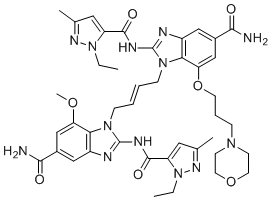 |
| Molecular Formula | C42H51N13O7 |
| Molecular Weight | 849.94 |
| CAS Registry Number | 2138498-18-5 |
| SMILES | CCN1C(=CC(=N1)C)C(=O)NC2=NC3=C(N2C/C=C/CN4C5=C(C=C(C=C5OCCCN6CCOCC6)C(=O)N)N=C4NC(=O)C7=CC(=NN7CC)C)C(=CC(=C3)C(=O)N)OC |
| Density | 1.4±0.1 g/cm3 Calc.* |
|---|---|
| Boiling point | 1007.8±75.0 °C 760 mmHg (Calc.)* |
| Flash point | 563.3±37.1 °C (Calc.)* |
| Index of refraction | 1.701 (Calc.)* |
| * | Calculated using Advanced Chemistry Development (ACD/Labs) Software. |
| Hazard Symbols |  GHS07 Warning Details GHS07 Warning Details |
|---|---|
| Risk Statements | H302-H315-H319 Details |
| Safety Statements | P501-P270-P264-P280-P302+P352-P337+P313-P305+P351+P338-P362+P364-P332+P313-P301+P312+P330 Details |
| SDS | Available |
 chemBlink Chemical Story
|
diABZI STING agonist-1 is a synthetic small molecule developed as a potent activator of the stimulator of interferon genes (STING) pathway, which is a central component of the innate immune system’s response to cytosolic DNA. Activation of STING triggers the production of type I interferons and other pro-inflammatory cytokines, essential for antiviral defense, immune surveillance, and antitumor immunity. The diABZI (dimeric amidobenzimidazole) class, to which this compound belongs, was designed to overcome the limitations of natural STING agonists such as cyclic dinucleotides. Natural ligands typically exhibit poor pharmacokinetic properties, limited cell permeability, and rapid degradation, restricting their use in systemic therapies. diABZI STING agonist-1 features a dimeric amidobenzimidazole scaffold that binds selectively and with high affinity to the STING protein, inducing conformational changes necessary for activation of downstream signaling pathways. This molecule was discovered through medicinal chemistry efforts focused on developing small-molecule STING agonists with improved drug-like properties, including better stability, cell permeability, and oral bioavailability. The structure allows for effective engagement of human STING variants, which differ in sensitivity to natural ligands, thereby broadening potential clinical applications. In preclinical studies, diABZI STING agonist-1 has demonstrated strong induction of interferon-beta and other interferon-stimulated genes, resulting in robust innate immune activation. This activation promotes dendritic cell maturation, enhances antigen presentation, and facilitates T cell priming, which are crucial steps in mounting an effective immune response against tumors or infections. Therapeutically, diABZI STING agonist-1 is being explored mainly as an immuno-oncology agent. It has shown promising antitumor activity in multiple animal models, where it can be administered systemically and stimulate tumor-specific immune responses. Furthermore, it is investigated in combination with immune checkpoint inhibitors, such as anti-PD-1 or anti-CTLA-4 antibodies, to improve the efficacy of cancer immunotherapies by enhancing the tumor microenvironment's immunogenicity. Beyond oncology, this compound is under evaluation for its potential role in infectious disease treatment and vaccine adjuvant development. By boosting innate immune responses, diABZI STING agonist-1 could improve the efficacy of vaccines or antiviral agents by enhancing early immune detection and the subsequent adaptive immune response. Safety profiles in animal models suggest that diABZI STING agonist-1 is generally well-tolerated, with side effects consistent with activation of inflammatory pathways, including transient cytokine release. Current research aims to optimize dosing strategies to maximize therapeutic benefits while minimizing adverse inflammatory reactions. In summary, diABZI STING agonist-1 represents a significant advancement in the development of small-molecule STING agonists. Its design addresses the pharmacological challenges of natural ligands, offering improved stability, bioavailability, and potency. Continued investigation of this compound may contribute to novel therapeutic strategies for cancer, infectious diseases, and immunomodulation by harnessing the innate immune system's power. References 2018. Design of amidobenzimidazole STING receptor agonists with systemic activity. Nature, 564(7736). DOI: 10.1038/s41586-018-0705-y 2021. Pharmacological activation of STING blocks SARS-CoV-2 infection. Science Immunology, 6(59). DOI: 10.1126/sciimmunol.abi9007 2022. Structure-Activity Relationship Study of Amidobenzimidazole Analogues Leading to Potent and Systemically Administrable Stimulator of Interferon Gene (STING) Agonists. Journal of Medicinal Chemistry, 64(2). DOI: 10.1021/acs.jmedchem.0c01900 |
| Market Analysis Reports |