
Online Database of Chemicals from Around the World
| Topscience Co. Ltd. | China | |||
|---|---|---|---|---|
 | www.tsbiochem.com | |||
 | +86 (400) 820-0310 | |||
 | +86 (021) 3469-2979 | |||
 | sales@tsbiochem.com | |||
| Chemical manufacturer since 2013 | ||||
| chemBlink Standard supplier since 2012 | ||||
| Classification | Biochemical >> Inhibitor >> Epigenetics >> Histone methyltransferase inhibitor |
|---|---|
| Name | MAK-683 hydrochloride |
| Synonyms | N-[(5-fluoro-2,3-dihydro-1-benzofuran-4-yl)methyl]-8-(2-methylpyridin-3-yl)-[1,2,4]triazolo[4,3-c]pyrimidin-5-amine hydrochloride |
| Molecular Structure | 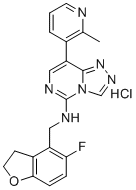 |
| Molecular Formula | C20H18ClFN6O |
| Molecular Weight | 412.85 |
| CAS Registry Number | 2170606-94-5 |
| SMILES | CC1=C(C=CC=N1)C2=CN=C(N3C2=NN=C3)NCC4=C(C=CC5=C4CCO5)F.Cl |
| SDS | Available |
|---|---|
 chemBlink Chemical Story
|
MAK-683 hydrochloride is a small-molecule antagonist of the receptor for neurokinin-3 (NK3R), a G protein-coupled receptor involved in regulating the neuroendocrine system. NK3R is activated by neurokinin B, a tachykinin peptide that plays a significant role in controlling the secretion of gonadotropin-releasing hormone (GnRH) and thus influences reproductive hormone levels. The discovery of MAK-683 hydrochloride emerged from efforts to develop selective NK3R antagonists that could modulate reproductive hormone release by inhibiting the stimulatory effects of neurokinin B. By blocking NK3R, MAK-683 interferes with the signaling pathways that regulate the hypothalamic-pituitary-gonadal axis, providing potential therapeutic benefits in hormone-dependent conditions. MAK-683 hydrochloride has been investigated primarily for its potential to treat sex hormone-related disorders such as prostate cancer, endometriosis, and menopausal symptoms. In prostate cancer, reducing the activity of the hypothalamic-pituitary-gonadal axis lowers circulating testosterone levels, which can slow the growth of hormone-sensitive tumors. The NK3R antagonism by MAK-683 represents a novel approach to hormonal regulation compared to traditional therapies such as luteinizing hormone-releasing hormone (LHRH) agonists or antagonists. In preclinical models, MAK-683 hydrochloride demonstrated potent and selective NK3R antagonism, resulting in reduced luteinizing hormone (LH) secretion and downstream suppression of sex steroids. Its pharmacological profile includes good oral bioavailability and a safety margin suitable for clinical development. Clinical trials with MAK-683 hydrochloride have focused on assessing its efficacy in lowering testosterone levels in patients with advanced prostate cancer and its safety and tolerability. Early clinical data indicate that MAK-683 can effectively reduce testosterone to castration levels, with a manageable side effect profile. This positions MAK-683 as a potential alternative or adjunct to existing androgen deprivation therapies. Besides oncology, MAK-683 hydrochloride has been evaluated for menopausal symptoms such as hot flashes and vasomotor instability, which are partly driven by neurokinin B signaling in the hypothalamus. By inhibiting NK3R, the compound may alleviate these symptoms without the risks associated with hormone replacement therapy. Overall, MAK-683 hydrochloride represents an innovative NK3R antagonist with therapeutic potential in hormone-driven diseases. Its ability to modulate neurokinin B signaling offers a targeted mechanism to influence reproductive hormone levels, supporting its ongoing development for prostate cancer and other endocrine-related conditions. References 2022. Discovery of the Clinical Candidate MAK683: An EED-Directed, Allosteric, and Selective PRC2 Inhibitor for the Treatment of Advanced Malignancies. Journal of Medicinal Chemistry, 65(7). DOI: 10.1021/acs.jmedchem.1c02148 |
| Market Analysis Reports |