
Online Database of Chemicals from Around the World
| Zhengzhou Alfachem Co., Ltd. | China | |||
|---|---|---|---|---|
 | www.alfachemch.com | |||
 | +86 (0371) 5505-2911 | |||
 | alfa5@alfachem.cn | |||
| Chemical manufacturer since 2010 | ||||
| chemBlink Standard supplier since 2024 | ||||
| Classification | Organic raw materials >> Organometallic compound >> Organotin |
|---|---|
| Name | PTQ10 |
| Synonyms | 5,8-dibromo-6,7-difluoro-2-(2-hexyldecoxy)quinoxaline trimethyl-(5-trimethylstannylthiophen-2-yl)stannane |
| Molecular Structure | 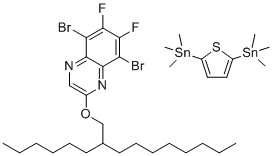 |
| Molecular Formula | C34H54Br2F2N2OSSn2 |
| Molecular Weight | 974.10 |
| CAS Registry Number | 2269476-13-1 |
| SMILES | CCCCCCCCC(CCCCCC)COC1=CN=C2C(=C(C(=C(C2=N1)Br)F)F)Br.C[Sn](C)(C)C1=CC=C(S1)[Sn](C)(C)C |
| Hazard Symbols |   GHS06;GHS09 Danger Details GHS06;GHS09 Danger Details |
|---|---|
| Risk Statements | H301+H311+H331-H410 Details |
| Safety Statements | P261-P264-P270-P271-P273-P280-P301+P310+P330-P302+P352+P312P304+P340+P311-P361+P364-P391-P403+P233-P405-P501 Details |
| SDS | Available |
 chemBlink Chemical Story
|
PTQ10 is a widely studied material in the field of organic electronics, particularly for its application in organic photovoltaic (OPV) devices. It is a polymer that falls under the category of donor materials, which are crucial for light absorption and charge transport in solar cells. The substance has garnered significant attention due to its promising optoelectronic properties, making it a key player in the development of high-performance, solution-processable organic solar cells. PTQ10 was first introduced by researchers in the context of enhancing the efficiency and stability of organic photovoltaics. The structure of PTQ10 is characterized by a conjugated backbone consisting of alternating electron-rich and electron-deficient units, which helps in the efficient absorption of sunlight and charge transfer. The polymer contains a unique combination of thiophene and quinoxaline units, which confer high absorption in the visible light spectrum, enhancing the power conversion efficiency (PCE) of solar cells. Additionally, the incorporation of fluorine atoms in the structure improves the polymer’s electron affinity and optimizes its energy levels for effective charge transport. One of the major breakthroughs in the development of PTQ10 is its exceptional performance in bulk heterojunction (BHJ) solar cells. In a BHJ solar cell, the donor and acceptor materials are blended together to form a photoactive layer, allowing for efficient light absorption and charge separation. PTQ10, when paired with suitable electron acceptors such as non-fullerene acceptors, has demonstrated high PCEs and superior stability compared to conventional fullerene-based systems. The fluorinated side chains in PTQ10 further contribute to its solubility, making it easier to process into thin films using solution-based techniques such as spin-coating or inkjet printing. In addition to its application in photovoltaics, PTQ10 has also been explored for use in other optoelectronic devices, including organic light-emitting diodes (OLEDs) and organic field-effect transistors (OFETs). Its ability to efficiently transport charges and its excellent film-forming properties make it a versatile material for a range of organic electronic applications. PTQ10’s high stability and processability are particularly valuable for developing flexible, lightweight, and cost-effective devices that can be used in a variety of settings, from renewable energy solutions to displays and sensors. Despite its promising properties, challenges remain in optimizing the performance of PTQ10-based devices. Researchers are continually exploring ways to further enhance the material’s properties, such as improving its charge mobility and fine-tuning its absorption spectra. Moreover, efforts are underway to scale up its production and reduce the costs of synthesis to make it commercially viable. In summary, PTQ10 is a significant development in the field of organic electronics, particularly for organic photovoltaics. Its unique molecular structure and excellent optoelectronic properties make it an ideal candidate for high-performance solar cells and other organic electronic devices. As research continues, PTQ10 holds great potential for contributing to the advancement of renewable energy technologies and flexible electronics. |
| Market Analysis Reports |