
Online Database of Chemicals from Around the World
| BOC Sciences | USA | |||
|---|---|---|---|---|
 | www.bocsci.com | |||
 | +1 (631) 485-4226 | |||
 | +1 (631) 614-7828 | |||
 | info@bocsci.com | |||
| Chemical manufacturer | ||||
| chemBlink Standard supplier since 2010 | ||||
| Hangzhou Leap Chem Co., Ltd. | China | |||
|---|---|---|---|---|
| www.leapchem.com | |||
| +86 (571) 8771-1850 | |||
| market19@leapchem.com | |||
 | QQ Chat | |||
| Chemical manufacturer since 2006 | ||||
| chemBlink Standard supplier since 2015 | ||||
| Cangzhou Enke Pharma-tech Co., Ltd. | China | |||
|---|---|---|---|---|
| www.enkepharma.com | |||
| +86 (317) 529-6180 510-6597 +86 15533709196 | |||
| +86 (317) 510-6596 | |||
| sale@enkepharma.com enkepharma@126.com | |||
| QQ Chat | |||
 | Skype Chat | |||
 | WeChat: ymzhao | |||
| Chemical manufacturer since 2011 | ||||
| chemBlink Standard supplier since 2016 | ||||
| Finetech Industry Limited | China | |||
|---|---|---|---|---|
| www.finetechchem.com | |||
| +86 (27) 8746-5837 +86 18971612321 | |||
| +86 (27) 8777-2287 | |||
| sales@finetechnology-ind.com | |||
| QQ Chat | |||
| Chemical manufacturer since 2009 | ||||
| chemBlink Standard supplier since 2019 | ||||
| Targetmol China | China | |||
|---|---|---|---|---|
| www.targetmol.cn | |||
| +86 (400) 820-0310 | |||
| sales@targetmol.cn | |||
| Chemical manufacturer since 2015 | ||||
| chemBlink Standard supplier since 2025 | ||||
| Axon MedChem BV | Netherlands | |||
|---|---|---|---|---|
| www.axonmedchem.com | |||
| +31 (50) 311-8007 | |||
| +31 (50) 360-0390 | |||
| order@axonmedchem.com | |||
| Chemical manufacturer | ||||
| Natland International Corporation | USA | |||
|---|---|---|---|---|
| www.natland.com | |||
| +1 (919) 380-9775 | |||
| +1 (919) 380-9886 | |||
| info@natland.com | |||
| Chemical manufacturer | ||||
| Toronto Research Chemicals Inc. | Canada | |||
|---|---|---|---|---|
| www.trc-canada.com | |||
| +1 (416) 665-9696 | |||
| +1 (416) 665-4439 | |||
| info@trc-canada.com | |||
| Chemical manufacturer since 1982 | ||||
| Santa Cruz Biotechnology, Inc. | USA | |||
|---|---|---|---|---|
| www.scbt.com | |||
| +1 (831) 457-3800 | |||
| +1 (831) 457-3801 | |||
| scbt@scbt.com | |||
| Chemical manufacturer | ||||
| Classification | Pharmaceutical intermediate >> Heterocyclic compound intermediate >> Pyridine compound |
|---|---|
| Name | 1-Methyl-4-phenyl-1,2,3,6-tetrahydropyridine hydrochloride |
| Synonyms | 23007-85-4 |
| Molecular Structure | 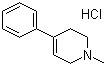 |
| Molecular Formula | C12H15N.HCl |
| Molecular Weight | 209.71 |
| CAS Registry Number | 23007-85-4 |
| EC Number | 622-416-7 |
| SMILES | CN1CCC(=CC1)C2=CC=CC=C2.Cl |
| Solubility | Water: ~ 100 mM (Expl.) |
|---|---|
| Hazard Symbols |   GHS06;GHS07 Danger Details GHS06;GHS07 Danger Details | ||||||||||||||||||||||||||||||||
|---|---|---|---|---|---|---|---|---|---|---|---|---|---|---|---|---|---|---|---|---|---|---|---|---|---|---|---|---|---|---|---|---|---|
| Risk Statements | H301-H301-H311-H315-H319-H331-H335 Details | ||||||||||||||||||||||||||||||||
| Safety Statements | P261-P262-P264-P264+P265-P270-P271-P280-P301+P316-P302+P352-P304+P340-P305+P351+P338-P316-P319-P321-P330-P332+P317-P337+P317-P361+P364-P362+P364-P403+P233-P405-P501 Details | ||||||||||||||||||||||||||||||||
| Hazard Classification | |||||||||||||||||||||||||||||||||
| |||||||||||||||||||||||||||||||||
| Transport Information | UN 2811 | ||||||||||||||||||||||||||||||||
| SDS | Available | ||||||||||||||||||||||||||||||||
 chemBlink Chemical Story
|
1-Methyl-4-phenyl-1,2,3,6-tetrahydropyridine hydrochloride is a chemical compound that has been extensively studied for its role in neuroscience research, particularly in modeling Parkinson’s disease. The compound was discovered during investigations into neurotoxins that induce selective degeneration of dopaminergic neurons in the brain, mimicking the pathology observed in Parkinson’s disease. 1-Methyl-4-phenyl-1,2,3,6-tetrahydropyridine hydrochloride is known as MPTP hydrochloride and functions as a neurotoxin. When administered to certain animals, including primates and rodents, MPTP crosses the blood-brain barrier and is metabolized by monoamine oxidase B (MAO-B) in glial cells to produce 1-methyl-4-phenylpyridinium ion (MPP+), a toxic metabolite. MPP+ selectively accumulates in dopaminergic neurons of the substantia nigra pars compacta via dopamine transporters. This accumulation causes mitochondrial dysfunction and oxidative stress, leading to the degeneration of these neurons. The neurotoxic properties of MPTP hydrochloride have made it a valuable tool for generating animal models of Parkinson’s disease, which are critical for studying the disease’s pathophysiology and for testing potential therapeutic interventions. MPTP-induced models replicate many features of Parkinson’s disease, including motor symptoms such as bradykinesia, rigidity, and tremor, as well as the characteristic loss of dopaminergic neurons and dopamine depletion in the striatum. Beyond its role in disease modeling, research on MPTP hydrochloride has contributed significantly to the understanding of neurodegeneration mechanisms, mitochondrial impairment, and the involvement of oxidative stress in neuronal death. It has also spurred the development of neuroprotective strategies and pharmacological agents aimed at preventing or slowing the progression of Parkinson’s disease. In laboratory settings, MPTP hydrochloride is typically used in controlled doses to induce dopaminergic neurodegeneration in animal studies. Its use requires careful handling due to its neurotoxic nature and potential risks to researchers. The compound has not been developed as a therapeutic agent but remains indispensable for experimental research into neurodegenerative disorders. Overall, 1-methyl-4-phenyl-1,2,3,6-tetrahydropyridine hydrochloride is a critical compound in neuroscience that enables the study of Parkinson’s disease mechanisms and the evaluation of potential treatments through reliable animal models. References 1986. Synthesis and toxicity toward nigrostriatal dopamine neurons of 1-methyl-4-phenyl-1,2,3,6-tetrahydropyridine (MPTP) analogues. Journal of Medicinal Chemistry, 29(3). DOI: 10.1021/jm00153a019 2023. Gut Microbial Alteration in MPTP Mouse Model of Parkinson Disease is Administration Regimen Dependent. Cellular and Molecular Neurobiology, 43(5). DOI: 10.1007/s10571-023-01319-7 2024. Positive allosteric mGluR2 modulation with BINA alleviates dyskinesia and psychosis-like behaviours in the MPTP-lesioned marmoset. Naunyn-Schmiedeberg's Archives of Pharmacology, 397(12). DOI: 10.1007/s00210-024-03215-3 |
| Market Analysis Reports |