
Online Database of Chemicals from Around the World
| Xi'an Reapsource Biotechnology Co., Ltd. | China | |||
|---|---|---|---|---|
 | www.rpybiotech.com | |||
 | +86 18991103357 | |||
 | buyun.ping@rpybiotech.com | |||
 | QQ Chat | |||
 | WeChat: 18991103357 | |||
| Chemical manufacturer since 2024 | ||||
| chemBlink Standard supplier since 2026 | ||||
| Classification | Chemical reagent >> Deuterated reagent |
|---|---|
| Name | 3-Bromo-1,1'-biphenyl-d9 |
| Synonyms | 1-bromo-2,3,4,6-tetradeuterio-5-(2,3,4,5,6-pentadeuteriophenyl)benzene |
| Molecular Structure | 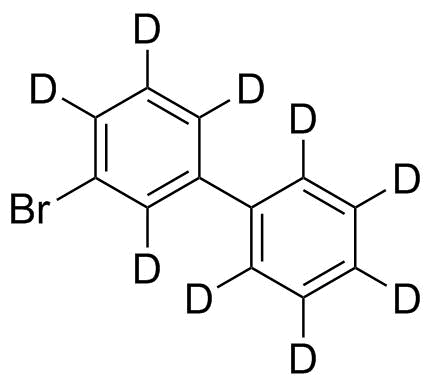 |
| Molecular Formula | C12D9Br |
| Molecular Weight | 242.16 |
| CAS Registry Number | 2363789-28-8 |
| SMILES | [2H]C1=C(C(=C(C(=C1[2H])[2H])C2=C(C(=C(C(=C2[2H])[2H])[2H])Br)[2H])[2H])[2H] |
| Density | 1.4±0.1 g/cm3 Calc.* |
|---|---|
| Boiling point | 300.0±9.0 °C 760 mmHg (Calc.)* |
| Flash point | 135.6±13.1 °C (Calc.)* |
| Index of refraction | 1.601 (Calc.)* |
| * | Calculated using Advanced Chemistry Development (ACD/Labs) Software. |
| Hazard Symbols |  GHS07 Warning Details GHS07 Warning Details |
|---|---|
| Risk Statements | H302-H315-H319-H335 Details |
| Safety Statements | P261-P305+P351+P338 Details |
| SDS | Available |
 chemBlink Chemical Story
|
3-Bromo-1,1′-biphenyl-d9 is a stable isotope-labeled halogenated biphenyl compound in which nine hydrogen atoms of the biphenyl framework are replaced with deuterium. It consists of a biphenyl core substituted with a bromine atom at the 3-position and deuterium labeling distributed across the aromatic rings. Compounds of this type belong to the class of isotopically labeled aromatic hydrocarbons, which are widely used in analytical chemistry, environmental studies, and instrumental calibration. The development of deuterated aromatic compounds is closely connected to the advancement of isotope chemistry and instrumental analytical techniques during the twentieth century. With the rise of gas chromatography and mass spectrometry as standard analytical tools, stable isotope-labeled standards became essential for accurate quantitative analysis. Deuterium was adopted as a labeling isotope because it introduces a predictable mass shift while minimally altering the chemical and physical behavior of the parent compound. Biphenyl compounds, including brominated derivatives, have long been studied due to their relevance in environmental chemistry and industrial applications. Brominated biphenyls are structurally related to other halogenated aromatic compounds that can arise in industrial processes and environmental systems. The substitution of bromine at the 3-position influences the electronic distribution of the biphenyl system, increasing molecular mass and altering reactivity compared with unsubstituted biphenyl. In 3-bromo-1,1′-biphenyl-d9, the replacement of hydrogen atoms with deuterium does not significantly change the overall chemical reactivity of the molecule under most conditions. However, the mass difference allows the compound to be clearly distinguished from non-deuterated analogs using mass spectrometric detection. This property forms the basis for its primary application as an internal standard in analytical workflows. One of the most important uses of deuterated biphenyl compounds is in gas chromatography–mass spectrometry (GC–MS) analysis. Internal standards such as 3-bromo-1,1′-biphenyl-d9 are added in known quantities to samples to correct for variability in sample preparation, extraction efficiency, and instrument response. Because isotopically labeled compounds closely mimic the behavior of target analytes, they provide reliable reference signals for quantitative measurements. The compound is also used in method development and validation studies for analytical chemistry. In such contexts, brominated biphenyls are of interest due to their characteristic fragmentation patterns and isotope distributions in mass spectrometry. The presence of bromine produces a distinctive isotopic signature, while deuterium labeling introduces an additional mass shift that improves analytical resolution and confidence in compound identification. Environmental analysis is another area in which isotopically labeled halogenated biphenyls are relevant. Brominated aromatic compounds can be present as contaminants or degradation products in certain industrial and environmental contexts. Deuterated analogs are used to calibrate analytical methods, evaluate recovery rates, and ensure accuracy in trace-level detection of similar compounds in complex environmental matrices. From a physicochemical perspective, 3-bromo-1,1′-biphenyl-d9 is expected to exhibit properties similar to those of the non-deuterated parent compound, including hydrophobicity and aromatic stability. The primary difference lies in its increased molecular mass and altered vibrational characteristics due to deuterium substitution. These differences are sufficient for analytical discrimination but generally do not affect chromatographic retention behavior significantly. In addition to its analytical applications, deuterated aromatic compounds can be used in research involving isotope effects. Although deuterium substitution in aromatic systems typically results in only subtle kinetic isotope effects, such compounds can still provide useful information in mechanistic studies where precise mass tracking is required. Overall, 3-bromo-1,1′-biphenyl-d9 is a stable isotope-labeled halogenated aromatic compound primarily used as an internal standard and reference material in analytical chemistry. Its combination of bromine substitution and extensive deuteration makes it particularly valuable in mass spectrometric applications involving the detection and quantification of biphenyl-related compounds. |
| Market Analysis Reports |