
Online Database of Chemicals from Around the World
| Shanghai Daji Medical Technology Co., Ltd. | China | |||
|---|---|---|---|---|
 | www.djpharm.com | |||
 | +86 13816245196 | |||
 | sales1@djpharm.com | |||
| Chemical distributor since 2019 | ||||
| chemBlink Standard supplier since 2025 | ||||
| Classification | Biochemical >> Carbohydrate >> Oligosaccharide |
|---|---|
| Name | Peracetylated beta-cyclodextrin |
| Synonyms | [(1R,3R,5R,6R,8R,10R,11R,13R,15R,16R,18R,20R,21R,23R,25R,26R,28R,30R,31R,33R,35R,36S,37R,38S,39R,40S,41R,42S,43R,44S,45R,46S,47R,48S,49R)-36,37,38,39,40,41,42,43,44,45,46,47,48,49-tetradecaacetyloxy-10,15,20,25,30,35-hexakis(acetyloxymethyl)-2,4,7,9,12,14,17,19,22,24,27,29,32,34-tetradecaoxaoctacyclo[31.2.2.23,6.28,11.213,16.218,21.223,26.228,31]nonatetracontan-5-yl]methyl acetate |
| Molecular Structure | 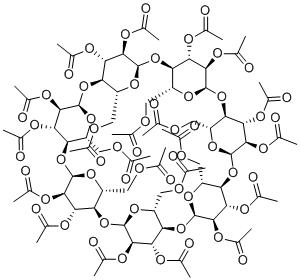 |
| Molecular Formula | C84H112O56 |
| Molecular Weight | 2017.75 |
| CAS Registry Number | 23739-88-0 |
| SMILES | CC(=O)OC[C@@H]1[C@@H]2[C@@H]([C@H]([C@H](O1)O[C@@H]3[C@H](O[C@@H]([C@@H]([C@H]3OC(=O)C)OC(=O)C)O[C@@H]4[C@H](O[C@@H]([C@@H]([C@H]4OC(=O)C)OC(=O)C)O[C@@H]5[C@H](O[C@@H]([C@@H]([C@H]5OC(=O)C)OC(=O)C)O[C@@H]6[C@H](O[C@@H]([C@@H]([C@H]6OC(=O)C)OC(=O)C)O[C@@H]7[C@H](O[C@@H]([C@@H]([C@H]7OC(=O)C)OC(=O)C)O[C@@H]8[C@H](O[C@H](O2)[C@@H]([C@H]8OC(=O)C)OC(=O)C)COC(=O)C)COC(=O)C)COC(=O)C)COC(=O)C)COC(=O)C)COC(=O)C)OC(=O)C)OC(=O)C |
| Density | 1.5±0.1 g/cm3 Calc.* |
|---|---|
| Boiling point | 1361.8±65.0 °C 760 mmHg (Calc.)* |
| Flash point | 444.8±34.3 °C (Calc.)* |
| Index of refraction | 1.545 (Calc.)* |
| * | Calculated using Advanced Chemistry Development (ACD/Labs) Software. |
| Hazard Symbols |  GHS07 Warning Details GHS07 Warning Details |
|---|---|
| Risk Statements | H302-H315-H319-H335 Details |
| Safety Statements | P261-P305+P351+P338 Details |
| SDS | Available |
 chemBlink Chemical Story
|
Peracetylated beta-cyclodextrin is a chemically modified derivative of beta-cyclodextrin in which all the hydroxyl groups on the glucose units are converted to acetate esters. Beta-cyclodextrin itself is a cyclic oligosaccharide composed of seven D-glucose units linked by α-1,4-glycosidic bonds, forming a toroidal structure with a hydrophobic cavity and hydrophilic outer surface. Acetylation of the hydroxyl groups enhances the compound’s solubility in organic solvents, reduces hydrogen-bonding interactions, and alters its inclusion properties, making it useful in various chemical and pharmaceutical applications. The synthesis of peracetylated beta-cyclodextrin generally involves the reaction of beta-cyclodextrin with acetic anhydride in the presence of a base or catalyst, such as pyridine or dimethylaminopyridine. Complete acetylation requires careful control of reaction time and stoichiometry to ensure that all primary and secondary hydroxyl groups are esterified, producing a uniform peracetylated product. The resulting derivative can be purified by recrystallization from organic solvents or by precipitation, yielding a solid material suitable for further chemical modification or application. In organic synthesis, peracetylated beta-cyclodextrin is used as an intermediate for selective functionalization of the cyclodextrin scaffold. The acetate groups protect the hydroxyls, allowing chemists to introduce additional substituents at specific positions via selective deprotection and derivatization. This property enables the preparation of various cyclodextrin derivatives with tailored solubility, binding affinities, and steric properties, which are valuable in supramolecular chemistry and host–guest complexation studies. In pharmaceutical research, peracetylated beta-cyclodextrin is used to modify the solubility and bioavailability of guest molecules through inclusion complex formation. The acetylated derivative retains the hydrophobic cavity characteristic of cyclodextrins but exhibits altered surface properties, which can influence interactions with drugs, lipophilic compounds, and other organic molecules. These complexes are employed to enhance drug stability, control release profiles, and improve transport across biological membranes. Peracetylated beta-cyclodextrin also finds applications in material science and catalysis. The derivative can serve as a building block for supramolecular assemblies, polymer conjugates, and functionalized nanomaterials. Its hydrophobic interior and acetylated exterior allow for selective encapsulation of guest molecules while maintaining solubility in organic media. In catalysis, modified cyclodextrins are used to create chiral environments for asymmetric reactions and to stabilize transition states through host–guest interactions. Physically, peracetylated beta-cyclodextrin is typically obtained as a crystalline or amorphous solid with good solubility in organic solvents such as chloroform, dichloromethane, and dimethylformamide. It is stable under standard laboratory conditions but should be protected from strong acids, bases, and prolonged exposure to moisture, which could hydrolyze the acetate esters. Proper handling ensures the integrity of the compound for synthetic, pharmaceutical, and material applications. Overall, peracetylated beta-cyclodextrin is a versatile modified cyclodextrin featuring acetyl-protected hydroxyl groups on a seven-glucose cyclic scaffold. Its chemical stability, solubility in organic media, and ability to form inclusion complexes make it an important intermediate and functional material for applications in organic synthesis, drug formulation, supramolecular chemistry, and materials science. References 2023. Thermodynamics of Sorption of Organic Compounds by Sorbents Based on Supramolecular Liquid Crystal HPFAB and β-Cyclodextrin Derivatives under Gas Chromatography Conditions. Protection of Metals and Physical Chemistry of Surfaces, 57(6). DOI: 10.1134/s2070205123701277 2019. Enhanced Nanoencapsulation of Sepiapterin within PEG-PCL Nanoparticles by Complexation with Triacetyl-Beta Cyclodextrin. Molecules, 24(15). DOI: 10.3390/molecules24152715 2008. Sustained-release matrix tablets of metformin hydrochloride in combination with triacetyl-beta-cyclodextrin. European Journal of Pharmaceutics and Biopharmaceutics, 68(2). DOI: 10.1016/j.ejpb.2007.06.004 |
| Market Analysis Reports |