
Online Database of Chemicals from Around the World
| Onichem Specialities Co., Ltd. | China | |||
|---|---|---|---|---|
 | www.onichem.com | |||
 | +86 (411) 8479-4022 | |||
 | +86 (411) 8479-4077 | |||
 | shiwanli@onichem.com | |||
| Chemical manufacturer since 2001 | ||||
| chemBlink Standard supplier since 2007 | ||||
| Kingfirst Chemical (Nanjing) Co., Ltd. | China | |||
|---|---|---|---|---|
| www.kingfirstchem.com | |||
| +86 (25) 8452-2992 8477-3604 | |||
| +86 (25) 8452-1617 | |||
| marketing@kingfirstchem.com | |||
| Chemical manufacturer | ||||
| chemBlink Standard supplier since 2007 | ||||
| Nanjing Capatue Chemical Co., Ltd. | China | |||
|---|---|---|---|---|
| www.capatue.com | |||
| +86 (25) 8637-1192 +86 13851602286 | |||
| +86 (25) 8637-1191 ex 0 | |||
| info@capatue.com stephenchow@capatue.com | |||
 | QQ Chat | |||
| Chemical manufacturer | ||||
| chemBlink Standard supplier since 2008 | ||||
| Simagchem Corporation | China | |||
|---|---|---|---|---|
| www.simagchem.com | |||
| +86 13806087780 | |||
| +86 (592) 268-0237 | |||
| sale@simagchem.com | |||
| Chemical manufacturer since 2002 | ||||
| chemBlink Standard supplier since 2008 | ||||
| Sigmasil Chem Co., Ltd. | China | |||
|---|---|---|---|---|
| www.sigmasil.com | |||
| +86 (27) 8870-5302 | |||
| +86 (27) 8870-5291 | |||
| silanes@sigmasil.com sigmasil@hotmail.com | |||
| Chemical manufacturer | ||||
| chemBlink Standard supplier since 2009 | ||||
| Zhejiang FeiDian Chemical Co., Ltd. | China | |||
|---|---|---|---|---|
| www.feidianchem.com | |||
| +86 (21) 5417-9062 | |||
| +86 (21) 5417-9379 | |||
| elvis@feidianchem.com exportsales@feidianchem.com | |||
| Chemical manufacturer | ||||
| chemBlink Standard supplier since 2009 | ||||
| Tianjin Zhongxin Chem-tech Co., Ltd. | China | |||
|---|---|---|---|---|
| www.tjzxchem.com | |||
| +86 (22) 6688-0623 | |||
| +86 (22) 8988-0739 ex 8030 | |||
| sales@tjzxchem.com | |||
| Chemical manufacturer since 2007 | ||||
| chemBlink Standard supplier since 2009 | ||||
| Qufu Chenguang Chemical Co., Ltd. | China | |||
|---|---|---|---|---|
| www.silanechem.com | |||
| +86 (537) 463-1088 +86 18953798012 | |||
| +86 (537) 455-6878 | |||
| sales@silanechem.com | |||
| QQ Chat | |||
| Chemical manufacturer since 2004 | ||||
| chemBlink Standard supplier since 2010 | ||||
| Wilshire Technologies, Inc. | USA | |||
|---|---|---|---|---|
| www.wilshiretechnologies.com | |||
| +1 (609) 683-1117 | |||
| +1 (732) 274-0049 | |||
| Wilshire-info@evonik.com | |||
| Chemical manufacturer since 1997 | ||||
| chemBlink Standard supplier since 2010 | ||||
| Win-Win Chemical Co., Ltd. | China | |||
|---|---|---|---|---|
| www.win-winchemical.com | |||
| +86 (577) 6449-8589 +86 15325081899 | |||
| +86 (577) 5699-4596 | |||
| sales@win-winchemical.com winwinchemical@gmail.com | |||
| QQ Chat | |||
 | Skype Chat | |||
| Chemical manufacturer since 2007 | ||||
| chemBlink Standard supplier since 2011 | ||||
| GBXF Chemical Co., Ltd. | China | |||
|---|---|---|---|---|
| www.gbxfsilicones.com | |||
| +86 18261946802 | |||
| elfin_chem@yahoo.com | |||
| Chemical manufacturer since 2010 | ||||
| chemBlink Standard supplier since 2013 | ||||
| Nanjing SiSiB Silicones Co., Ltd. | China | |||
|---|---|---|---|---|
| www.sisib.com | |||
| +86 (25) 5859-9930 5859-9931 5859-9932 +86 13913891929 | |||
| +86 (25) 5859-9935 | |||
| sales@sisib.com | |||
| QQ Chat | |||
| Chemical manufacturer since 1989 | ||||
| chemBlink Standard supplier since 2014 | ||||
| Yantai Topway Industrial Co., Ltd. | China | |||
|---|---|---|---|---|
| www.topway.biz | |||
| +86 (535) 661-5990 | |||
| +86 (535) 662-5679 | |||
| yttopway@163.com | |||
| Chemical manufacturer since 1998 | ||||
| chemBlink Standard supplier since 2016 | ||||
| Neostar United (Changzhou) Industrial Co., Ltd. | China | |||
|---|---|---|---|---|
| www.neostarunited.com | |||
| +86 (519) 8555-7386 +86 18015025600 | |||
| +86 (519) 8555-7389 | |||
| marketing1@neostarunited.com | |||
| Chemical distributor since 2014 | ||||
| chemBlink Standard supplier since 2020 | ||||
| Riverland Trading LLC. | USA | |||
|---|---|---|---|---|
| www.riverlandtrading.com | |||
| +1 (336).944-2293 | |||
| bens@riverlandtrading.com | |||
| Chemical distributor | ||||
| chemBlink Standard supplier since 2023 | ||||
| UCT Specialties, LLC | USA | |||
|---|---|---|---|---|
| www.unitedchem.com | |||
| +1 (800) 385-3153 | |||
| +1 (215) 785-1226 | |||
| customerservice@unitedchem.com | |||
| Chemical manufacturer since 1986 | ||||
| Classification | Chemical reagent >> Organic reagent >> Siloxane |
|---|---|
| Name | N-(Triethoxysilylpropyl)urea |
| Synonyms | Ureidopropyltriethoxysilane |
| Molecular Structure | 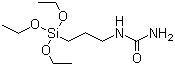 |
| Molecular Formula | C10H24N2O4Si |
| Molecular Weight | 264.40 |
| CAS Registry Number | 23779-32-0 |
| EC Number | 245-876-7 |
| SMILES | CCO[Si](CCCNC(=O)N)(OCC)OCC |
| Solubility | 1263 mg/L (25 °C water) |
|---|---|
| Density | 1.0±0.1 g/cm3, Calc.*, 0.92 g/mL |
| Index of Refraction | 1.451, Calc.* |
| Melting point | 129.57 °C |
| Boiling Point | 305.1±34.0 °C (760 mmHg), Calc.*, 354.12 °C |
| Flash Point | 138.3±25.7 °C, Calc.*, 14 °C |
| * | Calculated using Advanced Chemistry Development (ACD/Labs) Software. |
| Hazard Symbols |   GHS05;GHS07 Danger Details GHS05;GHS07 Danger Details | ||||||||||||||||
|---|---|---|---|---|---|---|---|---|---|---|---|---|---|---|---|---|---|
| Risk Statements | H315-H318-H319 Details | ||||||||||||||||
| Safety Statements | P264-P264+P265-P280-P302+P352-P305+P351+P338-P305+P354+P338-P317-P321-P332+P317-P337+P317-P362+P364 Details | ||||||||||||||||
| Hazard Classification | |||||||||||||||||
| |||||||||||||||||
| SDS | Available | ||||||||||||||||
 chemBlink Chemical Story
|
N-(Triethoxysilylpropyl)urea is an organosilicon compound notable for its unique structure, which combines a urea moiety with a triethoxysilyl group. This compound plays a crucial role in various industrial applications, particularly in surface modification, adhesion promotion, and as a coupling agent in composite materials. The discovery of N-(triethoxysilylpropyl)urea can be traced back to the increasing interest in silane chemistry during the mid-20th century, which aimed to enhance the performance of materials through improved bonding and compatibility. The synthesis of N-(triethoxysilylpropyl)urea typically involves the reaction of triethoxysilane with urea, resulting in the formation of the desired product. This method allows for the incorporation of silane functionalities, which are known for their ability to bond with both organic and inorganic materials. The presence of the triethoxysilyl group in the structure significantly enhances the compatibility of the urea compound with various substrates, making it particularly valuable in applications requiring effective adhesion and surface treatment. One of the primary applications of N-(triethoxysilylpropyl)urea is as a coupling agent in polymer and composite formulations. In this context, it serves to improve the adhesion between inorganic fillers and organic matrices, thereby enhancing the mechanical properties and durability of the resulting materials. This is particularly beneficial in the production of glass fiber-reinforced plastics, where the compatibility of the filler and resin is crucial for achieving optimal performance. The use of N-(triethoxysilylpropyl)urea in such applications leads to improved tensile strength, impact resistance, and overall structural integrity. In addition to its role in composites, N-(triethoxysilylpropyl)urea is utilized in surface treatment applications. Its silane functionality allows it to bond with a variety of substrates, including metals, glass, and ceramics. When applied as a surface modifier, it forms a silane layer that enhances adhesion for coatings, paints, and adhesives. This characteristic is particularly important in industries such as automotive and construction, where the longevity and performance of surface coatings are critical to product durability. By improving the bonding between different materials, N-(triethoxysilylpropyl)urea contributes to the overall performance and reliability of finished products. The compound also finds applications in the field of biotechnology, particularly in the development of bioactive surfaces. By modifying surfaces with N-(triethoxysilylpropyl)urea, researchers can enhance the biocompatibility of implants and medical devices. The urea component can facilitate the immobilization of biomolecules, promoting cellular adhesion and growth. This application is particularly relevant in tissue engineering and regenerative medicine, where the integration of biomaterials with biological systems is essential for successful outcomes. Despite its numerous advantages, the environmental impact and safety considerations associated with N-(triethoxysilylpropyl)urea must be carefully managed. Like many organosilicon compounds, it requires proper handling and assessment to minimize potential risks during production and application. Ongoing research focuses on evaluating its toxicity and environmental persistence to ensure safe usage in industrial and consumer applications. In summary, N-(triethoxysilylpropyl)urea is a versatile chemical substance with significant applications in materials science, particularly in surface modification and adhesion promotion. Its unique structure, combining urea and silane functionalities, enables improved compatibility and bonding in various industrial processes. As research continues to explore its potential, it remains a valuable compound in advancing the performance and reliability of materials across multiple sectors. References 2024. A magnetic epitope-imprinted microsphere used for selective separation and rapid detection of SHV-type β-lactamases in bacteria: a novel strategy of antimicrobial resistance detection. *Journal of Nanobiotechnology*, 22(1). DOI: 10.1186/s12951-024-02949-9 2017. Adsorption affinity and selectivity of 3-ureidopropyltriethoxysilane grafted oil palm empty fruit bunches towards mercury ions. *Environmental Science and Pollution Research International*, 24(19). DOI: 10.1007/s11356-017-9117-z 2012. Preparation and application of functionalized cellulose acetate/silica composite nanofibrous membrane via electrospinning for Cr(VI) ion removal from aqueous solution. *Journal of Environmental Management*, 112. DOI: 10.1016/j.jenvman.2012.05.031 |
| Market Analysis Reports |