Butyltin tris(2-ethylhexanoate), commonly referred to as butyltin octoate, is an organotin compound widely recognized for its role as a heat stabilizer and catalyst in various industrial applications. Its discovery can be traced back to the development of organotin chemistry in the mid-20th century, which aimed to utilize the unique properties of tin-based compounds in polymer chemistry and material science.
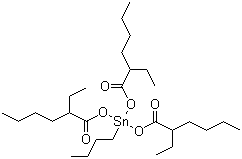
The synthesis of butyltin tris(2-ethylhexanoate) involves the reaction of butyl tin compounds with 2-ethylhexanoic acid. This reaction leads to the formation of a complex where three 2-ethylhexanoate groups are bonded to a central butyltin atom. The resulting compound exhibits significant solubility in organic solvents and compatibility with a variety of polymers, making it an essential additive in many formulations.
One of the primary applications of butyltin tris(2-ethylhexanoate) is as a heat stabilizer in polyvinyl chloride (PVC) and other thermoplastic materials. Its ability to enhance thermal stability allows for the production of durable and long-lasting products, such as pipes, cables, and roofing materials. In the processing of PVC, this compound helps to prevent degradation during manufacturing processes, which often involve high temperatures. By maintaining the integrity of the polymer, butyltin tris(2-ethylhexanoate) contributes to the overall quality and performance of the final product.
In addition to its role as a stabilizer, butyltin tris(2-ethylhexanoate) is also employed as a catalyst in the production of polyurethane foams and elastomers. The compound facilitates the polymerization process by promoting the reaction between isocyanates and polyols, leading to the formation of cross-linked structures. This application is critical in the manufacture of flexible and rigid foams used in furniture, automotive interiors, and insulation materials. The use of butyltin tris(2-ethylhexanoate) in these processes enhances the efficiency of production while ensuring that the resulting materials possess the desired physical properties.
The compound has also found applications in the coatings industry, particularly in the formulation of marine paints and antifouling agents. Its ability to provide effective adhesion and durability makes it valuable in protecting surfaces from environmental degradation and biological growth. In marine applications, butyltin tris(2-ethylhexanoate) helps to prevent the accumulation of barnacles and other marine organisms on ships and underwater structures, thereby enhancing operational efficiency and reducing maintenance costs.
Despite its beneficial properties, the use of butyltin tris(2-ethylhexanoate) and other organotin compounds has raised environmental and health concerns. Organotin compounds are known to exhibit toxicity towards aquatic organisms, leading to regulatory scrutiny and restrictions on their use. As a result, industries have been exploring alternative stabilizers and catalysts that provide similar performance without the associated environmental risks. Research into safer alternatives is ongoing, aiming to develop eco-friendly solutions for the applications currently dominated by butyltin tris(2-ethylhexanoate).
In conclusion, butyltin tris(2-ethylhexanoate) is a significant organotin compound with diverse applications in the plastic, polymer, and coatings industries. Its discovery and development have facilitated advancements in material performance, particularly in enhancing the thermal stability and durability of products. However, the environmental implications of its use necessitate continued research into safer alternatives to ensure sustainable practices in industrial applications.
References
2020. Organotin Compounds in Industrial Catalysis, Part I: Processes of (Trans)esterification. Catalysis in Industry, 12(4).
DOI: 10.1134/s2070050420040078
2016. Comparison of Adipic Versus Renewable Azelaic Acid Polyester Polyols as Building Blocks in Soft Thermoplastic Polyurethanes. Journal of the American Oil Chemists' Society, 93(11).
DOI: 10.1007/s11746-016-2903-9
|





 GHS05;GHS07 Danger Details
 chemBlink Chemical Story