
Online Database of Chemicals from Around the World
| Hangzhou Verychem Science And Technology Co., Ltd. | China | |||
|---|---|---|---|---|
 | www.verychem.com | |||
 | +86 (571) 8816-2785 +86 13606544505 | |||
 | +86 (571) 8816-2787 | |||
 | lucy@verychem.com | |||
| Chemical manufacturer since 2004 | ||||
| chemBlink Massive supplier since 2021 | ||||
| Simagchem Corporation | China | |||
|---|---|---|---|---|
| www.simagchem.com | |||
| +86 13806087780 | |||
| +86 (592) 268-0237 | |||
| sale@simagchem.com | |||
| Chemical manufacturer since 2002 | ||||
| chemBlink Standard supplier since 2008 | ||||
| Ring Specialty Chemicals Inc. | Canada | |||
|---|---|---|---|---|
| www.ringchemicals.com | |||
| +1 (416) 493-6870 | |||
| info@ringchemicals.com | |||
| Chemical distributor | ||||
| chemBlink Standard supplier since 2010 | ||||
| Hangzhou Leap Chem Co., Ltd. | China | |||
|---|---|---|---|---|
| www.leapchem.com | |||
| +86 (571) 8771-1850 | |||
| market19@leapchem.com | |||
 | QQ Chat | |||
| Chemical manufacturer since 2006 | ||||
| chemBlink Standard supplier since 2015 | ||||
| Shanghai Jinjinle Industry Co., Ltd. | China | |||
|---|---|---|---|---|
| www.jjlchem.com | |||
| +86 (21) 6610-5180 5291-0829 5291-3935 | |||
| +86 (21) 3201-0235 | |||
| jjlchem@jjlchem.com | |||
| Chemical manufacturer | ||||
| Anvia Chemicals, LLC | USA | |||
|---|---|---|---|---|
| www.anviachem.com | |||
| +1 (414) 534-7845 | |||
| +1 (414) 762-5539 | |||
| sales@anviachem.com | |||
| Chemical manufacturer | ||||
| Qidong A&P Chemical Factory Co., Ltd. | China | |||
|---|---|---|---|---|
| www.a-pchem.cn | |||
| +86 (513) 8388-3000 8388-4000 8388-5000 | |||
| +86 (513) 8388-6000 / 8388-7000 | |||
| exp@a-pchem.com | |||
| Chemical manufacturer | ||||
| Classification | Organic raw materials >> Amino compound >> Cycloalkylamines, aromatic monoamines, aromatic polyamines and derivatives and salts |
|---|---|
| Name | 2,6-Diisopropylaniline |
| Molecular Structure | 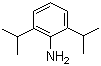 |
| Molecular Formula | C12H19N |
| Molecular Weight | 177.29 |
| CAS Registry Number | 24544-04-5 |
| EC Number | 246-305-4 |
| SMILES | CC(C)C1=C(C(=CC=C1)C(C)C)N |
| Density | 0.9±0.1 g/cm3 Calc.*, 0.94 g/mL (Expl.) |
|---|---|
| Melting point | -45 °C (Expl.) |
| Boiling point | 257.3±9.0 °C 760 mmHg (Calc.)*, 257 °C (Expl.) |
| Flash point | 123.9 °C (Calc.)*, 117 °C (Expl.) |
| Index of refraction | 1.526 (Calc.)*, 1.532 (Expl.) |
| Water solubility | <0.20 g/L |
| * | Calculated using Advanced Chemistry Development (ACD/Labs) Software. |
| Hazard Symbols |  GHS07 Warning Details GHS07 Warning Details | ||||||||||||||||||||
|---|---|---|---|---|---|---|---|---|---|---|---|---|---|---|---|---|---|---|---|---|---|
| Risk Statements | H319-H412 Details | ||||||||||||||||||||
| Safety Statements | P264+P265-P273-P280-P305+P351+P338-P337+P317-P501 Details | ||||||||||||||||||||
| Hazard Classification | |||||||||||||||||||||
| |||||||||||||||||||||
| SDS | Available | ||||||||||||||||||||
 chemBlink Chemical Story
|
2,6-Diisopropylaniline, also known by its chemical formula C12H19N, is an aromatic amine characterized by the presence of two isopropyl groups at the 2- and 6-positions of the aniline ring. This compound is a colorless to pale yellow liquid at room temperature and possesses a distinct aromatic odor typical of substituted anilines. It has been well documented in the chemical literature as a valuable intermediate in organic synthesis, particularly in the development of ligands and catalysts. The discovery of 2,6-diisopropylaniline can be traced back to the broader exploration of substituted anilines in the late 19th and early 20th centuries, during a period when chemists were systematically studying the effects of different substituents on the properties of aromatic compounds. Although an exact year of its first preparation is not clearly noted in the historical record, the compound became more prominent as chemical industries expanded their interest in fine chemicals and specialty amines during the 20th century. In modern applications, 2,6-diisopropylaniline plays an important role as a building block in the synthesis of ligands for transition metal catalysis. One notable class of ligands derived from this compound is the N-heterocyclic carbenes (NHCs) and bulky phosphines, which are used extensively in homogeneous catalysis. The bulky nature of the isopropyl groups in 2,6-diisopropylaniline provides steric protection around reactive centers, which can significantly influence the activity, selectivity, and stability of metal complexes. Such ligands are integral in catalyzing important industrial processes, including hydrogenation, hydroformylation, and cross-coupling reactions. 2,6-Diisopropylaniline is also used as a precursor in the synthesis of various specialty chemicals and materials. It serves as a key starting material for the production of hindered amine light stabilizers (HALS), which are compounds used to protect plastics and coatings from degradation caused by ultraviolet light. These stabilizers are critical in extending the service life of polymer materials exposed to outdoor environments. Another significant application of 2,6-diisopropylaniline is found in the pharmaceutical industry. It is used in the synthesis of certain pharmaceutical intermediates and active pharmaceutical ingredients (APIs). The steric properties imparted by the isopropyl groups can be exploited to achieve desired pharmacokinetic properties or to influence the biological activity of target molecules. Though it is not an API itself, its derivatives are involved in the development of compounds that act as anti-inflammatory agents, antihypertensive drugs, and other therapeutic classes. In the field of materials science, 2,6-diisopropylaniline derivatives have been investigated for use in organic electronics, such as organic light-emitting diodes (OLEDs) and organic photovoltaic cells (OPVs). The electronic properties of the aromatic amine structure, coupled with the steric effects of the isopropyl groups, make it a useful motif for designing novel organic semiconductors and conductive materials. Industrial production of 2,6-diisopropylaniline typically involves the selective alkylation of aniline with propylene in the presence of a Lewis acid catalyst, such as aluminum chloride, under controlled conditions to favor substitution at the 2- and 6-positions. This method allows for the efficient and scalable production of the compound, which is necessary to meet the demand from various industries. In summary, 2,6-diisopropylaniline is a well-established chemical substance with diverse applications across catalysis, materials science, and pharmaceutical development. Its discovery is rooted in the systematic study of substituted aromatic compounds, and its practical importance has grown significantly with advances in synthetic organic chemistry and industrial chemical processes. References 2001. Reaction of NiBr2(DME) with 2-pyridinal-methyl-N-2,6-diisopropylphenylimine. The first crystal structure of an α-diimine nickel(II) complex of the NiL2X2 type. Transition Metal Chemistry, 26(4-5). DOI: 10.1023/a:1007199330939 2020. Syntheses of Analogues of Propofol: A Review. Synthesis, 52(22). DOI: 10.1055/s-0040-1707287 2023. Open science discovery of potent noncovalent SARS-CoV-2 main protease inhibitors. Science (New York, N.Y.), 382(6671). DOI: 10.1126/science.abo7201 |
| Market Analysis Reports |