
Online Database of Chemicals from Around the World
| Simagchem Corporation | China | |||
|---|---|---|---|---|
 | www.simagchem.com | |||
 | +86 13806087780 | |||
 | +86 (592) 268-0237 | |||
 | sale@simagchem.com | |||
| Chemical manufacturer since 2002 | ||||
| chemBlink Standard supplier since 2008 | ||||
| Hefei TNJ Chemical Industry Co., Ltd. | China | |||
|---|---|---|---|---|
| www.tnjchem.com | |||
| +86 (551) 6541-8684 | |||
| +86 (551) 6541-8697 | |||
| sales@tnjchem.com | |||
| Chemical manufacturer since 2001 | ||||
| chemBlink Standard supplier since 2010 | ||||
| BOC Sciences | USA | |||
|---|---|---|---|---|
| www.bocsci.com | |||
| +1 (631) 485-4226 | |||
| +1 (631) 614-7828 | |||
| info@bocsci.com | |||
| Chemical manufacturer | ||||
| chemBlink Standard supplier since 2010 | ||||
| Hangzhou Leap Chem Co., Ltd. | China | |||
|---|---|---|---|---|
| www.leapchem.com | |||
| +86 (571) 8771-1850 | |||
| market19@leapchem.com | |||
 | QQ Chat | |||
| Chemical manufacturer since 2006 | ||||
| chemBlink Standard supplier since 2015 | ||||
| Jiangxi Zhonghuan New Materials Co., Ltd | China | |||
|---|---|---|---|---|
| www.jxzhxcl.com | |||
| 13766287383 | |||
| 2246992030@qq.com | |||
| QQ Chat | |||
 | WeChat: 13766287383 | |||
| Chemical manufacturer since 2016 | ||||
| chemBlink Standard supplier since 2024 | ||||
| Classification | Flavors and spices >> Synthetic spice >> Carboxylic acid and ester perfume >> Other carboxylic acid esters |
|---|---|
| Name | Methyl dihydrojasmonate |
| Synonyms | Methyl (3-oxo-2-pentylcyclopentyl)acetate; (3-Oxo-2-pentyl-cyclopentyl)-acetic acid methyl ester |
| Molecular Structure | 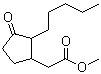 |
| Molecular Formula | C13H22O3 |
| Molecular Weight | 226.31 |
| CAS Registry Number | 24851-98-7 |
| EC Number | 246-495-9 |
| FEMA | 3408 |
| SMILES | CCCCCC1C(CCC1=O)CC(=O)OC |
| Boiling point | 110 °C (0.2 mmHg) |
|---|---|
| Refractive index | 1.459 |
| Hazard Symbols |  GHS07 Warning Details GHS07 Warning Details | ||||||||
|---|---|---|---|---|---|---|---|---|---|
| Risk Statements | H302-H315-H319 Details | ||||||||
| Safety Statements | P261-P305+P351+P338 Details | ||||||||
| Hazard Classification | |||||||||
| |||||||||
| SDS | Available | ||||||||
 chemBlink Chemical Story
|
Discovered in the mid-20th century, Methyl Dihydrojasmonate belongs to the jasmonic acid family, a compound naturally found in various plants, especially jasmine. Its light floral scent, reminiscent of jasmine, with a hint of fruity sweetness, has become a highly regarded ingredient in perfume and fragrance making. A notable feature of Methyl Dihydrojasmonate is its versatility and compatibility with a wide range of perfume ingredients. Its subtle and unique aroma adds depth, complexity and persistence to perfumes, colognes and aromatic products, making it a popular choice among perfumers and perfume lovers. In the field of perfumery, Methyl Dihydrojasmonate is valued for its ability to enhance and modify the olfactory characteristics of perfumes. Whether used as a top note to impart a fresh and uplifting aroma, as a middle note to add warmth and depth, or as a base note to provide a lasting and rich aroma, Methyl Dihydrojasmonate helps enhance the overall characteristics and sensory experience of a perfume. Methyl Dihydrojasmonate also has a wide range of applications in the cosmetics and personal care industries. Its delicate floral scent and skin conditioning properties make it a highly sought-after ingredient in skin care formulations including lotions, creams and body washes. Methyl dihydrojasmonate adds a luxurious touch to cosmetics, delighting consumers with its alluring scent and skin-soothing effects. Methyl dihydrojasmonate has potential applications in aromatherapy and wellness practices. Its calming and uplifting aroma can evoke feelings of relaxation, comfort and well-being, making it a popular choice for aromatherapy blends, massage oils and spa treatments. Whether used to relieve stress, promote sleep or improve mood, Methyl dihydrojasmonate provides aromatic therapeutic benefits that resonate with individuals seeking a holistic approach to health and wellness. In addition to its aromatic properties, Methyl dihydrojasmonate has been studied for its potential bioactive and therapeutic benefits. Preliminary studies suggest that Methyl dihydrojasmonate may have antioxidant and anti-inflammatory properties, which may be useful in skin care, wound healing and diseases of aging. However, further research is needed to fully understand its pharmacological effects and potential applications in healthcare. Despite its widespread use and popularity, Methyl dihydrojasmonate is not without its challenges and considerations. Like other fragrance ingredients, it may cause sensitive or allergic reactions in some people, and it is important to properly formulate, label, and assess safety in fragrance products. References 2024. Integrated Analysis of Transcriptome and Metabolome Reveal the Enhancement of Methyl Dihydrojasmonate on Physiological Indicators and Polyphyllins Biosynthesis in Paris polyphylla var. yunnanensis. *Journal of Plant Growth Regulation*, 43(8). DOI: 10.1007/s00344-024-11413-9 2024. GC-MS analysis underpins ethnomedicinal properties of Rhododendron flower ethanol extracts from Singalila Himalaya highlighting the anticipated biosynthesis pathways of the bioactives. *Discover Food*, 4(1). DOI: 10.1007/s44187-024-00168-7 2023. Fragrances in the Environment: Properties, Applications, and Emissions. *The Handbook of Environmental Chemistry*. DOI: 10.1007/698_2023_983 |
| Market Analysis Reports |