
Online Database of Chemicals from Around the World
| Simagchem Corporation | China | |||
|---|---|---|---|---|
 | www.simagchem.com | |||
 | +86 13806087780 | |||
 | +86 (592) 268-0237 | |||
 | sale@simagchem.com | |||
| Chemical manufacturer since 2002 | ||||
| chemBlink Standard supplier since 2008 | ||||
| Tianjin Zhongxin Chem-tech Co., Ltd. | China | |||
|---|---|---|---|---|
| www.tjzxchem.com | |||
| +86 (22) 6688-0623 | |||
| +86 (22) 8988-0739 ex 8030 | |||
| sales@tjzxchem.com | |||
| Chemical manufacturer since 2007 | ||||
| chemBlink Standard supplier since 2009 | ||||
| Hefei TNJ Chemical Industry Co., Ltd. | China | |||
|---|---|---|---|---|
| www.tnjchem.com | |||
| +86 (551) 6541-8684 | |||
| +86 (551) 6541-8697 | |||
| sales@tnjchem.com | |||
| Chemical manufacturer since 2001 | ||||
| chemBlink Standard supplier since 2010 | ||||
| BOC Sciences | USA | |||
|---|---|---|---|---|
| www.bocsci.com | |||
| +1 (631) 485-4226 | |||
| +1 (631) 614-7828 | |||
| info@bocsci.com | |||
| Chemical manufacturer | ||||
| chemBlink Standard supplier since 2010 | ||||
| Chembridge International Corp. Taipei / Dongguan / Nanjing | China | |||
|---|---|---|---|---|
| www.chembridge.com.tw | |||
| +886 (2) 2649-6320 +86 (769) 2250-4087 +86 (25) 8471-2192 | |||
| +886 (2) 2704-3915 / +86 (769) 2246-8225 / +86 (25) 8471-2052 | |||
| cnservice@chembridge.net | |||
| Chemical manufacturer | ||||
| chemBlink Standard supplier since 2011 | ||||
| Biosynth AG. | Switzerland | |||
|---|---|---|---|---|
| www.biosynth.com | |||
| +41 (71) 858-2020 | |||
| +41 (71) 858-2030 | |||
| welcome@biosynth.ch | |||
| Chemical manufacturer | ||||
| chemBlink Standard supplier since 2014 | ||||
| Hangzhou Leap Chem Co., Ltd. | China | |||
|---|---|---|---|---|
| www.leapchem.com | |||
| +86 (571) 8771-1850 | |||
| market19@leapchem.com | |||
 | QQ Chat | |||
| Chemical manufacturer since 2006 | ||||
| chemBlink Standard supplier since 2015 | ||||
| Zhang Jia Gang YaRui Chemical Co., Ltd. | China | |||
|---|---|---|---|---|
| www.zjgyrchemical.com | |||
| +86 (512) 5896-1066 +86 18921980669 | |||
| +86 (512) 5896-1120 | |||
| sales@yaruichem.com | |||
| QQ Chat | |||
 | Skype Chat | |||
| Chemical manufacturer since 2013 | ||||
| chemBlink Standard supplier since 2020 | ||||
| Achemica | Switzerland | |||
|---|---|---|---|---|
| www.achemica.com | |||
| +41 (24) 466-2929 | |||
| +41 (24) 466-2800 | |||
| contact@achemica.com | |||
| Chemical manufacturer since 2010 | ||||
| Classification | Organic raw materials >> Inorganic acid ester |
|---|---|
| Name | Trixylenyl phosphate |
| Synonyms | Dimethylphenol 1,1',1''-phosphate; Xylenol phosphate; Antiblaze 524; Antiblaze TXP; Coalite NTP; Durad 220X; Phosflex 179; Phosphoric acid trixylyl ester; TXP; Trixylyl phosphate |
| Molecular Structure | 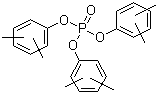 |
| Molecular Formula | C24H27O4P |
| Molecular Weight | 410.45 |
| CAS Registry Number | 25155-23-1 |
| EC Number | 246-677-8 |
| SMILES | CC1=CC(=CC(=C1)OP(=O)(OC2=CC(=CC(=C2)C)C)OC3=CC(=CC(=C3)C)C)C |
| Density | 1.2±0.1 g/cm3, Calc.*, 1.55 g/mL |
|---|---|
| Index of Refraction | 1.570, Calc.* |
| Boiling Point | 490.8±45.0 °C (760 mmHg), Calc.* |
| Flash Point | 263.8±49.1 °C, Calc.* |
| * | Calculated using Advanced Chemistry Development (ACD/Labs) Software. |
| Hazard Symbols |  GHS08 Danger Details GHS08 Danger Details | ||||||||||||||||||||||||||||||||||||||||
|---|---|---|---|---|---|---|---|---|---|---|---|---|---|---|---|---|---|---|---|---|---|---|---|---|---|---|---|---|---|---|---|---|---|---|---|---|---|---|---|---|---|
| Risk Statements | H315-H317-H319-H335-H360-H360F Details | ||||||||||||||||||||||||||||||||||||||||
| Safety Statements | P261-P280-P305+P351+P338-P308+P313 Details | ||||||||||||||||||||||||||||||||||||||||
| Hazard Classification | |||||||||||||||||||||||||||||||||||||||||
| |||||||||||||||||||||||||||||||||||||||||
| SDS | Available | ||||||||||||||||||||||||||||||||||||||||
 chemBlink Chemical Story
|
Trixylenyl phosphate, also known as tri-ortho-cresyl phosphate (TOCP), is an organophosphate compound that has drawn significant attention due to its unique chemical properties and diverse applications across various industries. The discovery of trixylenyl phosphate dates back to the early 20th century, with initial investigations into the properties and potential applications of phosphate esters. Trixylenyl phosphate is formed by the esterification of phosphoric acid with a mixture of ortho-cresol isomers, leading to a compound that exhibits excellent solvating properties. This chemical structure contributes to its effectiveness as a plasticizer, flame retardant, and lubricant. One of the distinguishing features of trixylenyl phosphate is its ability to dissolve a wide range of polymers, enhancing their mechanical properties and processing characteristics. In industrial applications, trixylenyl phosphate is widely used as a plasticizer in the production of flexible polyvinyl chloride (PVC) products. Its high compatibility with PVC enhances the material's flexibility, durability, and resistance to heat and chemicals. This makes it particularly valuable in the manufacturing of electrical cables, flooring, and synthetic leather, where flexibility and stability are essential. Another important application of trixylenyl phosphate is its role as a flame retardant. When incorporated into polymers, it imparts fire-resistant properties, reducing the flammability of materials and enhancing their safety in various applications, including construction materials and consumer goods. The effectiveness of trixylenyl phosphate in this regard has led to its use in numerous industries, including automotive, aerospace, and electronics. Moreover, trixylenyl phosphate has found applications in the formulation of lubricants and hydraulic fluids. Its excellent thermal stability and low volatility make it suitable for high-temperature applications, ensuring reliable performance in challenging environments. Additionally, its lubricating properties help reduce friction and wear in mechanical systems, contributing to improved efficiency and longevity. Despite its widespread use, concerns regarding the potential health and environmental impacts of trixylenyl phosphate have emerged. Research has indicated that exposure to organophosphate compounds may pose risks, including neurotoxic effects. Consequently, regulatory bodies have begun to evaluate the safety of trixylenyl phosphate and other similar compounds, prompting the exploration of alternative materials in some applications. As research continues to expand our understanding of trixylenyl phosphate, efforts are underway to develop safer alternatives that can replace it in applications where potential risks are a concern. Innovations in materials science and chemistry are likely to yield new compounds with similar or enhanced properties, ensuring that industry needs are met while prioritizing safety and environmental sustainability. The ongoing study of trixylenyl phosphate and its derivatives highlights the need for a balanced approach to utilizing this versatile chemical while addressing health and environmental concerns associated with its use. References 2023. Problems Connected with Operation of Fire-Resistant Oils and Ways for Solving Them. *Thermal Engineering*, 70(11). DOI: 10.1134/s0040601523110010 1999. Improved Method for Estimating Bioconcentration/Bioaccumulation Factor from Octanol/Water Partition Coefficient. *Environmental Toxicology and Chemistry*, 18(4). DOI: 10.1002/etc.5620180412 1979. Environmental fate of selected phosphate esters. *Environmental Science & Technology*, 13(7). DOI: 10.1021/es60155a010 |
| Market Analysis Reports |