
Online Database of Chemicals from Around the World
| Simagchem Corporation | China | |||
|---|---|---|---|---|
 | www.simagchem.com | |||
 | +86 13806087780 | |||
 | +86 (592) 268-0237 | |||
 | sale@simagchem.com | |||
| Chemical manufacturer since 2002 | ||||
| chemBlink Standard supplier since 2008 | ||||
| Hefei TNJ Chemical Industry Co., Ltd. | China | |||
|---|---|---|---|---|
| www.tnjchem.com | |||
| +86 (551) 6541-8684 | |||
| +86 (551) 6541-8697 | |||
| sales@tnjchem.com | |||
| Chemical manufacturer since 2001 | ||||
| chemBlink Standard supplier since 2010 | ||||
| BOC Sciences | USA | |||
|---|---|---|---|---|
| www.bocsci.com | |||
| +1 (631) 485-4226 | |||
| +1 (631) 614-7828 | |||
| info@bocsci.com | |||
| Chemical manufacturer | ||||
| chemBlink Standard supplier since 2010 | ||||
| Zhejiang Synose Tech Co., Ltd. | China | |||
|---|---|---|---|---|
| www.synose.com | |||
| +86(579)8227-5537 8917-2081 | |||
| +86 (579) 8227-7133 | |||
| expo@synose.com | |||
| Chemical manufacturer since 1996 | ||||
| chemBlink Standard supplier since 2011 | ||||
| Spectrum Chemical Mfg. Corp. | USA | |||
|---|---|---|---|---|
| www.spectrumchemical.com | |||
| +1 (310) 516-8000 | |||
| +1 (310) 516-7512 | |||
| sales@spectrumchemical.com | |||
| Chemical manufacturer | ||||
| CarboMer, Inc. | USA | |||
|---|---|---|---|---|
| www.carbomer.com | |||
| +1 (858) 552-0992 | |||
| +1 (858) 552-0999 | |||
| sales@carbomer.com | |||
| Chemical manufacturer | ||||
| Chem Service, Inc. | USA | |||
|---|---|---|---|---|
| www.chemservice.com | |||
| +1 (610) 692-3026 | |||
| +1 (610) 692-8729 | |||
| info@chemservice.com | |||
| Chemical manufacturer since 1962 | ||||
| Classification | Surfactant >> Nonionic surfactant >> Polyol ester type |
|---|---|
| Name | Sucrose stearate |
| Synonyms | Sucrose monostearate; Sucrose monostearic acid ester |
| Molecular Structure | 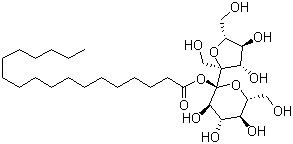 |
| Molecular Formula | C30H56O12 |
| Molecular Weight | 608.76 |
| CAS Registry Number | 25168-73-4 |
| EC Number | 246-705-9 |
| SMILES | CCCCCCCCCCCCCCCCCC(=O)O.C([C@@H]1[C@H]([C@@H]([C@H]([C@H](O1)O[C@]2([C@H]([C@@H]([C@H](O2)CO)O)O)CO)O)O)O)O |
| Density | 1.2±0.1 g/cm3 Calc.* |
|---|---|
| Boiling point | 763.2±60.0 °C 760 mmHg (Calc.)* |
| Flash point | 235.6±26.4 °C (Calc.)* |
| Index of refraction | 1.546 (Calc.)* |
| * | Calculated using Advanced Chemistry Development (ACD/Labs) Software. |
| Hazard Symbols |  GHS07 Warning Details GHS07 Warning Details | ||||||||
|---|---|---|---|---|---|---|---|---|---|
| Risk Statements | H302-H315-H319 Details | ||||||||
| Safety Statements | P501-P270-P264-P280-P302+P352-P337+P313-P305+P351+P338-P362+P364-P332+P313-P301+P312+P330 Details | ||||||||
| Hazard Classification | |||||||||
| |||||||||
| SDS | Available | ||||||||
 chemBlink Chemical Story
|
Sucrose stearate is an ester formed from sucrose and stearic acid and belongs to the broader class of sucrose fatty acid esters. Its development is closely connected to twentieth-century research on nonionic surfactants derived from renewable raw materials. Sucrose, a naturally occurring disaccharide composed of glucose and fructose, had long been known as a widely available carbohydrate obtained from sugar cane and sugar beet. Stearic acid, a saturated C18 fatty acid, is commonly derived from animal fats and vegetable oils. The combination of these two substances through esterification led to a family of amphiphilic compounds with valuable surface-active properties. The synthesis of sucrose esters was investigated extensively in the mid-twentieth century as part of efforts to develop biodegradable and food-compatible emulsifiers. Direct esterification of sucrose with fatty acids is complicated by the limited solubility of sucrose in nonpolar media and its thermal sensitivity. As a result, industrial production methods were established using transesterification reactions between sucrose and fatty acid methyl esters under controlled conditions. Catalysts and specific reaction parameters were optimized to promote partial esterification while minimizing decomposition. The resulting products typically contain a distribution of mono-, di-, and higher esters, with sucrose stearate referring to materials in which stearic acid residues are attached to one or more of the hydroxyl groups of sucrose. The amphiphilic structure of sucrose stearate underlies its principal applications. The sucrose moiety is strongly hydrophilic due to its multiple hydroxyl groups, whereas the stearate chain is hydrophobic. This dual character enables the molecule to adsorb at oil–water interfaces and reduce interfacial tension. Experimental studies have demonstrated its effectiveness as an emulsifier in oil-in-water systems. By stabilizing dispersed droplets and inhibiting coalescence, sucrose stearate contributes to the texture and stability of emulsified products. In the food industry, sucrose stearate is used as an emulsifier and stabilizer in products such as baked goods, confectionery, dairy preparations, and beverages. Its safety has been evaluated in toxicological studies, and sucrose fatty acid esters have been approved for food use in many jurisdictions. Their biodegradability and origin from edible raw materials have supported their acceptance as food additives. In formulations, the hydrophilic–lipophilic balance can be adjusted by controlling the degree of esterification, allowing manufacturers to tailor functional performance to specific applications. Beyond food uses, sucrose stearate has been applied in cosmetics and pharmaceuticals. In topical formulations, it functions as an emulsifying and dispersing agent, contributing to the stability and sensory properties of creams and lotions. In pharmaceutical systems, sucrose esters have been investigated as excipients to enhance solubilization of poorly water-soluble active ingredients and to improve dispersion uniformity. Their nonionic character reduces the likelihood of ionic interactions with active compounds, which can be advantageous in sensitive formulations. Research has also examined the physicochemical properties of sucrose stearate, including its phase behavior, critical micelle concentration, and interaction with other surfactants. These studies have provided insight into its performance in complex mixtures and its compatibility with a range of ingredients. Because sucrose stearate can form liquid crystalline phases under certain conditions, it has attracted interest in structured emulsions and controlled-release systems. The development and application of sucrose stearate illustrate the broader trend toward utilizing carbohydrate-based surfactants derived from renewable resources. Through experimentally established synthesis methods and documented functional properties, sucrose stearate has become an important component in food, cosmetic, and pharmaceutical formulations, reflecting a well-documented intersection of carbohydrate chemistry and surface science. References 2022. Tailoring crystallization and physical properties of palm mid-fraction with sorbitan tristearate and sucrose stearate. Food Chemistry. DOI: 10.1016/j.foodchem.2021.130943 2020. Controlling the Kinetics of an Enzymatic Reaction through Enzyme or Substrate Confinement into Lipid Mesophases with Tunable Structural Parameters. International Journal of Molecular Sciences. DOI: 10.3390/ijms21145116 2019. Allergic contact dermatitis to sucrose stearate in a facial moisturizing cream. Contact Dermatitis. DOI: 10.1111/cod.13449 |
| Market Analysis Reports |