
Online Database of Chemicals from Around the World
| Watec Laboratories, Inc. | China | |||
|---|---|---|---|---|
 | www.wateclaboratories.com | |||
 | +86 (519) 8692-1516 +86 18602586511 | |||
 | +86 (519) 8526-7382 | |||
 | info@wateclaboratories.com | |||
 | QQ Chat | |||
| Chemical manufacturer since 2014 | ||||
| chemBlink Standard supplier since 2012 | ||||
| Classification | Pharmaceutical intermediate >> Heterocyclic compound intermediate >> Pyrimidine compound >> Carboxylic acid |
|---|---|
| Name | 2-Hexyldecanoic acid |
| Molecular Structure | 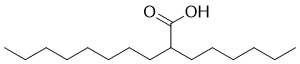 |
| Molecular Formula | C16H32O2 |
| Molecular Weight | 256.42 |
| CAS Registry Number | 25354-97-6 |
| EC Number | 246-885-9 |
| SMILES | CCCCCCCCC(CCCCCC)C(=O)O |
| Density | 0.88 g/mL |
|---|---|
| Melting point | 10 °C |
| Index of Refraction | 1.446 |
| Boiling Point | 165-168 °C (2 mmHg) |
| Flash Point | 174 °C |
| Hazard Symbols |  GHS07 Warning Details GHS07 Warning Details | ||||||||||||||||||||||||||||||||||||
|---|---|---|---|---|---|---|---|---|---|---|---|---|---|---|---|---|---|---|---|---|---|---|---|---|---|---|---|---|---|---|---|---|---|---|---|---|---|
| Risk Statements | H315-H319 Details | ||||||||||||||||||||||||||||||||||||
| Safety Statements | P264-P280-P302+P352+P332+P313+P362+P364-P305+P351+P338+P337+P313 Details | ||||||||||||||||||||||||||||||||||||
| Hazard Classification | |||||||||||||||||||||||||||||||||||||
| |||||||||||||||||||||||||||||||||||||
| SDS | Available | ||||||||||||||||||||||||||||||||||||
 chemBlink Chemical Story
|
2-Hexyldecanoic acid is a saturated fatty acid that has attracted great interest in various fields due to its unique properties and wide range of applications. This chemical is well known for its use in cosmetics, pharmaceuticals, and industrial applications, and its structural characteristics and functional capabilities bring many benefits. 2-Hexyldecanoic acid, also known as isostearic acid, was first discovered and synthesized when researchers were exploring the properties and potential uses of fatty acids. This branched fatty acid is a derivative of stearic acid, which is commonly found in animal and plant fats. The branched structure of 2-hexyldecanoic acid has unique physical and chemical properties that distinguish it from straight-chain fatty acids. The unique branched structure of 2-hexyldecanoic acid gives it a variety of beneficial properties, including enhanced stability, a reduced melting point, and solubility in various solvents. These properties make it a valuable ingredient in many formulations. In cosmetics, 2-hexyldecanoic acid is highly regarded for its emollient properties. It helps form a protective barrier against water loss, leaving the skin soft and smooth. This makes it an excellent ingredient in moisturizers, lotions, and creams designed for dry and sensitive skin. Additionally, its non-greasy texture and ability to spread easily on the skin make it popular in personal care products. In pharmaceuticals, 2-hexyldecanoic acid is used as an excipient in topical formulations. Its stability and compatibility with other ingredients make it an ideal carrier for active pharmaceutical compounds. It enhances the delivery and absorption of these compounds through the skin, improving the efficacy of topical treatments. In industrial applications, 2-hexyldecanoic acid can be used as a lubricant and plasticizer. Its ability to improve the flexibility and durability of materials makes it a valuable additive in the production of plastics, resins, and rubbers. The chemical stability and antioxidant properties of 2-hexyldecanoic acid also make it suitable for high-performance lubricants and coatings. The versatility of 2-hexyldecanoic acid has led to its widespread use in several industries. In the cosmetics industry, it is a key ingredient in formulations designed to enhance skin moisturization and texture. Its emollient properties make it a key ingredient in products targeting dry and sensitive skin. In the pharmaceutical industry, the role of 2-hexyldecanoic acid as an excipient in topical formulations highlights its importance in enhancing the delivery and efficacy of active compounds. Its use in industrial applications such as lubricants and plasticizers highlights its value in improving material properties and performance. References 2023. A Route to Synthesize Ionizable Lipid ALC-0315, a Key Component of the mRNA Vaccine Lipid Matrix. Russian Journal of Bioorganic Chemistry, 49(2). DOI: 10.1134/s1068162023020061 2015. Biodegradation of naphthenic acid surrogates by axenic cultures. Biodegradation, 26(4). DOI: 10.1007/s10532-015-9736-3 2013. Heats of Combustion of Fatty Acids and Fatty Acid Esters. Journal of the American Oil Chemists’ Society, 90(12). DOI: 10.1007/s11746-013-2367-0 |
| Market Analysis Reports |