
Online Database of Chemicals from Around the World
| Wuhan Kemi-works Chemical Co., Ltd. | China | |||
|---|---|---|---|---|
 | www.kemiworks.net | |||
 | +86 (27) 8573-6489 | |||
 | +86 (27) 8573-6485 | |||
 | info@kemiworks.net sales@kemiworks.com | |||
| Chemical manufacturer | ||||
| chemBlink Premium supplier since 2011 | ||||
| Classification | Chemical reagent >> Organic reagent >> Sulfonate / sulfinate |
|---|---|
| Name | Poly(sodium-p-styrenesulfonate) |
| Synonyms | Poly(Sodium 4-Styrenesulfonate); Poly(sodium styrenesulfonate); 4-Ethenyl-benzenesulfonic acid sodium salt homopolymer |
| Molecular Structure | 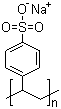 |
| Molecular Formula | (C8H7NaO3S)n |
| CAS Registry Number | 25704-18-1 |
| EC Number | 607-780-7 |
| SMILES | C=Cc1ccc(cc1)S(=O)(=O)[O-].[Na+] |
| Density | 0.801 |
|---|---|
| Melting point | 460 °C (dec.) |
| Water solubility | SOLUBLE |
| Hazard Symbols |  GHS07 Warning Details GHS07 Warning Details | ||||||||||||||||
|---|---|---|---|---|---|---|---|---|---|---|---|---|---|---|---|---|---|
| Risk Statements | H315-H319-H335 Details | ||||||||||||||||
| Safety Statements | P261-P264-P271-P280-P302+P352-P304+P340-P305+P351+P338-P312-P362-P403+P233-P501 Details | ||||||||||||||||
| Hazard Classification | |||||||||||||||||
| |||||||||||||||||
| SDS | Available | ||||||||||||||||
 chemBlink Chemical Story
|
Poly(sodium-p-styrenesulfonate), often abbreviated as PSS, is an important polyelectrolyte with a wide range of applications in various fields, including biochemistry, materials science, and environmental engineering. It is a water-soluble polymer that consists of a styrene backbone with sulfonate groups (-SO3Na) attached to the aromatic rings. These sulfonate groups impart strong anionic character to the polymer, making it highly soluble in water and able to interact with a variety of substances in solution. The discovery of poly(sodium-p-styrenesulfonate) dates back to the mid-20th century when researchers were exploring the properties of sulfonated styrene derivatives for use in ion-exchange resins and other applications. The development of PSS was part of a broader effort to create polymers with specific functional groups that could interact with charged particles, such as metal ions and other charged species in solution. The introduction of sulfonate groups onto the styrene polymer backbone was a significant step forward in the synthesis of functionalized polyelectrolytes, as it allowed for better control over the polymer’s solubility and ionic properties. Poly(sodium-p-styrenesulfonate) has found a wide range of uses, primarily due to its high water solubility and anionic character. One of the primary applications of PSS is in the field of water treatment, where it is used as a dispersant or flocculant. The polymer's ability to stabilize suspensions of particles in water and prevent aggregation makes it valuable for controlling the dispersion of materials in water-based systems. For example, it is often used in wastewater treatment plants to help remove suspended solids and other contaminants from the water. In biochemistry, poly(sodium-p-styrenesulfonate) is commonly employed as a stabilizer for enzymes, proteins, and other biomolecules in solution. Its anionic nature helps prevent the aggregation of these molecules and stabilizes their structure, which is essential for maintaining their biological activity. PSS is also used in electrophoresis, where its ability to impart a negative charge to molecules is leveraged for the separation of proteins, nucleic acids, and other biomolecules in gel electrophoresis techniques. Another key application of poly(sodium-p-styrenesulfonate) is in the field of electronics and materials science. It is used in the fabrication of conductive polymers, particularly in the development of organic electronic devices, such as organic light-emitting diodes (OLEDs) and organic solar cells. PSS acts as a stabilizing agent in these systems, enhancing the dispersion of conducting materials and improving the performance of the devices. In conclusion, poly(sodium-p-styrenesulfonate) is a versatile polyelectrolyte with a wide range of applications across various industries, including water treatment, biochemistry, and electronics. Its unique chemical properties, such as water solubility and anionic character, make it an essential component in numerous technologies and products. |
| Market Analysis Reports |