
Online Database of Chemicals from Around the World
| Hubei Nanxing Polymer Additives Co., Ltd. | China | |||
|---|---|---|---|---|
 | www.polymeradditives.cn | |||
 | +86 (717) 675-2602 | |||
 | +86 (717) 675-2825 | |||
 | info@polymeradditives.cn | |||
| Chemical manufacturer since 1987 | ||||
| chemBlink Standard supplier since 2008 | ||||
| Alfa Chemistry | USA | |||
|---|---|---|---|---|
| www.alfa-chemistry.com | |||
| +1 (516) 734-6573 | |||
| +1 (516) 927-0118 | |||
| support@alfa-chemistry.com | |||
| Chemical manufacturer since 2005 | ||||
| chemBlink Standard supplier since 2012 | ||||
| Xiamen WangQin Chemical Technology Co., Ltd. | China | |||
|---|---|---|---|---|
| www.resin-wq.com | |||
| +86 (592) 579-6154 | |||
| lias@xmcontinent.com | |||
| Chemical manufacturer since 2010 | ||||
| chemBlink Standard supplier since 2026 | ||||
| Classification | Food additive |
|---|---|
| Name | Butyl acrylate-methyl methacrylate polymers |
| Synonyms | Butyl acrylate-methyl methacrylate copolymer |
| Molecular Structure | 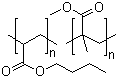 |
| Molecular Formula | (C5H8O2)n.(C7H12O2)n |
| CAS Registry Number | 25852-37-3 |
| EC Number | 630-433-6 |
| SMILES | C=C(C)C(=O)OC.C=CC(=O)OCCCC |
| * | Calculated using Advanced Chemistry Development (ACD/Labs) Software. |
| Hazard Classification | |||||||||
|---|---|---|---|---|---|---|---|---|---|
| |||||||||
 chemBlink Chemical Story
|
Butyl acrylate-methyl methacrylate polymers, identified by CAS 25852-37-3, are acrylic copolymers built from two monomers with very different personalities. Butyl acrylate forms soft, flexible polymers, while methyl methacrylate forms much harder, glassier materials. By combining the two in different proportions and architectures, polymer chemists can tune properties such as flexibility, hardness, film formation, adhesion, toughness, and glass-transition temperature. This ability to balance opposing characteristics has made butyl acrylate-methyl methacrylate copolymers important examples of modern formulation-driven polymer design. The scientific idea behind these materials emerged as polymer chemistry moved beyond the discovery of individual plastics. Early polymers were often judged as fixed substances: polyethylene was flexible, polystyrene was rigid, and polymethyl methacrylate was hard and transparent. As copolymerization became better understood, chemists realized that a material did not have to inherit the limitations of a single monomer. Different building blocks could be combined within the same macromolecule, allowing properties to be adjusted continuously rather than selected from a fixed menu. Butyl acrylate and methyl methacrylate illustrate this principle particularly clearly. Poly(butyl acrylate) is soft and rubbery at ordinary temperatures, whereas poly(methyl methacrylate) is much more rigid. When the two monomers are copolymerized, increasing the butyl acrylate content generally lowers the glass-transition temperature and increases flexibility, while increasing methyl methacrylate raises hardness and dimensional stability. Studies of BA-MMA copolymers have shown that their glass-transition behavior can be systematically varied through composition, demonstrating how molecular recipe directly controls macroscopic performance. This tunability became especially valuable in latex and emulsion polymers. In a typical waterborne acrylic dispersion, tiny polymer particles are suspended in water. When the coating is applied and the water evaporates, those particles must deform, contact one another, and allow polymer chains to interdiffuse until a continuous film forms. If the polymer is too hard, good film formation may require excessive heat or added coalescing solvents. If it is too soft, the finished film may remain tacky or lack sufficient mechanical strength. BA-MMA copolymers provide a practical way to balance these competing requirements. Research on poly(butyl acrylate-co-methyl methacrylate) latex films has therefore focused extensively on glass-transition temperature, particle deformation, chain diffusion, and film formation. These studies helped establish fundamental concepts that are now central to waterborne coatings technology. By adjusting monomer ratio, molecular weight, particle structure, and additional comonomers, formulators can create films ranging from soft and pressure-sensitive to harder and more durable. The same balance between softness and rigidity also makes BA-MMA chemistry useful in adhesives, impact modifiers, coatings, polymer blends, and specialty resins. In some commercial systems, the two monomers are arranged in core-shell or block-like architectures rather than as simple random copolymers. A soft butyl-acrylate-rich phase can absorb impact or provide elasticity, while a methyl-methacrylate-rich phase can contribute strength and surface hardness. This demonstrates another major principle of modern polymer science: composition matters, but molecular architecture matters as well. CAS 25852-37-3 has also appeared in regulated polymer applications, including certain food-contact materials under specified conditions. Such listings reflect the broad industrial role of acrylic copolymers and the importance of controlling residual monomers, formulation, and intended use rather than treating the polymer simply as a single small-molecule chemical. The scientific significance of butyl acrylate-methyl methacrylate copolymers therefore lies in a deceptively simple idea: combine a soft monomer with a hard one and tune the balance until the material does exactly what the application requires. This approach helped transform polymer science from the search for entirely new plastics into the design of customized material systems. Modern coatings, adhesives, impact-resistant plastics, and waterborne polymer technologies all rely on this same philosophy—materials are not merely discovered; they are formulated. References 1. Fernandez-Garcia, M.; Cuervo-Rodriguez, R.; Madruga, E. L. (1999). "Glass transition temperatures of butyl acrylate-methyl methacrylate copolymers." Journal of Polymer Science Part B: Polymer Physics, 37, 2512-2520. https://doi.org/10.1002/(SICI)1099-0488(19990901)37:17<2512::AID-POLB22>3.0.CO;2-2 2. Liu, Y.; Haley, J. C.; Deng, K.; Lau, W.; Winnik, M. A. (2007). "Effect of Polymer Composition on Polymer Diffusion in Poly(butyl acrylate-co-methyl methacrylate) Latex Films." Macromolecules, 40(17), 6422-6431. https://doi.org/10.1021/ma070853c 3. U.S. Food and Drug Administration. Inventory of Food Contact Substances Listed in 21 CFR: Methyl methacrylate-butyl acrylate copolymer, CAS 25852-37-3. FDA Food Contact Substance Inventory |
| Market Analysis Reports |