
Online Database of Chemicals from Around the World
| Earlier HK Company Limited | China | |||
|---|---|---|---|---|
 | www.earlierchem.com | |||
 | +86 (10) 6142-6769 +86 18616907430 | |||
 | +86 (10) 6142-6769 | |||
 | info@earlierchem.com | |||
 | QQ Chat | |||
| Chemical manufacturer since 2011 | ||||
| chemBlink Premium supplier since 2014 | ||||

| Hangzhou Verychem Science And Technology Co., Ltd. | China | |||
|---|---|---|---|---|
| www.verychem.com | |||
| +86 (571) 8816-2785 +86 13606544505 | |||
| +86 (571) 8816-2787 | |||
| lucy@verychem.com | |||
| Chemical manufacturer since 2004 | ||||
| chemBlink Massive supplier since 2021 | ||||
| Classification | Organic raw materials >> Amino compound >> Oxy-containing amino compound |
|---|---|
| Name | 1-(3-Dimethylaminopropyl)-3-ethylcarbodiimide hydrochloride |
| Synonyms | N'-(ethylcarbonimidoyl)-N,N-dimethylpropane-1,3-diamine monohydrochloride; N-Ethyl-N'-(3-dimethylaminopropyl)carbodiimide hydrochloride; WSC; EDC.HCl; EDAC.HCl |
| Molecular Structure | 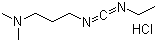 |
| Molecular Formula | C8H17N3.HCl;C8H18ClN3 |
| Molecular Weight | 191.70 |
| CAS Registry Number | 25952-53-8 |
| EC Number | 247-361-2 |
| SMILES | CCN=C=NCCCN(C)C.Cl |
| Melting point | 110-114 °C |
|---|---|
| Water solubility | Soluble |
| Hazard Symbols |      GHS05;GHS06;GHS07;GHS08;GHS09 Danger Details GHS05;GHS06;GHS07;GHS08;GHS09 Danger Details | ||||||||||||||||||||||||||||||||||||||||||||||||||||||||||||||||||||
|---|---|---|---|---|---|---|---|---|---|---|---|---|---|---|---|---|---|---|---|---|---|---|---|---|---|---|---|---|---|---|---|---|---|---|---|---|---|---|---|---|---|---|---|---|---|---|---|---|---|---|---|---|---|---|---|---|---|---|---|---|---|---|---|---|---|---|---|---|---|
| Risk Statements | H302-H311-H315-H317-H318-H319-H335-H373-H400-H410 Details | ||||||||||||||||||||||||||||||||||||||||||||||||||||||||||||||||||||
| Safety Statements | P260-P261-P262-P264-P264+P265-P270-P271-P272-P273-P280-P301+P317-P302+P352-P304+P340-P305+P351+P338-P305+P354+P338-P316-P317-P319-P321-P330-P332+P317-P333+P317-P337+P317-P361+P364-P362+P364-P391-P403+P233-P405- Details | ||||||||||||||||||||||||||||||||||||||||||||||||||||||||||||||||||||
| Hazard Classification | |||||||||||||||||||||||||||||||||||||||||||||||||||||||||||||||||||||
| |||||||||||||||||||||||||||||||||||||||||||||||||||||||||||||||||||||
| SDS | Available | ||||||||||||||||||||||||||||||||||||||||||||||||||||||||||||||||||||
 chemBlink Chemical Story
|
1-(3-Dimethylaminopropyl)-3-ethylcarbodiimide hydrochloride, often abbreviated as EDC or EDC-HCl, is a coupling agent widely used in organic synthesis, especially in the formation of amide bonds. Its efficiency and versatility have made it a staple reagent in biochemical and pharmaceutical research. EDC-HCl was first introduced in the mid-20th century as a carbodiimide coupling agent. It is a water-soluble white crystalline powder with the chemical formula C₈H₁₇N₃·HCl. The compound is characterized by its ability to activate carboxyl groups, promoting their reaction with nucleophiles such as amines and alcohols to form amide and ester bonds. EDC-HCl is particularly valued for its solubility in water and organic solvents, making it suitable for a wide range of reaction conditions. Unlike other carbodiimides, EDC-HCl does not form urea byproducts that are insoluble in water, thus simplifying the purification of the reaction products. One of the main uses of EDC-HCl is in peptide synthesis, where it activates the carboxyl groups of amino acids to promote the formation of peptide bonds. This process is essential in the assembly of peptides and proteins, making EDC-HCl indispensable in both laboratory and industrial settings. EDC-HCl is also used in the synthesis of nucleotides and nucleic acid derivatives. By activating phosphate groups, EDC-HCl is able to form phosphodiester bonds, which are essential for the construction of DNA and RNA chains. In the synthesis of glycopeptides and other glycoconjugates, EDC-HCl facilitates the formation of glycosidic bonds. This application is particularly important in the development of vaccines and therapeutics. Bioconjugation involves the chemical attachment of biomolecules to improve their functionality or enable their detection and quantification. EDC-HCl plays a vital role in this process by facilitating the attachment of proteins, peptides, and other biomolecules to surfaces or other molecules. EDC-HCl is used to cross-link proteins by forming stable amide bonds between carboxyl groups on one protein and amine groups on another. This technique is widely used in the preparation of enzyme-linked immunosorbent assays (ELISAs) and other diagnostic tools. In biosensor development, EDC-HCl is used to immobilize biomolecules on sensor surfaces. This application enhances the sensitivity and specificity of biosensors used for medical diagnostics and environmental monitoring. EDC-HCl is used in the design of drug delivery systems, where it helps bind drugs to targeting molecules, thereby increasing the specificity and efficacy of therapeutic agents. Although EDC-HCl is a potent reagent, it must be handled with care. It can irritate the skin, eyes, and respiratory system. Taking appropriate safety precautions, including the use of gloves, goggles, and working in well-ventilated areas, is essential to prevent exposure. EDC-HCl should be stored in a cool, dry place away from moisture and incompatible materials. References 2024. Fabrication and characteristics of paclitaxel-loaded Mn-doped dendritic mesoporous silica coated with carboxymethyl chitosan. Indian Journal of Physics. DOI: 10.1007/s12648-024-03433-8 2013. Tips for the Functionalization of Nanoparticles with Antibodies. Methods in Molecular Biology. DOI: 10.1007/978-1-62703-550-7_11 2012. Nanoporous gold as a solid support for protein immobilization and development of an electrochemical immunoassay for prostate specific antigen and carcinoembryonic antigen. Microchimica Acta. DOI: 10.1007/s00604-012-0870-x |
| Market Analysis Reports |