
Online Database of Chemicals from Around the World
| Guangzhou Amsper Biotechnology Ltd. | China | |||
|---|---|---|---|---|
 | www.amsper.com | |||
 | +8618565278009 | |||
 | gifty@amsper.com | |||
 | QQ Chat | |||
 | Skype Chat | |||
 | WeChat: +8618565278009 | |||
 | WhatsApp:+8618565278009 | |||
| Chemical distributor since 2018 | ||||
| chemBlink Standard supplier since 2025 | ||||
| Classification | Organic raw materials >> Carboxylic compounds and derivatives |
|---|---|
| Name | Fmoc-Tyr(tBu)-Aib-OH |
| Synonyms | N-alpha-(9-Fluorenylmethyloxycarbonyl)-O-t-butyl-L-tyrosyl-aminoisobutyric acid (Fmoc-L-Tyr(tBu)-Aib-OH); 2-[[(2S)-2-(9H-fluoren-9-ylmethoxycarbonylamino)-3-[4-[(2-methylpropan-2-yl)oxy]phenyl]propanoyl]amino]-2-methylpropanoic acid |
| Molecular Structure | 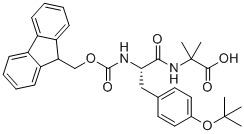 |
| Molecular Formula | C32H36N2O6 |
| Molecular Weight | 544.64 |
| Protein Sequence | XX |
| CAS Registry Number | 2645414-22-6 |
| SMILES | CC(C)(C)OC1=CC=C(C=C1)C[C@@H](C(=O)NC(C)(C)C(=O)O)NC(=O)OCC2C3=CC=CC=C3C4=CC=CC=C24 |
| Hazard Symbols |  GHS07 Warning Details GHS07 Warning Details |
|---|---|
| Risk Statements | H315-H319-H335 Details |
| Safety Statements | P261-P305+351+338-P302+352 Details |
| SDS | Available |
 chemBlink Chemical Story
|
Fmoc-Tyr(tBu)-Aib-OH is a synthetic dipeptide derivative that plays a significant role in modern peptide synthesis. It is composed of three important protective and structural elements. The N-terminus carries the Fmoc (9-fluorenylmethoxycarbonyl) group, one of the most widely used protecting groups in solid-phase peptide synthesis, removable under mild basic conditions such as piperidine in dimethylformamide. The first amino acid residue is tyrosine (Tyr), a naturally occurring aromatic amino acid with a phenolic hydroxyl group. In this compound, the hydroxyl of tyrosine is protected by a tert-butyl (tBu) group to prevent unwanted side reactions during coupling. The second residue is α-aminoisobutyric acid (Aib), a non-proteinogenic amino acid with two methyl substituents on the α-carbon. This unusual structure restricts backbone flexibility and stabilizes helical conformations. The C-terminus is present as a free carboxylic acid (-OH), allowing the compound to be incorporated into longer peptide chains. The discovery and use of Fmoc-Tyr(tBu)-Aib-OH are linked to two key developments in peptide chemistry: the introduction of the Fmoc protecting group and the growing use of Aib as a conformationally constraining amino acid. Fmoc-based chemistry became a standard in the late 20th century due to its orthogonal protection strategy, allowing selective removal of protecting groups without damaging the peptide backbone or other side-chain protections. At the same time, researchers studying secondary structures discovered that incorporating Aib residues promoted stable α-helices and 310-helices. The combination of these approaches gave rise to building blocks such as Fmoc-Tyr(tBu)-Aib-OH, which allow synthetic chemists to construct peptides with both functional diversity and structural rigidity. Applications of Fmoc-Tyr(tBu)-Aib-OH are diverse, spanning peptide synthesis, medicinal chemistry, and structural biology. In peptide synthesis, it functions as a protected dipeptide building block, enabling efficient incorporation of tyrosine and Aib into growing sequences. The tBu group ensures that the reactive hydroxyl of tyrosine remains protected until selective deprotection is desired, while the Fmoc group provides reversible N-terminal protection compatible with automated solid-phase synthesis. This makes it a versatile intermediate in designing peptides with complex architectures. In medicinal chemistry, Aib-containing peptides derived from Fmoc-Tyr(tBu)-Aib-OH are particularly valuable. The steric hindrance of Aib confers resistance to enzymatic degradation, improving the metabolic stability of therapeutic peptides. Tyrosine residues add functional interaction points through hydrogen bonding and aromatic stacking, enhancing binding to biological targets. These features make Aib-containing peptides attractive scaffolds in drug design, including enzyme inhibitors, receptor ligands, and antimicrobial peptides. In structural biology, Fmoc-Tyr(tBu)-Aib-OH is used in synthesizing model peptides for studying protein folding and secondary structure formation. The helical stabilization effect of Aib allows researchers to examine short peptide helices that mimic natural protein motifs. These synthetic peptides are often studied using circular dichroism, fluorescence spectroscopy, and NMR to understand the influence of sequence and environment on peptide conformation. Tyrosine residues also serve as intrinsic spectroscopic probes due to their aromatic side chains, further aiding structural investigations. Beyond fundamental research, derivatives of Fmoc-Tyr(tBu)-Aib-OH find use in materials science. Peptides containing Aib residues can form stable self-assembled structures such as nanofibers and gels, which are of interest for biomedical applications including drug delivery and tissue engineering. The presence of protected tyrosine residues provides opportunities for selective modification, enabling the introduction of functional groups to tailor the properties of peptide-based materials. The development of Fmoc-Tyr(tBu)-Aib-OH exemplifies the sophistication of peptide synthesis, where protecting group strategies and conformationally restrictive amino acids are combined to create powerful tools for both basic research and applied sciences. It remains a key intermediate that enables precise control over peptide structure and function, contributing to advances in chemistry, biology, and materials engineering. References 2022. Methods of making incretin analogs. Publication Number: US-2022411461-A1. |
| Market Analysis Reports |