
Online Database of Chemicals from Around the World
| Allmpus laboratories private limited | India | |||
|---|---|---|---|---|
 | www.allmpus.com | |||
 | 08655752646 | |||
 | reach@allmpus.co.in | |||
| Chemical manufacturer since 2017 | ||||
| chemBlink Standard supplier since 2026 | ||||
| Classification | Pharmaceutical intermediate >> Heterocyclic compound intermediate >> Pyrimidine compound |
|---|---|
| Name | Alogliptin Impurity 43 |
| Synonyms | (6-Chloro-3-methyl-1-(2-cyanobenzyl)-1,2,3,4-tetrahydropyrimidinyl-5-yl) Alogliptin; 2-[[6-chloro-1-[(2-cyanophenyl)methyl]-3-methyl-2,4-dioxopyrimidin-5-yl]methyl]benzonitrile |
| Molecular Structure | 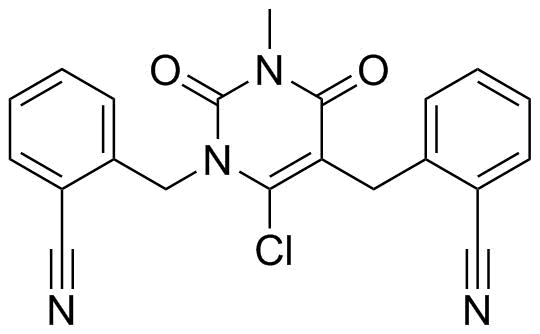 |
| Molecular Formula | C21H15ClN4O2 |
| Molecular Weight | 390.82 |
| CAS Registry Number | 2716884-59-0 |
| SMILES | CN1C(=O)C(=C(N(C1=O)CC2=CC=CC=C2C#N)Cl)CC3=CC=CC=C3C#N |
| Density | 1.41±0.1 g/mL |
|---|---|
| Boiling point | 570.4±60.0 °C (760 mmHg) |
 chemBlink Chemical Story
|
Alogliptin Impurity 43, CAS 2716884-59-0, is a process-related compound associated with the synthesis and quality control of alogliptin, a dipeptidyl peptidase-4 inhibitor used in the treatment of type 2 diabetes. The compound has the molecular formula C21H15ClN4O2 and a molecular weight of approximately 390.83. Its structure contains a chlorinated methyluracil-derived core bearing two 2-cyanobenzyl-derived substituents. The designation "Alogliptin Impurity 43" is used commercially for the reference compound; it should not be interpreted as a universal pharmacopoeial numbering system. Its structure provides a particularly clear illustration of how a pharmaceutical process impurity can arise. An established route to alogliptin begins with 6-chloro-3-methyluracil and 2-cyanobenzyl bromide. The intended first alkylation introduces one 2-cyanobenzyl group onto the uracil-derived core, producing an intermediate that can subsequently react with an (R)-3-aminopiperidine derivative on the way to alogliptin. CAS 2716884-59-0 differs in a revealing way: it contains two cyanobenzyl-derived groups rather than one. Its molecular structure therefore records an alternative alkylation pathway that can compete with formation of the desired intermediate. This relationship has been demonstrated experimentally rather than inferred only from structural similarity. A patent devoted to an alogliptin benzoate impurity deliberately prepared the compound by reacting 6-chloro-3-methyluracil with 2-cyanobenzyl bromide under basic conditions. In a representative experiment, 0.020 mol of the uracil derivative was treated with 0.044 mol of 2-cyanobenzyl bromide, corresponding to approximately 2.2 equivalents of the alkylating reagent. Reaction in N-methylpyrrolidone with triethylamine at 80 °C for 4.5 hours afforded 6.8 g of the impurity in 87% yield and 97.2% purity. LC-MS showed an [M+H]+ ion at m/z 391.1, and the product was further characterized by 1H NMR spectroscopy. The experiment demonstrates an important principle of pharmaceutical process chemistry: the amount of a reagent can influence not only how completely the desired reaction proceeds, but also which competing reactions become significant. If a molecule has more than one position capable of reacting with an alkylating reagent, using a large excess can increase the opportunity for additional substitution. Process development therefore requires careful control of stoichiometry, temperature, reaction time, solvent, base, crystallization, and purification. An impurity such as CAS 2716884-59-0 is useful because its structure provides evidence about one particular route by which the chemistry can go wrong. Once such an impurity has been identified, chemists face an apparently paradoxical task: they may deliberately manufacture the unwanted compound. The reason is analytical. To determine reliably whether an impurity is present in a drug substance, researchers benefit from an authentic, well-characterized sample. The impurity can be used as a reference substance to establish chromatographic behavior, test separation from the active pharmaceutical ingredient, validate analytical methods, and support quantitative measurement. The patent describing CAS 2716884-59-0 followed exactly this approach, preparing the impurity and developing an HPLC method capable of distinguishing it from alogliptin benzoate. This work belongs to a broader effort to understand the impurity profile of alogliptin. A 2014 study characterized 11 process-related impurities and forced-degradation products of alogliptin benzoate using NMR spectroscopy, mass spectrometry, and infrared spectroscopy, and proposed likely formation mechanisms based on the synthetic route. A 2016 investigation used liquid chromatography coupled with high-resolution quadrupole time-of-flight mass spectrometry to characterize seven related substances in alogliptin benzoate and its tablets. That study included both process-related substances and degradation products, and two compounds were independently synthesized and confirmed by NMR. Importantly, the researchers used their understanding of impurity formation to propose ways of reducing or eliminating related substances during manufacturing. These studies illustrate why pharmaceutical impurity analysis extends far beyond simply measuring the purity percentage of a final product. An unexpected chromatographic peak can contain information about an earlier chemical reaction. Determining its molecular structure may reveal excessive alkylation, incomplete reaction, an alternative substitution pathway, degradation, or another process problem. That information can then be fed back into process development so that reaction conditions are changed to make the unwanted pathway less favorable. Alogliptin Impurity 43 is a particularly understandable example because the structural clue is so visible: the desired early alogliptin intermediate carries one cyanobenzyl-derived group, whereas this impurity carries two. The extra group acts almost like a chemical fingerprint of an alternative reaction pathway. The compound is unwanted in the medicine, but a purified sample becomes valuable in the laboratory because it helps analysts recognize and measure precisely what manufacturers are trying to avoid. This apparent contradiction captures an important feature of modern pharmaceutical chemistry. Chemists sometimes need to make an impurity carefully, characterize it thoroughly, and keep it as a reference material precisely so that they can prevent or control that same impurity in pharmaceutical production. The molecule nobody wants in the final drug can therefore become one of the tools used to ensure the drug's quality. References 1. CN113444051A. Alogliptin benzoate impurity, and preparation method and detection method thereof. Preparation, characterization, and HPLC determination of an alogliptin benzoate process impurity. 2. Zhou, Y.; Zhou, W.; Sun, L.; Zou, Q.; Wei, P.; OuYang, P. (2014). "Characterization of process-related impurities including forced degradation products of alogliptin benzoate and the development of the corresponding reversed-phase high-performance liquid chromatography method." Journal of Separation Science, 37, 1248-1255. 3. Lu, Y.; Yang, D.; Li, Z.; Hang, T.; Song, M. (2016). "Isolation and characterization of related substances in alogliptin benzoate by LC-QTOF mass spectrometric techniques." Journal of Pharmaceutical and Biomedical Analysis, 128, 253-263. 4. Published alogliptin process literature describing the preparation of the mono-2-cyanobenzyl-substituted intermediate from 6-chloro-3-methyluracil. |
| Market Analysis Reports |