
Online Database of Chemicals from Around the World
| BrightGene Bio-medical Technology Co., Ltd. | China | |||
|---|---|---|---|---|
 | www.bright-gene.com | |||
 | +86 (512) 6255-1801 6255-1767 +86 13812696362 | |||
 | +86 (512) 6255-1799 | |||
 | kevinwan@bright-gene.com kevinwan0203@gmail.com | |||
 | QQ Chat | |||
 | Skype Chat | |||
| Chemical manufacturer since 2001 | ||||
| chemBlink Standard supplier since 2009 | ||||
| Hefei TNJ Chemical Industry Co., Ltd. | China | |||
|---|---|---|---|---|
| www.tnjchem.com | |||
| +86 (551) 6541-8684 | |||
| +86 (551) 6541-8697 | |||
| sales@tnjchem.com | |||
| Chemical manufacturer since 2001 | ||||
| chemBlink Standard supplier since 2010 | ||||
| BOC Sciences | USA | |||
|---|---|---|---|---|
| www.bocsci.com | |||
| +1 (631) 485-4226 | |||
| +1 (631) 614-7828 | |||
| info@bocsci.com | |||
| Chemical manufacturer | ||||
| chemBlink Standard supplier since 2010 | ||||
| Hangzhou Leap Chem Co., Ltd. | China | |||
|---|---|---|---|---|
| www.leapchem.com | |||
| +86 (571) 8771-1850 | |||
| market19@leapchem.com | |||
| QQ Chat | |||
| Chemical manufacturer since 2006 | ||||
| chemBlink Standard supplier since 2015 | ||||
| Carbosynth China Ltd. | China | |||
|---|---|---|---|---|
| www.carbosynth.cn | |||
| +86 (512) 6260-5585 | |||
| +86 (512) 6260-5576 | |||
| sales@carbosynth.com | |||
| QQ Chat | |||
| Chemical manufacturer since 2006 | ||||
| chemBlink Standard supplier since 2016 | ||||
| Nanjing Sunsure Chemical Technology Co., Ltd. | China | |||
|---|---|---|---|---|
| www.sunsurechem.com | |||
| +86 (25) 5853-5435 | |||
| +86 (25) 5853-5435 | |||
| sales@sunsurechem.com | |||
| Chemical manufacturer since 2018 | ||||
| chemBlink Standard supplier since 2018 | ||||
| Zhejiang Boxiao Biopharmaceutical Co., Ltd. | China | |||
|---|---|---|---|---|
| www.bx-biopharm.com | |||
| +86 (571) 6328-0982 | |||
| helena_huang@bx-biopharm.com | |||
| QQ Chat | |||
| Chemical manufacturer since 2020 | ||||
| chemBlink Standard supplier since 2023 | ||||
| Shanghai 3s Technology Co., Ltd. | China | |||
|---|---|---|---|---|
| www.3s-tech.net | |||
| +86 (021) 5290-7809 | |||
| market@3s-tech.net | |||
| Chemical manufacturer since 2019 | ||||
| chemBlink Standard supplier since 2025 | ||||
| Classification | API >> Circulatory system medication >> Peripheral vasodilator |
|---|---|
| Name | Nicergoline |
| Synonyms | 5-Bromonicotinic acid 10-methoxy-1,6-dimethylergoline-8-methyl ester |
| Molecular Structure | 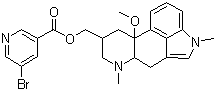 |
| Molecular Formula | C24H26BrN3O3 |
| Molecular Weight | 484.39 |
| CAS Registry Number | 27848-84-6 |
| EC Number | 248-694-6 |
| SMILES | CN1C[C@@H](C[C@]2([C@H]1CC3=CN(C4=CC=CC2=C34)C)OC)COC(=O)C5=CC(=CN=C5)Br |
| Density | 1.5±0.1 g/cm3 Calc.* |
|---|---|
| Boiling point | 594.4±50.0 °C 760 mmHg (Calc.)* |
| Flash point | 313.3±30.1 °C (Calc.)* |
| Solubility | 10 mM in DMSO (Expl.) |
| Index of refraction | 1.67 (Calc.)* |
| * | Calculated using Advanced Chemistry Development (ACD/Labs) Software. |
| Hazard Symbols |  GHS07 Warning Details GHS07 Warning Details | ||||||||||||||||||||
|---|---|---|---|---|---|---|---|---|---|---|---|---|---|---|---|---|---|---|---|---|---|
| Risk Statements | H302 Details | ||||||||||||||||||||
| Safety Statements | P264-P270-P301+P317-P330-P501 Details | ||||||||||||||||||||
| Hazard Classification | |||||||||||||||||||||
| |||||||||||||||||||||
| SDS | Available | ||||||||||||||||||||
 chemBlink Chemical Story
|
Nicergoline is a semisynthetic ergot derivative that has been used in clinical practice since the 1970s. It was first synthesized as part of a broader effort to develop ergot alkaloid analogs with reduced vasoconstrictive activity and enhanced cerebral vasodilatory and neurotrophic effects. Structurally, nicergoline is a hydrogenated derivative of ergoline, modified to include a nicotinic acid moiety. The presence of this nicotinic acid ester group distinguishes nicergoline from other ergot compounds and contributes to its pharmacological profile. The primary therapeutic use of nicergoline has been in the treatment of cognitive disorders and cerebrovascular insufficiency, especially in elderly patients. It has been prescribed for managing symptoms associated with dementia, including memory impairment, mood disturbances, and behavioral dysfunction. Its clinical application also extends to conditions such as vascular dementia and transient ischemic attacks, although its use is primarily concentrated in Europe and parts of Asia. Pharmacologically, nicergoline acts by improving cerebral blood flow and enhancing metabolic activity in the brain. It increases the utilization of oxygen and glucose by neural tissue, thereby supporting cognitive function. Additionally, nicergoline exhibits antiplatelet activity and has been reported to increase the release of neurotrophic factors, which may contribute to its neuroprotective effects. Unlike classic ergot alkaloids, it does not induce peripheral vasoconstriction, which reduces the risk of adverse vascular events. Nicergoline is metabolized in the liver, where it undergoes hydrolysis to produce active metabolites, including 10-α-methoxy-nicergoline and 6-methyl-8β-hydroxy-methyl-10-α-methoxy-ergoline. These metabolites retain some pharmacological activity and are excreted primarily via the kidneys. The pharmacokinetic profile of nicergoline allows for sustained therapeutic effects with regular oral administration. The compound has also been studied for its potential benefits in peripheral vascular diseases, including Raynaud’s phenomenon and diabetic angiopathy. In these contexts, its vasodilatory properties and ability to improve microcirculation have been considered therapeutically relevant. However, its use in such indications is less common compared to its application in cognitive and cerebrovascular conditions. Nicergoline has been formulated for oral administration, commonly in tablet form. It is generally well tolerated, although side effects such as hypotension, dizziness, gastrointestinal disturbances, and skin rash have been reported. In rare cases, prolonged use at high doses has been associated with fibrotic complications, a class effect observed with other ergot derivatives. For this reason, regulatory agencies in certain regions have recommended restrictions on its use, particularly in long-term therapy. Research into nicergoline has included a variety of clinical trials and observational studies, many of which have reported improvements in cognitive performance and quality of life in elderly patients with mild to moderate cognitive decline. Despite the availability of newer treatments for dementia, nicergoline remains a therapeutic option in settings where traditional ergot-based agents are still in use. In summary, nicergoline represents a distinctive example of a semisynthetic ergot alkaloid developed to enhance cerebral perfusion and cognitive function without the potent vasoconstrictive effects associated with traditional ergot compounds. Its well-characterized pharmacological actions, including cerebral vasodilation and neuroprotection, have supported its use in the management of age-related cognitive impairment and cerebrovascular disorders for several decades. References 1974. Effect of Nicergoline on Some Ischemia-Induced Metabolic Changes in the Brain of Cat. Central Nervous System. DOI: 10.1007/978-3-642-65714-6_24 2023. Concomitant Bandage Contact Lens, Oral Nicergoline, and Topical Autologous Serum for Severe Neurotrophic Keratitis. Eye & Contact Lens: Science & Clinical Practice, 49(2). DOI: 10.1097/icl.0000000000000970 2023. Cognitive Impairment and Nootropic Drugs: Mechanism of Action and Spectrum of Effects. Neurochemical Journal, 17(2). DOI: 10.1134/s1819712423020198 |
| Market Analysis Reports |