
Online Database of Chemicals from Around the World
| Hefei TNJ Chemical Industry Co., Ltd. | China | |||
|---|---|---|---|---|
 | www.tnjchem.com | |||
 | +86 (551) 6541-8684 | |||
 | +86 (551) 6541-8697 | |||
 | sales@tnjchem.com | |||
| Chemical manufacturer since 2001 | ||||
| chemBlink Standard supplier since 2010 | ||||
| BOC Sciences | USA | |||
|---|---|---|---|---|
| www.bocsci.com | |||
| +1 (631) 485-4226 | |||
| +1 (631) 614-7828 | |||
| info@bocsci.com | |||
| Chemical manufacturer | ||||
| chemBlink Standard supplier since 2010 | ||||
| Nanjing Pharma Chemical Plant | China | |||
|---|---|---|---|---|
| www.njpharmchem.com | |||
| +86 (25) 8557-3482 | |||
| +86 (25) 8557-9530 | |||
| njpc@163.com | |||
| Chemical manufacturer since 1995 | ||||
| Shanghai Worldyang Chemical Co., Ltd. | China | |||
|---|---|---|---|---|
| www.worldyachem.com | |||
| +86 13651600618 +86 (21) 5679-5779 | |||
| +86 (21) 5679-5266 | |||
| sales7777@worldyachem.com | |||
 | QQ Chat | |||
 | WeChat: 13651600618 | |||
 | WhatsApp:+86 13651600618 | |||
| Chemical manufacturer since 2012 | ||||
| Classification | API >> Antiparasitic drug >> Antiprotozoal |
|---|---|
| Name | Imidocarb |
| Synonyms | 1,3-Bis[3-(4,5-dihydro-1H-imidazol-2-yl)-phenyl]urea |
| Molecular Structure | 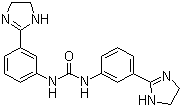 |
| Molecular Formula | C19H20N6O |
| Molecular Weight | 348.41 |
| CAS Registry Number | 27885-92-3 |
| EC Number | 248-711-7 |
| SMILES | C1CN=C(N1)C2=CC(=CC=C2)NC(=O)NC3=CC=CC(=C3)C4=NCCN4 |
| Density | 1.4±0.1 g/cm3 Calc.* |
|---|---|
| Index of refraction | 1.724 (Calc.)* |
| * | Calculated using Advanced Chemistry Development (ACD/Labs) Software. |
| Hazard Symbols |   GHS07;GHS08 Danger Details GHS07;GHS08 Danger Details | ||||||||||||||||||||
|---|---|---|---|---|---|---|---|---|---|---|---|---|---|---|---|---|---|---|---|---|---|
| Risk Statements | H302-H361-H370-H372 Details | ||||||||||||||||||||
| Safety Statements | P203-P260-P264-P270-P280-P301+P317-P308+P316-P318-P319-P321-P330-P405-P501 Details | ||||||||||||||||||||
| Hazard Classification | |||||||||||||||||||||
| |||||||||||||||||||||
| SDS | Available | ||||||||||||||||||||
 chemBlink Chemical Story
|
Imidocarb is a synthetic aromatic diamidine compound primarily used as a veterinary drug for the treatment and prophylaxis of protozoal infections in animals. Its most common applications are in the control of babesiosis and anaplasmosis, diseases caused by *Babesia* and *Anaplasma* species respectively, which are transmitted by ticks and pose serious health threats to livestock, particularly cattle, horses, and dogs. The chemical name of imidocarb is 3,3'-(1,3-propanediyl)bis[1-methylimidazolium] dihydrochloride, though it is more commonly encountered in its dipropionate salt form as imidocarb dipropionate. The compound’s molecular structure includes two substituted imidazoles connected by a three-carbon linker, and each imidazole contains a positively charged nitrogen atom. In the dipropionate form, two propionic acid molecules are used to neutralize the charge, forming a crystalline salt suitable for pharmaceutical formulation. Imidocarb was developed in the mid-20th century as part of efforts to identify therapeutic agents capable of treating tick-borne parasitic infections in farm animals. Its discovery followed observations that aromatic amidines had trypanocidal and antiprotozoal effects. Structural optimization led to the creation of imidocarb, which demonstrated both therapeutic efficacy and tolerability in field trials. The mechanism of action of imidocarb is not fully elucidated but is believed to involve interference with DNA replication in protozoan organisms. Imidocarb may intercalate into DNA or inhibit enzymes essential to nucleic acid metabolism, thereby preventing the proliferation of protozoan cells. In *Babesia*, it has been proposed that the compound interferes with polyamine metabolism and inhibits inositol uptake, although these actions are not conclusively proven. Imidocarb is administered by deep intramuscular or subcutaneous injection, and the dose depends on the species and body weight of the animal being treated. The dipropionate salt has good tissue penetration and exhibits a long half-life, allowing for extended therapeutic or prophylactic effects. The long persistence of the compound in tissues also supports its use in tick-endemic areas for preventing reinfection. In veterinary medicine, imidocarb is used to treat bovine babesiosis caused by *Babesia bovis* and *Babesia bigemina*, equine piroplasmosis caused by *Babesia caballi* and *Theileria equi*, and canine babesiosis caused by *Babesia canis* and related species. It is also effective against *Anaplasma marginale*, a rickettsial pathogen affecting cattle. While imidocarb is generally effective and well tolerated, its use is not without adverse effects. Common side effects include transient pain at the injection site, salivation, vomiting, and mild cholinergic signs due to possible anticholinesterase activity. Pretreatment with atropine is sometimes employed to mitigate these effects. Toxic doses may result in hepatic or renal impairment, and repeated use should be carefully monitored. Imidocarb is not approved for human use, and its use in animals intended for human consumption is strictly regulated due to the potential for tissue residues. Withdrawal times must be observed following administration to livestock, particularly cattle, to prevent contamination of meat or milk. The compound is not permitted for use in food-producing animals in some countries. Storage of imidocarb formulations requires protection from light and should be maintained at controlled room temperatures. The stability of the compound under appropriate storage conditions supports its shelf life for veterinary use. In conclusion, imidocarb is an established veterinary antiprotozoal drug used to treat and prevent tick-borne diseases in livestock and companion animals. Its efficacy against *Babesia* and *Anaplasma* species, combined with a long duration of action, makes it a valuable agent in managing parasitic infections that affect animal health and agricultural productivity. |
| Market Analysis Reports |