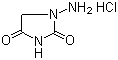
1-Aminohydantoin hydrochloride is a synthetic organic compound derived from the hydantoin class, specifically a substituted imidazolidine-2,4-dione bearing an amino group at the 1-position and a hydrochloride salt form. The hydantoin ring system, a five-membered heterocycle with two carbonyl groups at positions 2 and 4, is a well-established scaffold in medicinal and synthetic chemistry. The introduction of an amino substituent at the nitrogen atom and the presence of the hydrochloride salt enhance the compound’s solubility and reactivity profile.
Hydantoins have been studied extensively since the 19th century. The parent compound, hydantoin (imidazolidine-2,4-dione), was first synthesized in 1861 by the German chemist Adolf von Baeyer. Since then, various N- and C-substituted hydantoins have been developed for pharmaceutical, agricultural, and materials science applications. The amino-substituted derivative 1-aminohydantoin emerged as a reactive intermediate in organic synthesis and has been investigated for its potential in multiple research contexts.
The primary applications of 1-aminohydantoin hydrochloride are found in synthetic organic chemistry. Its reactive amino group and the electrophilic centers of the hydantoin ring enable its participation in substitution, condensation, and cyclization reactions. The compound can be used to prepare more complex heterocycles, particularly by reactions involving nucleophilic attack on carbonyl groups or condensation with aldehydes and ketones. The hydrochloride salt form improves its handling and stability, as the free base is typically more sensitive to moisture and oxidation.
In pharmaceutical chemistry, hydantoin derivatives are of great interest due to their known biological activities, including anticonvulsant, antiarrhythmic, antimicrobial, and antitumor properties. Although 1-aminohydantoin hydrochloride itself is not a marketed drug, its structural core is related to other pharmacologically active compounds such as phenytoin (5,5-diphenylhydantoin), a widely used antiepileptic drug. Research on aminohydantoins has explored their potential as intermediates for novel drug candidates and bioactive molecules.
The hydantoin nucleus provides a rigid, planar structure conducive to hydrogen bonding and stacking interactions, which can be relevant in ligand-receptor binding. Substitution at the 1-position, such as with an amino group, modifies the electronic properties and can affect reactivity and biological affinity. As such, 1-aminohydantoin has been used in exploratory synthesis aimed at designing enzyme inhibitors and receptor ligands.
From an analytical perspective, 1-aminohydantoin hydrochloride can be characterized by standard techniques such as nuclear magnetic resonance (NMR), infrared (IR) spectroscopy, and mass spectrometry (MS). In IR spectroscopy, it exhibits characteristic absorptions for the NH2 stretch, carbonyl groups, and NH vibrations of the hydantoin ring. In NMR spectra, signals for the amino and methylene protons of the imidazolidine ring are typically observed.
The synthesis of 1-aminohydantoin hydrochloride generally involves the condensation of cyanamide with glycine or urea derivatives, followed by ring closure to yield the hydantoin core. Treatment with hydrochloric acid yields the hydrochloride salt. The synthetic process can be adjusted to obtain analogs or functionalized derivatives, which may be evaluated for further chemical development.
In summary, 1-aminohydantoin hydrochloride is a functionalized hydantoin derivative used mainly as a chemical intermediate. Its structure allows for diverse chemical reactivity and derivatization, making it a useful compound in the preparation of complex heterocycles and potential pharmaceutical agents. While not approved for direct therapeutic use, it plays a supporting role in synthetic and medicinal chemistry research.
References
2023. Synthesis and antibacterial activity of Schiff base-pyridine quaternary ammonium salt-halamine compounds on cotton fabrics. Cellulose, 30(15).
DOI: 10.1007/s10570-023-05510-3
2020. Synthesis of a Hein-Schiff base compound and its antibacterial activity on cotton fabrics. Cellulose, 27(11).
DOI: 10.1007/s10570-020-03143-4
2009. Analysis of antibiotics in fish samples. Analytical and Bioanalytical Chemistry, 394(4).
DOI: 10.1007/s00216-009-2872-z
|




 GHS07 Warning Details
 chemBlink Chemical Story