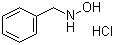
N-Benzylhydroxylamine hydrochloride is a chemical compound that belongs to the family of hydroxylamines, which are nitrogen-based compounds with a -NH-OH group. This compound specifically consists of a benzyl group (C6H5-CH2) attached to a hydroxylamine group (NH-OH), and it is available in the form of its hydrochloride salt, N-Benzylhydroxylamine hydrochloride (C7H10NO·HCl).
The discovery of hydroxylamines and their various derivatives has greatly impacted the field of organic chemistry, particularly in areas concerning the synthesis of pharmaceuticals and other fine chemicals. Hydroxylamine derivatives, including N-Benzylhydroxylamine hydrochloride, have been explored for their diverse reactivity, including their ability to participate in redox reactions, nucleophilic substitution, and electrophilic aromatic substitution.
The primary application of N-Benzylhydroxylamine hydrochloride has been seen in organic synthesis, particularly as a reagent in the preparation of various chemical compounds. Hydroxylamine derivatives, including N-Benzylhydroxylamine hydrochloride, are frequently utilized in the reduction of nitro groups to amines, which is a common reaction in synthetic organic chemistry. They can also act as reducing agents in certain reactions where mild reduction conditions are desired, as they are often less reactive than other reducing agents like metal hydrides.
Furthermore, N-Benzylhydroxylamine hydrochloride has found its place in pharmaceutical chemistry. It has been studied for its potential as an intermediate in the synthesis of drugs, particularly those involving the modification of aromatic amines and the formation of nitrogen-containing heterocycles. Due to its hydroxylamine group, it has also been investigated for its potential in the synthesis of compounds with applications in treating conditions related to oxidative stress, as hydroxylamines can sometimes act as antioxidants by scavenging free radicals.
Additionally, N-Benzylhydroxylamine hydrochloride is used in the synthesis of various fine chemicals, including certain agrochemicals and specialty chemicals that require selective reactivity. It can be employed in processes such as the functionalization of aromatic rings, where it introduces a hydroxylamine group that can participate in further reactions, often leading to the creation of more complex molecules.
In the industrial setting, N-Benzylhydroxylamine hydrochloride is not only useful in small-scale laboratory reactions but can also be applied in larger-scale chemical manufacturing processes where selective reduction or functionalization of specific substrates is needed. Its versatility as a reagent in the synthesis of both simple and complex compounds makes it a valuable tool in synthetic chemistry.
In summary, N-Benzylhydroxylamine hydrochloride is a useful reagent in organic chemistry, especially in the synthesis of amines, reductions, and functionalization reactions. Its applications span various fields, including drug synthesis, materials science, and agrochemicals. As with other hydroxylamine derivatives, it continues to be an essential compound for chemists seeking to explore novel reaction pathways and develop new molecules with specific properties.
References
2013. Methyltrioxorhenium-catalysed oxidation of secondary amines to nitrones in ionic liquids. Chemical Papers, 67(1).
DOI: 10.2478/s11696-012-0208-5
2019. A green synthesis of nitrones in glycerol. Journal of Chemical Sciences, 131(10).
DOI: 10.1007/s12039-019-1677-7
2023. Design and development of an efficient convergent synthetic strategy for novel β-lactam enhancer zidebactam (WCK 5107). Chemical Papers, 78(3).
DOI: 10.1007/s11696-023-03176-6
|




 GHS07 Warning Details
 chemBlink Chemical Story