
Online Database of Chemicals from Around the World
| Hangzhou Verychem Science And Technology Co., Ltd. | China | |||
|---|---|---|---|---|
 | www.verychem.com | |||
 | +86 (571) 8816-2785 +86 13606544505 | |||
 | +86 (571) 8816-2787 | |||
 | lucy@verychem.com | |||
| Chemical manufacturer since 2004 | ||||
| chemBlink Massive supplier since 2021 | ||||
| BOC Sciences | USA | |||
|---|---|---|---|---|
| www.bocsci.com | |||
| +1 (631) 485-4226 | |||
| +1 (631) 614-7828 | |||
| info@bocsci.com | |||
| Chemical manufacturer | ||||
| chemBlink Standard supplier since 2010 | ||||
| Shanghai Hanjing Chemicals Co., Ltd. | China | |||
|---|---|---|---|---|
| www.hanjingchemicals.com | |||
| +86 (21) 3700-9251 3700-9252 | |||
| +86 (21) 3700-9253 | |||
| jack.xue@hanjinggroup.com jackxue1976@hotmail.com | |||
| Chemical manufacturer | ||||
| chemBlink Standard supplier since 2011 | ||||
| Taizhou Shengyu Chemical Co., Ltd. | China | |||
|---|---|---|---|---|
| www.shengyuchemical.com | |||
| +86 (576) 8181-6118 +86 13957681062 | |||
| +86 (576) 8886-1056 | |||
| sales@shengyuchemical.com | |||
 | QQ Chat | |||
| Chemical distributor since 2005 | ||||
| chemBlink Standard supplier since 2014 | ||||
| Enki Biopharmaceuticals (Shanghai) Limited | China | |||
|---|---|---|---|---|
| www.enkibiopharma.com | |||
| +86 (21) 5768-0965 +86 13916707528 | |||
| +86 (21) 5768-0922 | |||
| info@enkibiopharma.com | |||
| QQ Chat | |||
| Chemical distributor since 2014 | ||||
| chemBlink Standard supplier since 2015 | ||||
| Amadis Chemical Co., Ltd. | China | |||
|---|---|---|---|---|
| www.amadischem.com | |||
| +86 (571) 8992-5085 | |||
| +86 (571) 8992-5065 | |||
| sales@amadischem.com | |||
| Chemical manufacturer since 2010 | ||||
| chemBlink Standard supplier since 2015 | ||||
| Shanghai Fuxin Pharmaceutical Co., Ltd. | China | |||
|---|---|---|---|---|
| www.fuxinpharm.com | |||
| +86 (21) 3130-0828 +86 18645121291 | |||
| +86 (21) 3130-0828 | |||
| contact@fuxinpharm.com | |||
| Chemical manufacturer since 2016 | ||||
| chemBlink Standard supplier since 2018 | ||||
| Beijing Lianben Pharm-Chemicals Tech. Co., Ltd. | China | |||
|---|---|---|---|---|
| www.lianben.com | |||
| +86 (10) 8338-6766 | |||
| +86 (10) 8338-6758 | |||
| contact@lianben.com | |||
| Chemical manufacturer since 2004 | ||||
| Toronto Research Chemicals Inc. | Canada | |||
|---|---|---|---|---|
| www.trc-canada.com | |||
| +1 (416) 665-9696 | |||
| +1 (416) 665-4439 | |||
| info@trc-canada.com | |||
| Chemical manufacturer since 1982 | ||||
| Shanghai Fine Chemicals Co., Ltd. | China | |||
|---|---|---|---|---|
| www.sfcc-chem.com | |||
| +86 (21) 3358-1117 3358-1118 3358-1119 | |||
| +86 (21) 3358-1128 | |||
| sfcc@sfcc-chem.com | |||
| Chemical manufacturer | ||||
| Classification | Chemical reagent >> Organic reagent >> Halogenated aliphatic hydrocarbon |
|---|---|
| Name | 4-Chlorobutanal dimethyl acetal |
| Synonyms | 4-chloro-1,1-dimethoxybutane |
| Molecular Structure | 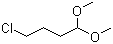 |
| Molecular Formula | C6H13ClO2 |
| Molecular Weight | 152.62 |
| CAS Registry Number | 29882-07-3 |
| EC Number | 249-924-8 |
| SMILES | COC(CCCCl)OC |
| Hazard Symbols |    GHS02;GHS05;GHS07 Danger Details GHS02;GHS05;GHS07 Danger Details | ||||||||||||||||||||||||||||||||
|---|---|---|---|---|---|---|---|---|---|---|---|---|---|---|---|---|---|---|---|---|---|---|---|---|---|---|---|---|---|---|---|---|---|
| Risk Statements | H226-H302--H315-H317-H318-H319-H335 Details | ||||||||||||||||||||||||||||||||
| Safety Statements | P210-P233-P240-P241-P242-P243-P261-P264-P264+P265-P270-P271-P272-P280-P301+P317-P302+P352-P303+P361+P353-P304+P340-P305+P351+P338-P305+P354+P338-P317-P319-P321-P330-P332+P317-P333+P317-P337+P317-P362+P364-P370+P378-P403+P233-P403+P235-P405-P501 Details | ||||||||||||||||||||||||||||||||
| Hazard Classification | |||||||||||||||||||||||||||||||||
| |||||||||||||||||||||||||||||||||
| Transport Information | UN 1993 | ||||||||||||||||||||||||||||||||
| SDS | Available | ||||||||||||||||||||||||||||||||
 chemBlink Chemical Story
|
4-Chlorobutanal dimethyl acetal was discovered during efforts to develop versatile intermediates for organic synthesis, particularly for creating complex molecules in pharmaceuticals and agrochemicals. The compound was synthesized by reacting 4-chlorobutanal with methanol in the presence of an acid catalyst to protect the aldehyde group as an acetal. This reaction provided a stable, less reactive intermediate that could be used in further synthetic transformations. Its discovery allowed chemists to control reactivity and selectively modify molecules without unwanted side reactions. The synthesis and subsequent applications of 4-chlorobutanal dimethyl acetal have made it a valuable tool in organic chemistry for constructing complex molecular architectures. In organic synthesis, 4-chlorobutanal dimethyl acetal is used to protect aldehyde groups. The dimethyl acetal formation renders the aldehyde stable, allowing chemists to perform further reactions without affecting the sensitive aldehyde functionality. Once the desired transformations are complete, the acetal can be hydrolyzed back to the aldehyde under acidic conditions. This makes it an essential tool for multi-step synthetic routes where control over functional group reactivity is crucial. It serves as a precursor in various functional group transformations. For example, it can undergo nucleophilic substitution to introduce different functional groups in place of the chlorine atom, providing a pathway to synthesize a variety of compounds. Its structure allows for modifications that can lead to the synthesis of complex molecules, enhancing the versatility of synthetic strategies. 4-Chlorobutanal dimethyl acetal is useful in synthesizing cyclic compounds. It can participate in cyclization reactions, leading to the formation of heterocyclic structures that are important in pharmaceuticals and agrochemicals. This application is valuable for creating ring systems with specific biological activities. In the pharmaceutical industry, 4-chlorobutanal dimethyl acetal is an important intermediate in the synthesis of various drug molecules. Its ability to protect and later regenerate the aldehyde group allows for the selective introduction of functional groups essential for biological activity. This makes it a key building block in the development of drug candidates, including those for treating diseases such as cancer, infections, and neurological disorders. It can be used in the synthesis of active pharmaceutical ingredients by providing a stable form of an aldehyde that can be selectively modified. This stability is crucial in the early stages of drug development when optimizing lead compounds for better efficacy and reduced side effects. Researchers use 4-chlorobutanal dimethyl acetal in medicinal chemistry to explore structure-activity relationships (SAR). By modifying its structure and incorporating it into larger molecular frameworks, scientists can study how changes in the molecule affect its biological activity. This helps in designing new compounds with improved therapeutic properties. In materials science, 4-chlorobutanal dimethyl acetal can be used as a precursor in the synthesis of polymers. Its reactive sites allow for the introduction of various functional groups into polymer chains, leading to materials with specific properties such as improved mechanical strength, thermal stability, or chemical resistance. This application is valuable in creating advanced materials for use in coatings, adhesives, and electronic devices. It can be employed to functionalize surfaces by incorporating it into surface treatments or coatings. The ability to modify surfaces with specific functional groups allows for the development of materials with tailored surface properties, such as hydrophobicity or biocompatibility, which are important in medical devices and industrial applications. It serves as an intermediate in the development of specialty chemicals for various industrial applications. Its reactivity and versatility enable the synthesis of complex molecules used in fine chemicals, fragrances, and flavor industries, contributing to the production of high-value products. References 2020. Synthesis and biological evaluation of novel N-substituted nipecotic acid derivatives with tricyclic cage structures in the lipophilic domain as GABA uptake inhibitors. Medicinal Chemistry Research, 29(12). DOI: 10.1007/s00044-020-02647-9 2011. Concise Enantiospecific, Stereoselective Syntheses of (+)-Crispine A and (−)-Antipode. The Journal of Organic Chemistry, 76(6). DOI: 10.1021/jo102112k 2010. From 4-Chlorobutanal and Arylhydrazines; Grandberg Tryptamine Synthesis. Science of Synthesis. URL: https://science-of-synthesis.thieme.com/app/text/?id=SD-110-00016 |
| Market Analysis Reports |